

On this page
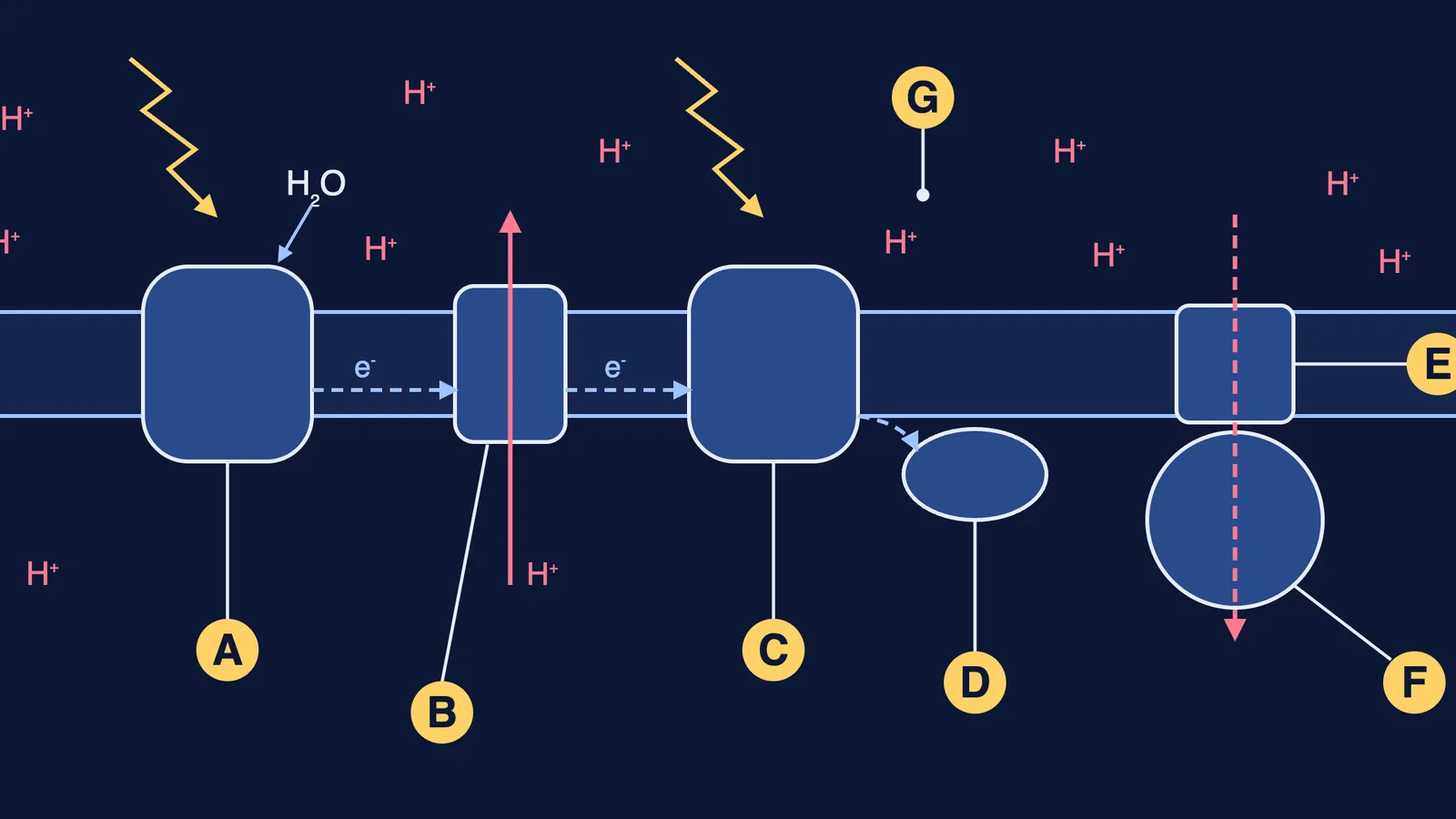
The NEET (UG) 2026 syllabus places photosynthesis in Unit 4, Plant Physiology. Every fact behind the 13 original questions below comes from the NCERT Class 11 Biology chapter (Reprint 2026-27); none is a past-paper item or a prediction. Q1 to Q6 use our lettered thylakoid schematic; Q7 to Q13 describe other figures in words.
How do you read a NEET diagram question?
Orient first: find the two sides of the membrane and which way light, electrons and protons move. Name the easiest part, then place its neighbours.
Questions on the lettered thylakoid diagram
Q1. Which letter marks the complex whose reaction centre absorbs best at 680 nm and which is linked to water splitting? (a) A (b) B (c) C (d) D
Q2. Match each letter with its role. List-I: P. A Q. D R. E S. F List-II: (i) Uses protons from the stroma to reduce NADP+ (ii) Changes shape to make ATP (iii) Forms a channel for facilitated diffusion of protons (iv) Gets electrons back from water (a) P-iv, Q-i, R-iii, S-ii (b) P-i, Q-iv, R-ii, S-iii (c) P-iv, Q-i, R-ii, S-iii (d) P-iii, Q-i, R-iv, S-ii
Q3. Statement I: Part F sits inside the membrane and is the channel that carries protons across it. Statement II: Protons leave G through E, and the gradient's breakdown changes F's shape so it makes ATP. (a) Both correct (b) Both incorrect (c) I correct, II incorrect (d) I incorrect, II correct
Q4. Which sequence shows the path of electrons in the diagram? (a) C → B → A → D (b) A → B → C → D (c) A → D → C → B (d) B → A → C → D
Q5. Which processes add protons to region G? (i) Splitting of water at A (ii) A hydrogen carrier taking protons from the outer side and releasing them inside (iii) The reaction at D (a) (i) only (b) (i) and (ii) only (c) (ii) and (iii) only (d) All three
Q6. Which two lettered parts each have a single chlorophyll a molecule as their reaction centre? (a) B and D (b) E and F (c) A and C (d) D and G
Answer key for the lettered diagram
A: PS II (P680). B: cytochrome electron transport system. C: PS I (P700). D: NADP reductase. E: CF0. F: CF1. G: thylakoid lumen.
Q1: (a). NCERT ties water splitting to PS II, whose reaction centre is P680.
Q2: (a). CF0 is the proton channel; CF1 changes shape to make ATP.
Q3: (d). F (CF1) projects into the stroma; E (CF0) is the channel, so only Statement II holds.
Q4: (b). PS II to cytochromes to PS I, then on towards NADP+.
Q5: (b). D removes protons from the stroma; it adds none to the lumen.
Q6: (c). Only the photosystems, PS II and PS I, have reaction centres.
Questions on other photosynthesis figures
Q7. In a light harvesting complex figure, pigments pass energy inward to one molecule. It is: (a) a carotenoid (b) chlorophyll b (c) a single chlorophyll a forming the reaction centre (d) a xanthophyll
Q8. Statement I: The Z scheme gets its shape when all carriers are placed in order on a redox potential scale. Statement II: PS I and PS II are numbered in the order in which they work during the light reaction. (a) Both correct (b) Both incorrect (c) I correct, II incorrect (d) I incorrect, II correct
Q9. A chloroplast section labels membranes, grana, a stromal lamella, stroma, ribosomes, a starch granule and a lipid droplet. Which two belong to the light-trapping system? (a) Grana and stromal lamella (b) Stroma and starch granule (c) Ribosomes and lipid droplet (d) Stroma and grana
Q10. A graph lays the action spectrum of photosynthesis over the absorption spectrum of chlorophyll a. Which reading matches NCERT? (a) Photosynthesis occurs only where chlorophyll a absorbs (b) Green light gives the highest rate (c) Most photosynthesis is in blue and red light; chlorophyll a is the chief pigment (d) The curves never overlap
Q11. Match parts of a Calvin cycle figure with what NCERT links to them. List-I: P. Carboxylation Q. Reduction R. Regeneration S. Triose phosphate leaving the cycle List-II: (i) Needs ATP but no NADPH to re-form RuBP (ii) Sucrose and starch (iii) Uses both ATP and NADPH (iv) RuBisCO forms two molecules of 3-PGA (a) P-iii, Q-iv, R-i, S-ii (b) P-iv, Q-iii, R-i, S-ii (c) P-iv, Q-i, R-iii, S-ii (d) P-ii, Q-iii, R-i, S-iv
Q12. In a Hatch and Slack pathway figure: Statement I: The 3-carbon molecule left in bundle sheath cells returns to the mesophyll and becomes PEP again. Statement II: The C4 acid from the mesophyll is broken down in the bundle sheath to give CO2 and a 3-carbon molecule. (a) Both correct (b) Both incorrect (c) I correct, II incorrect (d) I incorrect, II correct
Q13. In the Z scheme figure, where do electrons move uphill on the redox scale? (a) Through the cytochrome chain only (b) From the PS I acceptor to NADP+ only (c) From water to PS II only (d) From each reaction centre to its acceptor, after light excites it
Answers for questions 7 to 13
Q7: (c). The reaction centre is one chlorophyll a molecule; the other pigments act as antennae.
Q8: (c). The photosystems are named in the order they were discovered, not the order they act.
Q9: (a). The grana and stroma lamellae membranes trap light; the stroma makes sugar.
Q10: (c). Some photosynthesis also occurs at other visible wavelengths, so (a) is wrong.
Q11: (b). Reduction is the only stage that uses NADPH; regeneration of RuBP uses ATP alone.
Q12: (a). CO2 is released in the bundle sheath; the 3-carbon remnant returns to form PEP.
Q13: (d). Light lifts electrons uphill at PS II and again at PS I; the carrier steps run downhill.
What should you do after this set?
Sort each miss: wrong part, wrong side or wrong number, then redraw the thylakoid from memory. For text-only formats, try our photosynthesis statement and match-the-list set. Revise with the Photosynthesis in Higher Plants chapter guide.
Not sure which figure is your weak spot? Fermi's AI tutor works out what you already know and builds a plan for the session.


