On this page
Indian rosin starts as resin tapped from chir pine. Steam-distil the resin and turpentine comes over, leaving a glassy amber solid that is almost entirely carboxylic acid. So one titration, the acid number, tells you how much of it is resin acid. Measured on ester gum, the same number tells you how far an esterification with glycerol went.
This one material touches three syllabus points: steam distillation (Class 11, purification of organic compounds), titration and esterification of carboxylic acids (Class 12), and counting stereocentres.
Where does Indian rosin come from?
The Bureau of Indian Standards covers rosin in IS 553:1984, Rosin (Gum Rosin). Its foreword says that in India, rosin or colophony "is obtained as the residual solid matter in the steam distillation of the oleoresin gum, exudate of Pinus roxburghii and other allied Pinus species". Pinus roxburghii is chir pine.
This is the principle of steam distillation at industrial scale. The volatile part, gum spirit of turpentine, is a mixture of C₁₀H₁₆ terpenes. IS 533:2007 calls it "the genuine distillation product of the oleoresin of Pinus roxburghii Sargent mainly" and sets limits on its two major constituents, α-pinene and car-3-ene. The C₂₀ resin acids are far less volatile, so they stay in the still.
What does the acid number of rosin measure?
The acid number is the mass of KOH, in mg, needed to neutralise 1 g of sample. In IS 553 (Appendix C), about 4 g of rosin is dissolved in 100 mL of neutral alcohol and titrated with 0.5 N alkali to phenolphthalein or thymol blue. Then:
Acid number = (A × N × 56.1) / B
where A is the titre in mL, N the normality of the alkali and B the mass of sample in g. The reaction is a plain acid–base neutralisation of the COOH group:
C₁₉H₂₉COOH + KOH → C₁₉H₂₉COOK + H₂O
The definition matches the one in our post on acid value and free fatty acids in rice bran oil, but the meaning flips. In an edible oil, acid is spoilage. In rosin, acid is the product, so the standard sets a minimum.
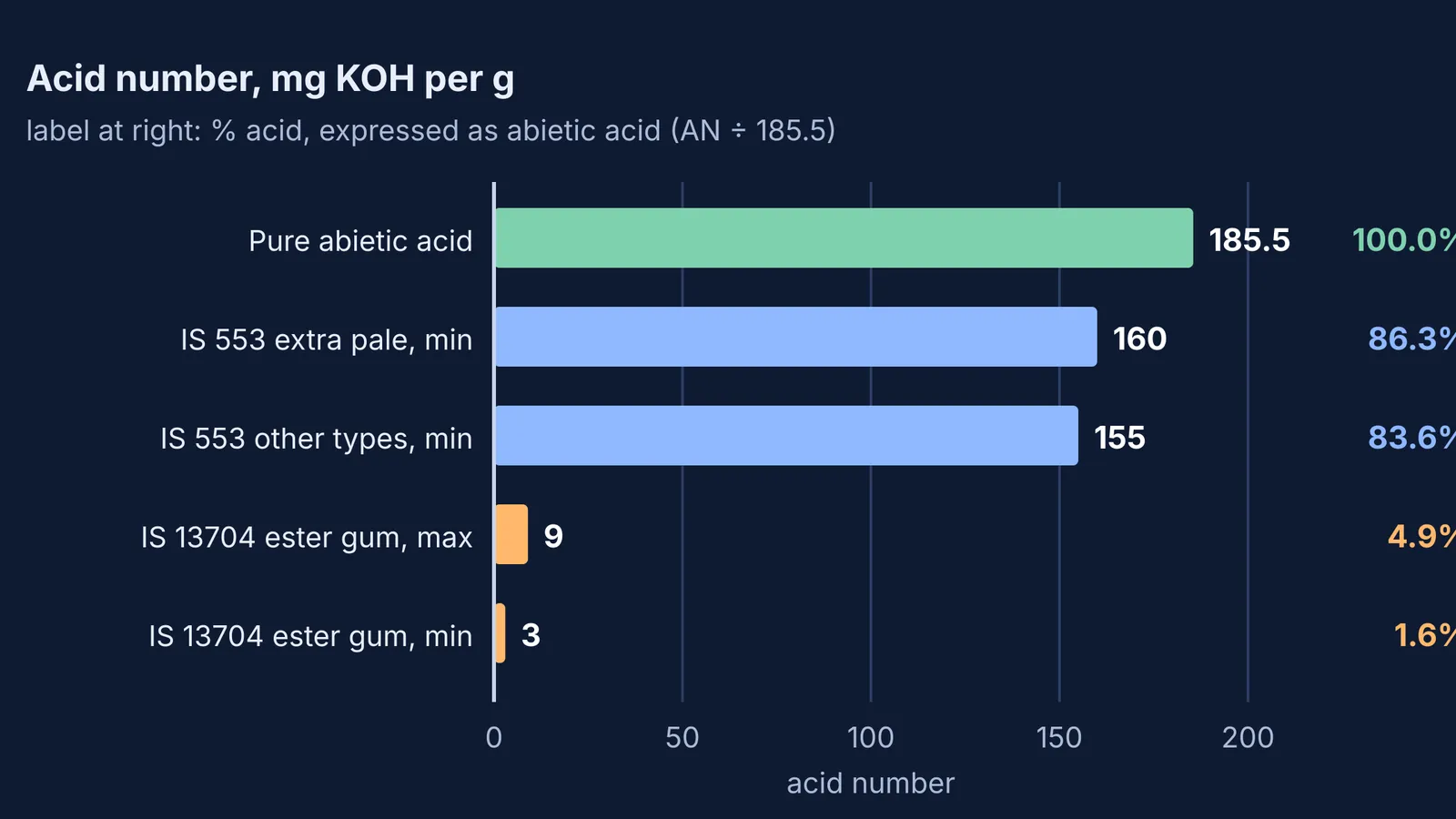
IS 553 has four types (extra pale, pale, medium, dark). Its Table 1 sets the acid number at a minimum of 160 for extra pale rosin and 155 for the other three. The saponification number minimums are 165 and 160.
How do you turn an acid number into percent resin acid?
Acid number of the pure acid. Abietic acid, C₂₀H₃₀O₂, has M = 302.46 g/mol and one COOH. One mole needs one mole of KOH, so 1 g needs 56.1 × 1000 / 302.46 = 185.5 mg KOH.
Titrate a sample. Say 4.00 g of rosin needs 23.5 mL of 0.500 N alkali. Acid number = 23.5 × 0.500 × 56.1 / 4.00 = 164.8, which the standard says to report to the nearest whole number: 165.
Convert to composition. 165 / 185.5 × 100 = 88.9% resin acid, expressed as abietic acid.
Read the standard. A minimum of 160 means at least 86.3% acid; 155 means 83.6%.
"Expressed as abietic acid" matters, because rosin is a mixture of C₂₀ resin acids. Isomers such as levopimaric acid (C₂₀H₃₀O₂, PubChem) have the same molar mass and acid number. Dehydroabietic acid, C₂₀H₂₈O₂ (M = 300.44), gives 186.7. The answer moves by less than 1%, so the shortcut holds.
The saponification number (an hour's reflux with alcoholic KOH, then a back titration against a blank) minus the acid number is the ester value. For a pure acid it is zero, and rosin's two Table 1 minimums sit only 5 units apart. The back-titration logic is in our post on saponification value and iodine value.
What is ester gum and how far does its esterification go?
IS 13704:1993 covers glycerol esters of wood rosin, called ester gums, food grade. It says they are produced "by the esterification of pale wood rosin with food grade glycerin", and lists uses in chewing gum base and as a beverage stabiliser and clouding agent. Note that this standard specifies wood rosin, not the gum rosin of IS 553. The acids are the same family: a 2018 amendment adds a gas chromatography check in which the reduced esters give mainly abietyl and dehydroabietyl alcohols.
It is Class 12 esterification with a triol:
3C₁₉H₂₉COOH + C₃H₅(OH)₃ ⇌ C₃H₅(OOCC₁₉H₂₉)₃ + 3H₂O
Table 1 of IS 13704 sets the acid value at 3 to 9 and the hydroxyl number at 15 to 45.
Free acid left. 3 / 185.5 × 100 = 1.6% and 9 / 185.5 × 100 = 4.9%. So only about 1.6 to 4.9% of the gum's mass is still free acid, expressed as abietic.
Hydroxyl number of each ester. It counts unreacted OH groups, again as mg KOH per g. Glycerol triabietate, C₆₃H₉₂O₆ (M = 945.42), has no free OH, so 0. The diester, C₄₃H₆₄O₅ (M = 660.98), has one: 56.1 × 1000 / 660.98 = 84.9. The monoester, C₂₃H₃₆O₄ (M = 376.54), has two: 298.0.
Read the range. 15 to 45 sits between triester (0) and diester (84.9). In a simple model of triester plus diester only, 15 means about 18% diester by mass and 45 means about 53%.
Degree of esterification. Take a gum with acid value 6 and hydroxyl number 30. Per 100 g, the same model gives 3.2 g free acid (0.0107 mol), 35.3 g diester and 61.4 g triester. The esterified COOH groups come to 3 × 61.4/945.42 + 2 × 35.3/660.98 = 0.302 mol. So 0.302 / (0.302 + 0.0107) = 96.6% of the acid groups are esterified, while about 85% of glycerol's OH groups are used.
The model ignores free glycerol, monoester and any correction a lab applies to the hydroxyl number, so treat steps 3 and 4 as estimates. The picture is clear: mostly triester, some diester, a few percent of unreacted acid.
Stoichiometry check: 100 g of acid-number-165 rosin holds 165 × 100 / 56,100 = 0.294 mol COOH. One OH per COOH needs 0.294 / 3 mol glycerol (9.0 g), and full esterification releases 0.294 × 18.02 = 5.3 g of water.
Why does abietic acid have four stereocentres but dehydroabietic acid three?
PubChem names abietic acid (1R,4aR,4bR,10aR)-1,4a-dimethyl-7-propan-2-yl-2,3,4,4b,5,6,10,10a-octahydrophenanthrene-1-carboxylic acid. Its four stereocentres are:
C1, which carries both the CH₃ and the COOH
C4a, the ring-fusion carbon with the other CH₃
C4b and C10a, ring-fusion carbons that each carry an H
Its two C=C bonds form a conjugated diene. In dehydroabietic acid, C₂₀H₂₈O₂, one ring has become a benzene ring. C4b is now an sp² ring carbon with no H, so it can no longer be a stereocentre. PubChem lists three: 1R, 4aS, 10aR.
If a step in a numerical like this trips you up, the Fermi Problem Library has worked problems with a step-by-step solver that explains the reasoning, and the Concept Library covers the ideas underneath, such as esterification equilibria.
Quick checklist
Pure abietic acid has an acid number of 185.5. Divide any acid number by it to get % acid, expressed as abietic.
IS 553: minimum 160 for extra pale (86.3%), 155 for the other types (83.6%).
Ester gum: acid value 3 to 9 means 1.6 to 4.9% free acid; hydroxyl number 15 to 45 lies between triester (0) and diester (84.9).
Abietic acid has 4 stereocentres; dehydroabietic acid has 3, because C4b becomes part of a benzene ring.