On this page
Some science centres have a wave machine: a long row of masses joined by springs or by a twisting wire. Push one end gently and a wave runs along it. Push it fast and something odd happens. Above a certain frequency, the wave does not travel at all. The masses near your hand jiggle, and the rest of the chain stays almost still.
A continuous string has no such limit. Any frequency travels, at the same speed v = fλ. A chain of separate masses is different, and the reason takes one line of Class 11 algebra. It is also why atoms in a crystal cannot vibrate faster than a few terahertz.
Fermi News has covered the speed of a wave on a continuous wire and how two pendulums joined by a spring pass energy back and forth. This post joins the two ideas: many oscillators in a row.
What is the equation of motion for a chain of masses and springs?
Take identical masses m, spaced a apart along a line, each joined to its neighbours by a spring of constant k. Let uₙ be how far mass number n has moved from its rest position along the chain. The spring on its right is stretched by uₙ₊₁ − uₙ and the one on its left by uₙ − uₙ₋₁. So the net force on mass n is:
m × (acceleration of n) = k(uₙ₊₁ − uₙ) − k(uₙ − uₙ₋₁) = k(uₙ₊₁ + uₙ₋₁ − 2uₙ)
This assumes small motions, springs that obey Hooke's law, and springs only between nearest neighbours.
How do you find the frequency of a wave on the chain?
Try a travelling wave, uₙ = A cos(Kna − ωt), where K = 2π/λ is the wavenumber. Each mass does SHM with angular frequency ω, so its acceleration is −ω²uₙ. Put this into the equation, use cos(x + y) + cos(x − y) = 2 cos x cos y, and the uₙ cancels:
−mω² = k(2 cos Ka − 2), so ω² = (2k/m)(1 − cos Ka) = (4k/m) sin²(Ka/2)
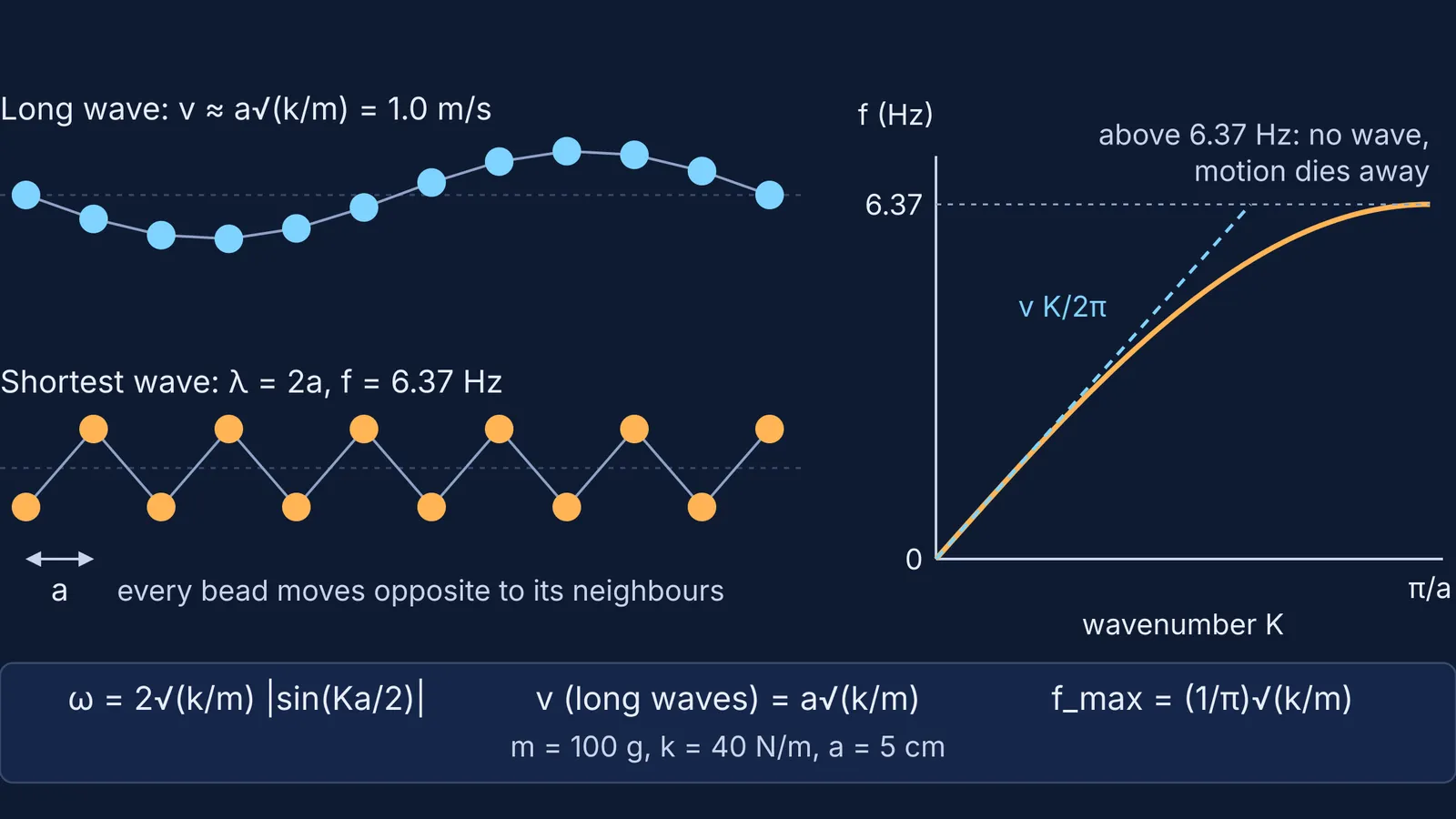
ω = 2√(k/m) |sin(Ka/2)|
For a long wave, Ka is small and sin(Ka/2) ≈ Ka/2. Then ω ≈ a√(k/m) K, so ω/K is a constant. That is an ordinary wave with speed v = a√(k/m), the same for every frequency, just like sound in a rod.
As the wavelength shrinks, sin(Ka/2) grows more slowly than Ka/2, so the wave slows down. The phase speed ω/K falls, and the speed at which energy travels, dω/dK = a√(k/m) cos(Ka/2), falls even faster.
Why is there a highest frequency?
A sine can never exceed 1. So ω can never exceed ω_max = 2√(k/m), which is f_max = (1/π)√(k/m). This top is reached at Ka = π, a wavelength λ = 2a. Each mass then moves exactly opposite to its neighbours, which stretches and squashes every spring as much as possible.
Why can't you go shorter? The chain only has masses at the points na. A wave with λ shorter than 2a gives the masses the same positions as some longer wave, so it is not a new motion. There is nothing in between the masses to carry the extra wiggles.
What if you shake one end faster than f_max anyway? Try a pattern in which each mass moves opposite to the one before and by a smaller amount: uₙ = (−r)ⁿ A cos ωt, with r less than 1. The same equation gives ω² = (k/m)(2 + r + 1/r). For any ω above 2√(k/m) there is a value of r below 1 that fits. The motion shrinks by the factor r at each mass. The chain does not carry the wave away; the disturbance stays near your hand.
Worked example: a 100 g, 40 N/m chain
Take masses of 100 g, springs of 40 N/m and a spacing of 5 cm. These are illustrative values for a classroom-sized chain.
Basic frequency: √(k/m) = √(40/0.1) = 20 rad/s.
Long-wave speed: v = a√(k/m) = 0.05 × 20 = 1.0 m/s.
Highest frequency: ω_max = 2 × 20 = 40 rad/s, so f_max = 40/2π = 6.37 Hz, at λ = 2a = 10 cm.
At 1 Hz: sin(Ka/2) = 2π × 1/40 = 0.157, so Ka = 0.316 and λ = 2πa/0.316 = 99.6 cm. That is 0.4% shorter than the 100 cm that v = 1.0 m/s would give, so the chain behaves like a continuous rod.
At 5 Hz: sin(Ka/2) = 0.785, so Ka = 1.81 and λ = 17.4 cm. The phase speed is fλ = 0.87 m/s. The energy speed is a√(k/m) cos(Ka/2) = 1.0 × 0.62 = 0.62 m/s.
At 6 Hz: λ = 12.8 cm, and the energy creeps along at only 0.33 m/s.
At 8 Hz (above the limit): ω/√(k/m) = 50.3/20 = 2.51, so 2 + r + 1/r = 6.32, which gives r + 1/r = 4.32 and r = 0.25. Each mass moves a quarter as much as the one before, and in the opposite direction. Five masses along, the motion is 0.25⁵ ≈ 0.09% of the driven mass's motion.
So 6 Hz travels down the chain, slowly. 8 Hz barely gets past the first two masses.
What does this have to do with crystals?
A solid is a three-dimensional chain: atoms of mass about 10⁻²⁵ kg held by bonds that act like springs. The same sum gives a highest vibration frequency, now in the terahertz range, because the masses are tiny. Real crystals have several kinds of wave (one longitudinal and two transverse in each direction) and forces that reach beyond nearest neighbours, so the one-dimensional formula is only a model.
Neutron scattering measures these frequencies directly. For the longitudinal wave at the shortest wavelength along the cube edge, the measured values tabulated by Savrasov and Savrasov in Physical Review B (1996) are about 9.7 THz for aluminium, 7.3 THz for copper and 1.9 THz for lead. Lead's atoms are heavy and its bonds are soft, so its limit is lowest, just as f_max = (1/π)√(k/m) suggests. The cut-off at short wavelengths, the "zone boundary", is a standard result in solid-state texts such as Kittel's Introduction to Solid State Physics (chapter on phonons).
This topic goes beyond the Class 11 syllabus, but it uses only SHM, Hooke's law and v = fλ. To see a single spring and block oscillate before stacking many, try the Simulation Lab. To revise wave speed, wavelength and SHM, use the Concept Library. If you want to know when a real spring's own mass starts to matter, see the m/3 correction for a spring's mass, which is the long-wave end of the same story.
Quick checklist
Force on mass n: k(uₙ₊₁ + uₙ₋₁ − 2uₙ).
Dispersion: ω = 2√(k/m)|sin(Ka/2)|.
Long waves: v = a√(k/m), the same for all frequencies.
Highest frequency: f_max = (1/π)√(k/m), at λ = 2a, with neighbours moving opposite.
Above f_max the motion falls by a factor r each mass, with ω² = (k/m)(2 + r + 1/r).
Example: 100 g, 40 N/m, 5 cm gives 1.0 m/s and 6.37 Hz.
Crystals: the same limit sits at a few terahertz.