On this page
The NMC's NEET (UG) 2026 syllabus puts Locomotion and Movement in Unit 5, Human Physiology. Every order below is NCERT's own, from Chapter 17 of Class 11 Biology (Reprint 2026-27). All 12 questions are original, not past-paper items or predictions. This is a study summary, not medical advice.
Which sequences in Locomotion and Movement does NCERT give in order?
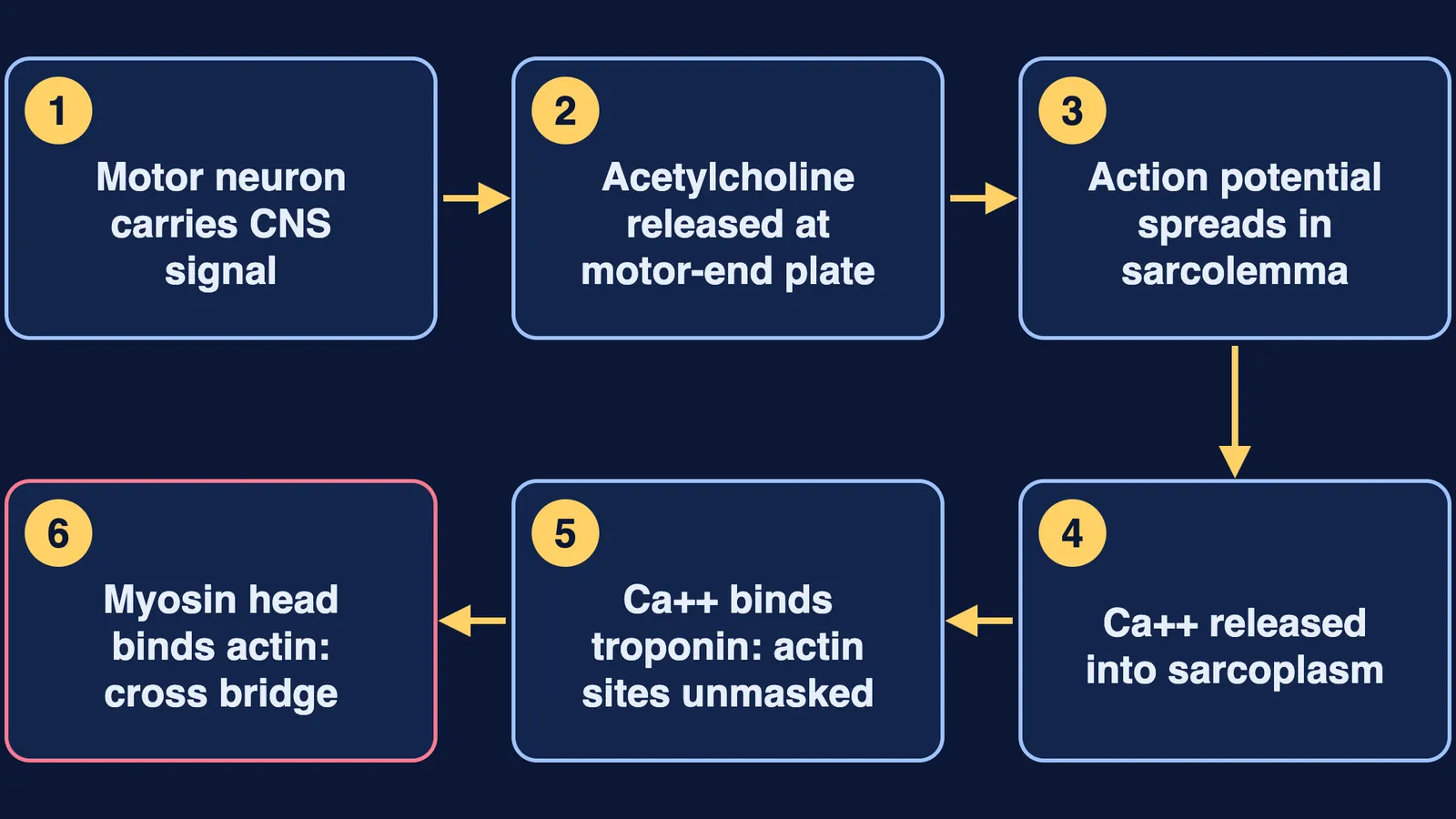
Contraction, one chain in three stages (17.2.2): *excitation:* CNS signal via motor neuron → acetylcholine at the motor-end plate → action potential spreads in the sarcolemma → Ca++ released into the sarcoplasm → Ca++ binds a troponin subunit, unmasking actin's sites → myosin head, using ATP hydrolysis energy, binds actin (cross bridge); *sliding:* actin pulled towards the A band centre → Z lines pulled inwards → sarcomere shortens (I bands shrink, A bands do not) → myosin releases ADP and Pi → new ATP binds, bridge breaks → head hydrolyses it, cycle repeats; *relaxation:* Ca++ pumped back into the sarcoplasmic cisternae → actin masked → Z lines return.
Fatigue, a separate causal chain (17.2.2): repeated activation → anaerobic glycogen breakdown → lactic acid builds up → fatigue.
Muscle, largest to smallest (17.2): muscle (wrapped in fascia) → fascicle → muscle fibre → myofibril → sarcomere.
Resting sarcomere, Z line to centre (17.2): Z line → light I band (actin) → overlap of thin and thick filament ends → H zone → M line.
Vertebral column from the skull (17.3): seven cervical → 12 thoracic → five lumbar → one fused sacral → one fused coccygeal.
Rib pairs, first to last (17.3): true ribs (pairs 1-7) → vertebrochondral, false ribs (8-10) → floating ribs (11, 12).
How do you attack arrange-in-order questions?
Write the first and last steps yourself and cross out options that disagree. Survivors usually differ by one swapped pair: put the cause first. For before-or-after items, name both neighbours before reading options.
Arrange-in-order questions (Q1 to Q7)
Q1. From the nerve signal: A. Action potential spreads through the sarcolemma; B. Motor neuron carries a CNS signal; C. Ca++ released into the sarcoplasm; D. Acetylcholine released at the motor-end plate; E. Troponin subunit binds Ca++
(1) B, D, A, C, E (2) D, B, A, C, E (3) B, A, D, C, E (4) B, D, C, A, E
Answer: (1). Signal, transmitter, action potential, calcium, troponin (17.2.2).
Q2. From cross bridge to shortening: A. Sarcomere shortens; B. Myosin head forms a cross bridge with actin; C. Z lines pulled inwards; D. Actin pulled towards the A band centre
(1) B, C, D, A (2) B, D, C, A (3) D, B, C, A (4) B, D, A, C
Answer: (2). The bridge pulls actin, which drags its Z lines in (17.2.2).
Q3. Ending a contraction: A. Cross-bridge cycles keep causing sliding; B. Ca++ pumped back into the cisternae; C. Actin masked again; D. Z lines return to their original positions
(1) A, B, C, D (2) B, A, C, D (3) A, C, B, D (4) A, B, D, C
Answer: (1). Sliding lasts until Ca++ is pumped back; masking returns the Z lines (17.2.2).
Q4. Vertebral regions from the skull: A. Lumbar; B. Sacral; C. Thoracic; D. Coccygeal; E. Cervical
(1) E, A, C, B, D (2) E, C, A, B, D (3) E, C, A, D, B (4) C, E, A, B, D
Answer: (2). Cervical, thoracic, lumbar, then the fused units (17.3).
Q5. Largest to smallest: A. Myofibril; B. Fascicle; C. Sarcomere; D. Muscle fibre; E. Whole skeletal muscle
(1) E, D, B, A, C (2) E, B, A, D, C (3) B, E, D, A, C (4) E, B, D, A, C
Answer: (4). Fascicles hold fibres; fibres hold myofibrils of serial sarcomeres (17.2).
Q6. Resting sarcomere, from a Z line inwards to the centre: A. M line; B. Z line; C. Overlap of thin and thick filament ends; D. Light I band; E. H zone
(1) B, C, D, E, A (2) B, D, E, C, A (3) B, D, C, E, A (4) D, B, C, E, A
Answer: (3). Thin filaments overlap only thick-filament ends, leaving the H zone around the M line (17.2).
Q7. Towards fatigue: A. Lactic acid accumulates; B. Muscle activated repeatedly; C. Glycogen broken down anaerobically; D. Fatigue
(1) B, A, C, D (2) C, B, A, D (3) B, C, D, A (4) B, C, A, D
Answer: (4). Anaerobic glycogen breakdown leaves lactic acid, causing fatigue (17.2.2).
Which step comes before, after or out of place? (Q8 to Q10)
Q8. What comes immediately before Ca++ release into the sarcoplasm? (1) Acetylcholine release (2) Action potential spreading through the fibre (3) Ca++ binding troponin (4) Cross-bridge formation
Answer: (2). The spreading action potential triggers the release (17.2.2).
Q9. What comes immediately after the cross bridge breaks? (1) Head hydrolyses ATP again (2) Myosin releases ADP and Pi (3) Ca++ pumped back (4) Acetylcholine released
Answer: (1). The head hydrolyses the new ATP and the cycle repeats (17.2.2).
Q10. Which step is out of place? P. Acetylcholine released; Q. Ca++ binds troponin; R. Action potential in the sarcolemma; S. Ca++ released into the sarcoplasm; T. Myosin head binds actin. (1) P (2) Q (3) R (4) T
Answer: (2). Calcium is released before it binds troponin; Q belongs after S (17.2.2).
Two-statement questions on order (Q11 and Q12)
Options: (1) Both correct (2) Both incorrect (3) Only I correct (4) Only II correct
Q11. I: A troponin subunit binds Ca++ only after the action potential has spread through the fibre. II: Counting rib pairs from the first, the floating ribs come before the vertebrochondral ribs.
Answer: (3). Action potential precedes Ca++ release (17.2.2); floating ribs are pairs 11-12 (17.3).
Q12. I: From the skull down, the sacral region comes before the lumbar. II: During relaxation, actin is masked again before Ca++ is pumped back into the cisternae.
Answer: (2). Lumbar precedes sacral (17.3); pumping Ca++ back causes the masking (17.2.2).
How should you use this set?
Hide the answers and do all 12. For each miss, rewrite that sequence from memory and check its section. Try other formats: the Locomotion and Movement diagram-based questions and the NCERT exceptions and odd-one-out set, or revise with the Locomotion and Movement Class 11 guide.
Not sure which chapter to drill next? Fermi's AI tutor works out what you already know and builds a plan for the session.