

On this page
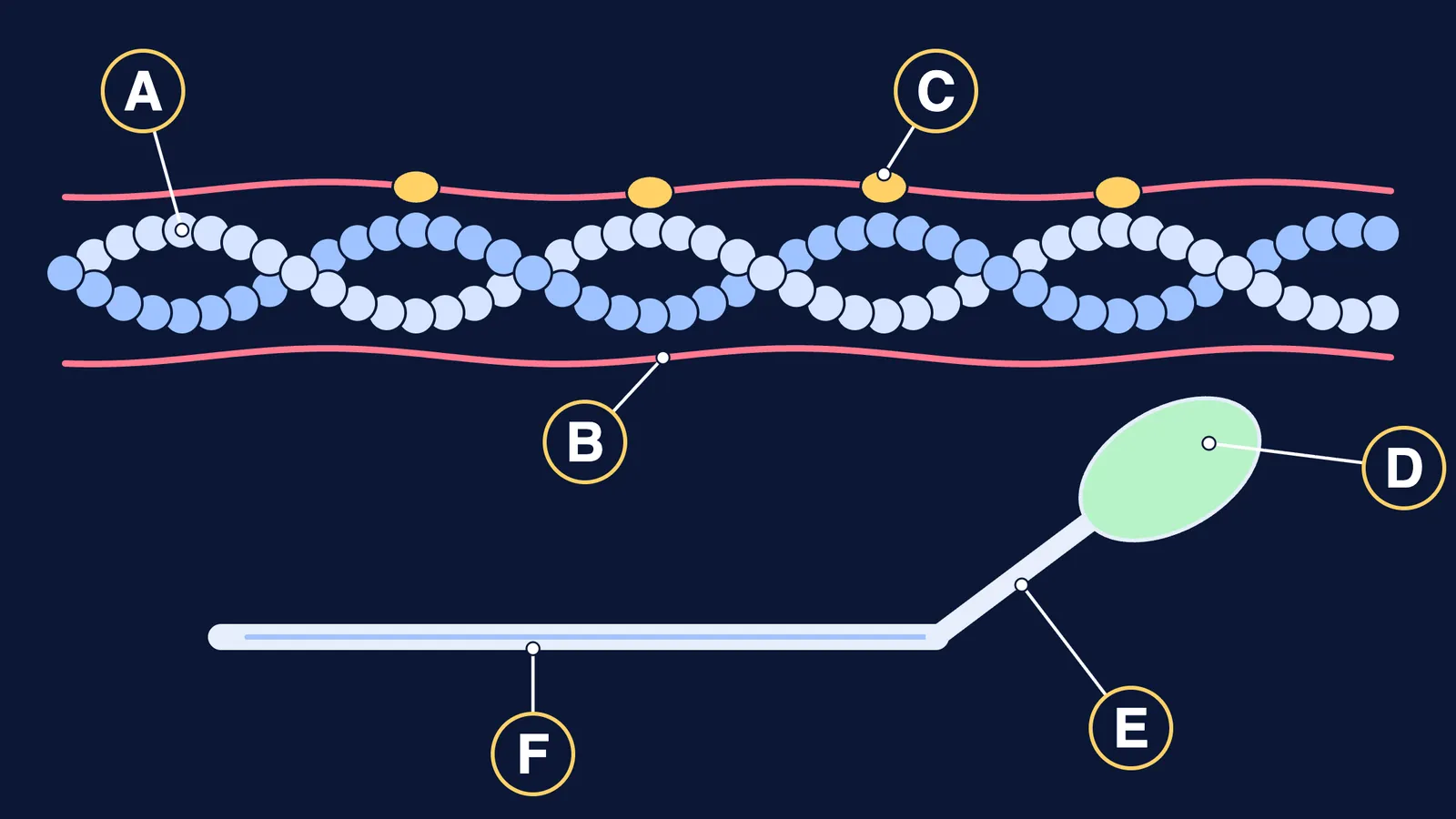
The hero is our own schematic of NCERT's two contractile proteins: an actin (thin) filament above and one myosin monomer below, with parts A to F. Questions 1 to 6 use those letters; 7 to 14 describe other figures in words. All items are original; answers follow the NCERT Class 11 Biology text, Reprint 2026-27.
Which NEET (UG) unit covers this chapter?
Under the NMC NEET (UG) 2026 syllabus, this chapter falls in Unit 5, Human Physiology, including contractile proteins and muscle contraction. Per the NTA's NEET (UG) 2026 bulletin, Biology has 90 of the paper's 180 questions; a right answer earns +4 and a wrong one costs 1 mark.
How do you read a NEET diagram question?
Name every letter in the margin before reading the options.
Check what each leader line touches: a strand, one bead or a knob.
Recall the one function NCERT gives each part.
Strike options with a wrong pair, then check the pair that splits the rest.
Questions on the lettered diagram (Q1 to Q6)
How to attack: fix the letters first, then answer from recall.
Q1. At rest, a subunit of which part hides the myosin-binding sites on actin?
(1) A (2) B (3) C (4) F
Answer: (3). C is troponin, whose subunit masks those sites at rest.
Q2. Which part is an ATPase that also binds both ATP and actin?
(1) E (2) D (3) F (4) B
Answer: (2). D is the globular head of the meromyosin.
Q3. Statement I: Many units like the lower one polymerise to form one thick filament. Statement II: Part C, not part B, is the protein running close to the F-actins along their length.
(1) Both correct (2) Both incorrect (3) I correct, II incorrect (4) I incorrect, II correct
Answer: (3). Many meromyosins make a thick filament; B (tropomyosin) runs along the F-actins.
Q4. Match List-I with List-II.
List-I: A; B; C; E
List-II: I. Globular monomer of the thin filament; II. Protein running along the F-actins; III. Complex protein spaced regularly on II; IV. Joins the head to the tail
(1) A-II, B-I, C-III, E-IV (2) A-I, B-III, C-II, E-IV (3) A-IV, B-II, C-III, E-I (4) A-I, B-II, C-III, E-IV
Answer: (4). G-actin, tropomyosin, troponin, short arm.
Q5. Once Ca++ binds a subunit of C, the head D can attach to active sites on which part?
(1) B (2) A (3) F (4) E
Answer: (2). The unmasked sites lie on the actin filament, built of G-actin units.
Q6. Which lettered parts project outwards from the thick filament as the cross arm?
(1) D and E (2) E and F (3) D and F (4) C and D
Answer: (1). The head with its short arm (HMM) forms the cross arm.
How do you answer questions on figures you cannot see? (Q7 to Q14)
How to attack: sketch the figure in ten seconds, label only what the question needs, then answer.
Q7. A muscle cross-section shows bundles wrapped together by a common collagenous layer. That layer is the:
(1) sarcolemma (2) fascia (3) sarcoplasmic reticulum (4) Z line
Answer: (2). Fascicles are held together by the fascia.
Q8. In a resting sarcomere diagram, the thin membrane holding thick filaments together mid-way along the dark band is the:
(1) M line (2) H zone (3) Z line (4) I band
Answer: (1). The M line sits in the middle of the A band.
Q9. Statement I: In a myofibril figure, light and dark bands alternate along its length. Statement II: The sarcomere is the stretch between two successive M lines.
(1) Both correct (2) Both incorrect (3) I correct, II incorrect (4) I incorrect, II correct
Answer: (3). A sarcomere runs from one Z line to the next.
Q10. A figure of the cross-bridge cycle shows four events. Choose the correct order.
P. Ca++ binds troponin; Q. Myosin head binds an exposed actin site; R. Myosin releases ADP and Pi and returns to its relaxed state; S. Fresh ATP attaches and the cross bridge breaks
(1) Q, P, R, S (2) P, Q, R, S (3) P, Q, S, R (4) P, R, Q, S
Answer: (2). Unmasking, binding, release of ADP and Pi, then a new ATP breaks the bridge.
Q11. A figure compares relaxed and contracted sarcomeres. Statement I: In the contracted one, the Z lines are drawn closer to the centre of the A band. Statement II: In the contracted one, the I bands are drawn longer.
(1) Both correct (2) Both incorrect (3) I correct, II incorrect (4) I incorrect, II correct
Answer: (3). Z lines are pulled inwards, and the I bands get reduced.
Q12. A sketch shows two bone ends separated by a fluid-filled cavity. Which statement about this joint is correct?
(1) It allows considerable movement and aids locomotion (2) Its bones are joined by cartilage (3) Dense fibrous tissue forms sutures in it (4) It allows no movement
Answer: (1). A fluid-filled cavity marks a synovial joint.
Q13. A figure of the right pectoral girdle and upper arm: match the parts.
List-I: P. Acromion; Q. Scapula; R. Clavicle; S. Spine of scapula
List-II: I. Large triangular flat bone on the dorsal thorax; II. Raised ridge on the scapula's dorsal body; III. Flat process meeting the clavicle; IV. Long slender bone with two curvatures
(1) P-II, Q-III, R-IV, S-I (2) P-IV, Q-I, R-III, S-II (3) P-III, Q-I, R-IV, S-II (4) P-III, Q-IV, R-I, S-II
Answer: (3). The spine expands into the acromion, which meets the clavicle.
Q14. In a diagram of the human skull, the two occipital condyles articulate with the:
(1) axis (2) hyoid (3) mandible (4) atlas
Answer: (4). The atlas, the first vertebra, meets both condyles (dicondylic skull).
Answer key for the lettered diagram
A: G-actin monomer
B: tropomyosin
C: troponin
D: globular head (ATPase)
E: short arm
F: tail (light meromyosin)
How should you use this set?
Cover the key, name A to F, then attempt all 14 in one sitting. For each miss, reread that NCERT paragraph and redraw the figure from memory. For other formats, try our Locomotion and Movement statement and match-the-list questions and the assertion-reason set for this chapter.
Not sure which chapter to practise next? Fermi's AI tutor works out what you already know and builds a plan for the session.


