

On this page
Locomotion and Movement is short, but its assertion-reason items punish loose reading. Each statement below was checked against the NCERT Class 11 Biology chapter on Locomotion and Movement (2026-27 reprint), and every topic sits inside the NMC syllabus for NEET (UG)-2026 (Human Physiology unit). For the whole unit, start with our Human Physiology for NEET preparation guide.
How do you answer assertion-reason questions?
Judge each statement on its own first. Only when both are true do you ask: is R the direct reason NCERT gives for A? Two true facts about one muscle are not automatically cause and effect.
Keys for every question:
Assertion-reason: (A) Both A and R are true and R is the correct explanation of A. (B) Both A and R are true but R is NOT the correct explanation of A. (C) A is true but R is false. (D) A is false but R is true.
Statement pairs: (A) Both statements are correct. (B) Both statements are incorrect. (C) Statement I is correct, Statement II is incorrect. (D) Statement I is incorrect, Statement II is correct.
Locomotion and movement assertion-reason questions with answers
All facts below are from the NCERT Locomotion and Movement chapter.
Q1 (easy). Assertion (A): Skeletal muscles are called striated muscles. Reason (R): The activities of skeletal muscles are under voluntary control of the nervous system.
Answer: (B). Both are true, but the name comes from their striped look under the microscope; voluntary control explains the other name, voluntary muscles. Trap: matching two correct facts about one tissue and assuming one causes the other.
Q2 (easy). Assertion (A): Dust that reaches the trachea with each breath can be moved out of it. Reason (R): The trachea is lined by ciliated epithelium whose cilia move in a coordinated way.
Answer: (A). Both are true, and NCERT names the coordinated beating of these cilia as what clears the dust. Trap: overthinking an easy item and choosing (B) out of habit.
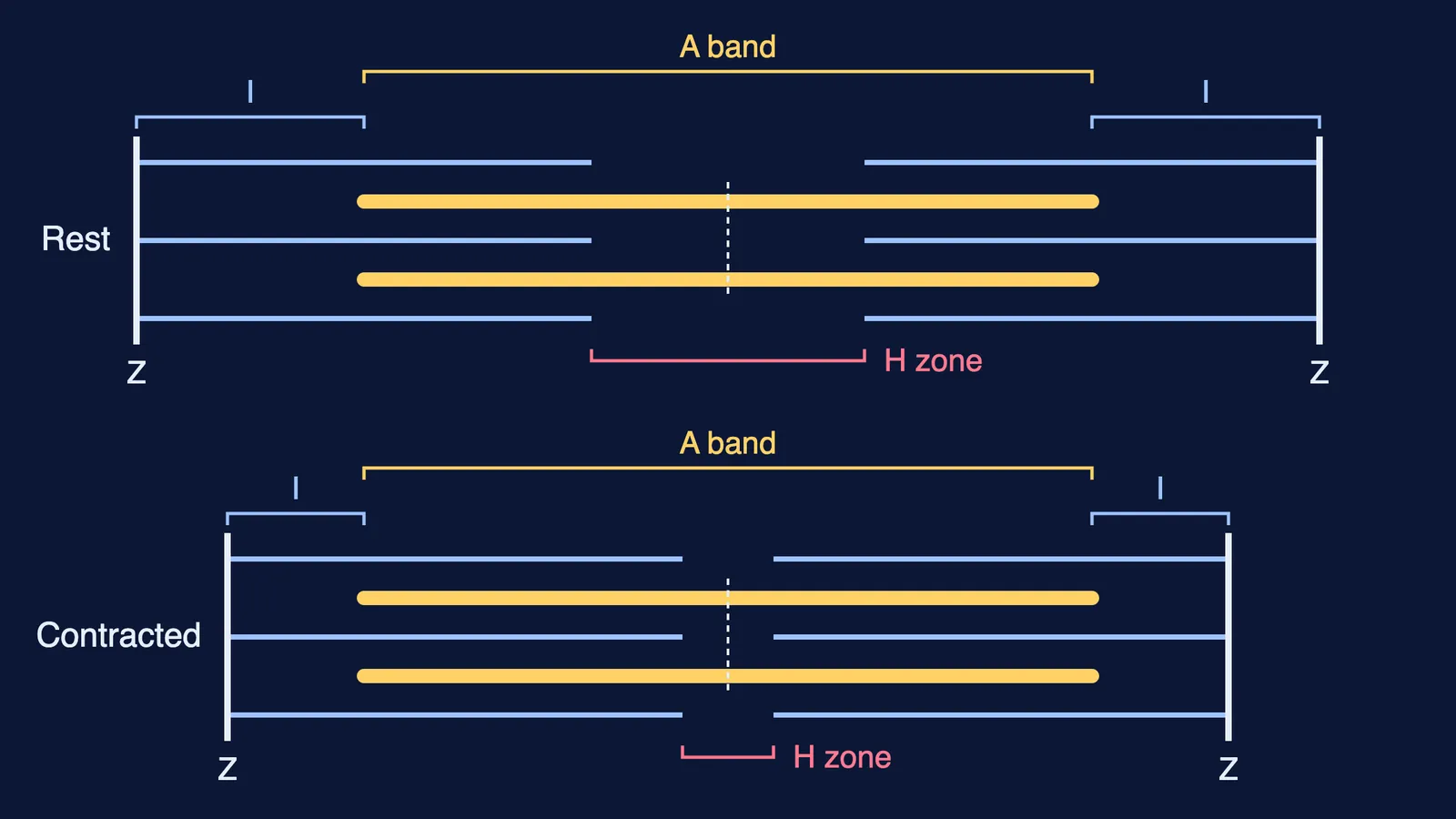
Q3 (medium). Assertion (A): When a muscle fibre contracts, the A band keeps its length. Reason (R): The A band is made of thin actin filaments that slide over the thick filaments.
Answer: (C). A is true: I bands shorten while A bands keep their length. R is false: the dark A band holds myosin, the thick filament; actin forms the light I band. Trap: remembering "actin slides" and pinning actin to the wrong band.
Q4 (medium). Assertion (A): In a resting sarcomere, the H zone is the region where actin and myosin filaments overlap. Reason (R): At rest, thin filaments overlap only the end portions of each thick filament.
Answer: (D). R is true, but A is false: the H zone is the central part of the thick filaments that thin filaments do not overlap. Trap: reading "overlap" in R and carrying it into the centre of the sarcomere.
Q5 (medium). Assertion (A): In a resting muscle fibre, myosin heads do not form cross bridges with actin. Reason (R): At rest, a subunit of troponin masks the active binding sites for myosin on the actin filaments.
Answer: (A). Both are true, and the masking is the direct cause; contraction starts only when Ca++ binds troponin and unmasks the sites. Trap: blaming tropomyosin, when NCERT says a troponin subunit does the masking.
Q6 (hard). Assertion (A): Tetany, rapid spasms of muscle, is caused by low Ca++ in body fluid. Reason (R): Calcium binding to troponin is needed to expose myosin-binding sites on actin.
Answer: (B). Both are true, but NCERT links tetany to low Ca++ without using the troponin step, and R alone would predict weaker contraction, not spasms. Trap: choosing (A) because both statements mention calcium.
Statement I and Statement II questions on locomotion and movement
Same source: the NCERT chapter. The human skeleton has 206 bones, 80 of them in the axial skeleton, and each limb has 30.
Q7 (easy). Statement I: The human vertebral column has 26 vertebrae, with the sacrum and the coccyx each counted as one fused unit. Statement II: The 11th and 12th pairs of ribs are called vertebrochondral ribs.
Answer: (C). Statement I matches NCERT: 7 cervical, 12 thoracic, 5 lumbar, 1 sacral and 1 coccygeal. Statement II is wrong: pairs 8 to 10 are vertebrochondral (false) ribs, while pairs 11 and 12 are floating ribs. Trap: "false ribs" and "floating ribs" sound alike.
Q8 (medium). Statement I: Counting the phalanges of one hand and one foot together gives 28 bones. Statement II: Each coxal bone of the pelvic girdle forms by the fusion of the ilium, ischium and pubis.
Answer: (A). Each hand and each foot has 14 phalanges, so 14 + 14 = 28. Statement II is NCERT's own description of the coxal bone. Trap: counting 5 digits instead of 14 phalanges.
Q9 (medium). Statement I: The joint between the atlas and the axis is a hinge joint. Statement II: Fibrous joints between the cranial bones permit limited movement.
Answer: (B). Atlas and axis form a pivot joint; the knee is NCERT's hinge example. Fibrous joints allow no movement; limited movement belongs to cartilaginous joints, as between vertebrae. Trap: swapping joint types between neighbouring examples.
Q10 (hard). Statement I: A motor unit is one muscle fibre together with the neuromuscular junction on it. Statement II: Acetylcholine released at the motor-end plate generates an action potential in the sarcolemma.
Answer: (D). A motor unit is a motor neuron plus all the muscle fibres connected to it, so Statement I is wrong. Statement II follows NCERT's sequence exactly. Trap: confusing the motor unit with the neuromuscular junction.
How should you use this practice set?
Do all ten in one sitting, without notes.
For every miss, note which step failed: a false statement you believed, or a wrong cause-and-effect call.
Re-read the NCERT paragraph behind each miss, then redraw a sarcomere from memory: Z line, A band, I band, H zone.
Retry the set after three days in a new order.
If one idea keeps tripping you, such as which band shortens, the Fermi Concept Library gives every concept in biology its own lesson, so you can rebuild it first. For the full chapter in notes form, read our Locomotion and Movement Class 11 guide, and for the method behind this format across subjects, see how to crack assertion-reason questions.


