On this page
Locomotion and Movement is Chapter 17 of Class 11 NCERT Biology. Below: the syllabus, a worked sarcomere example, the 206-bone count and practice questions.
What does the 2026-27 syllabus include for Locomotion and Movement?
The CBSE Biology curriculum for 2026-27 places it in Unit V, Human Physiology, which carries 18 marks of the 70-mark Class XI theory paper. Chapters 14 to 19 share them; CBSE gives no per-chapter split.
Its Chapter 17 line names ciliary, flagellar and muscular movement, muscle contraction, the skeleton, joints and six disorders. Only Digestion and Absorption is kept out of the Class XI theory paper, so all of this chapter can be examined.
See the NCERT rationalised content booklet and the current NCERT chapter (Reprint 2026-27).
What are the types of movement and muscle?
Locomotion is voluntary movement that changes the body's place. Human cells show three movement types:
Amoeboid: macrophages and leucocytes, using pseudopodia.
Ciliary: cilia in the trachea clear dust; ciliary movement also moves ova along the female reproductive tract.
Muscular: limbs, jaws and tongue.
CBSE lists flagellar movement, but NCERT 17.1 does not; section 17.2 notes it moves sperm, sponge water currents and Euglena.
Muscle is about 40 to 50 per cent of adult body weight, says the NCERT chapter. Skeletal muscle is striated and voluntary; visceral (smooth) muscle is non-striated and involuntary; cardiac muscle is striated, branched and involuntary.
How does the sliding filament theory work?
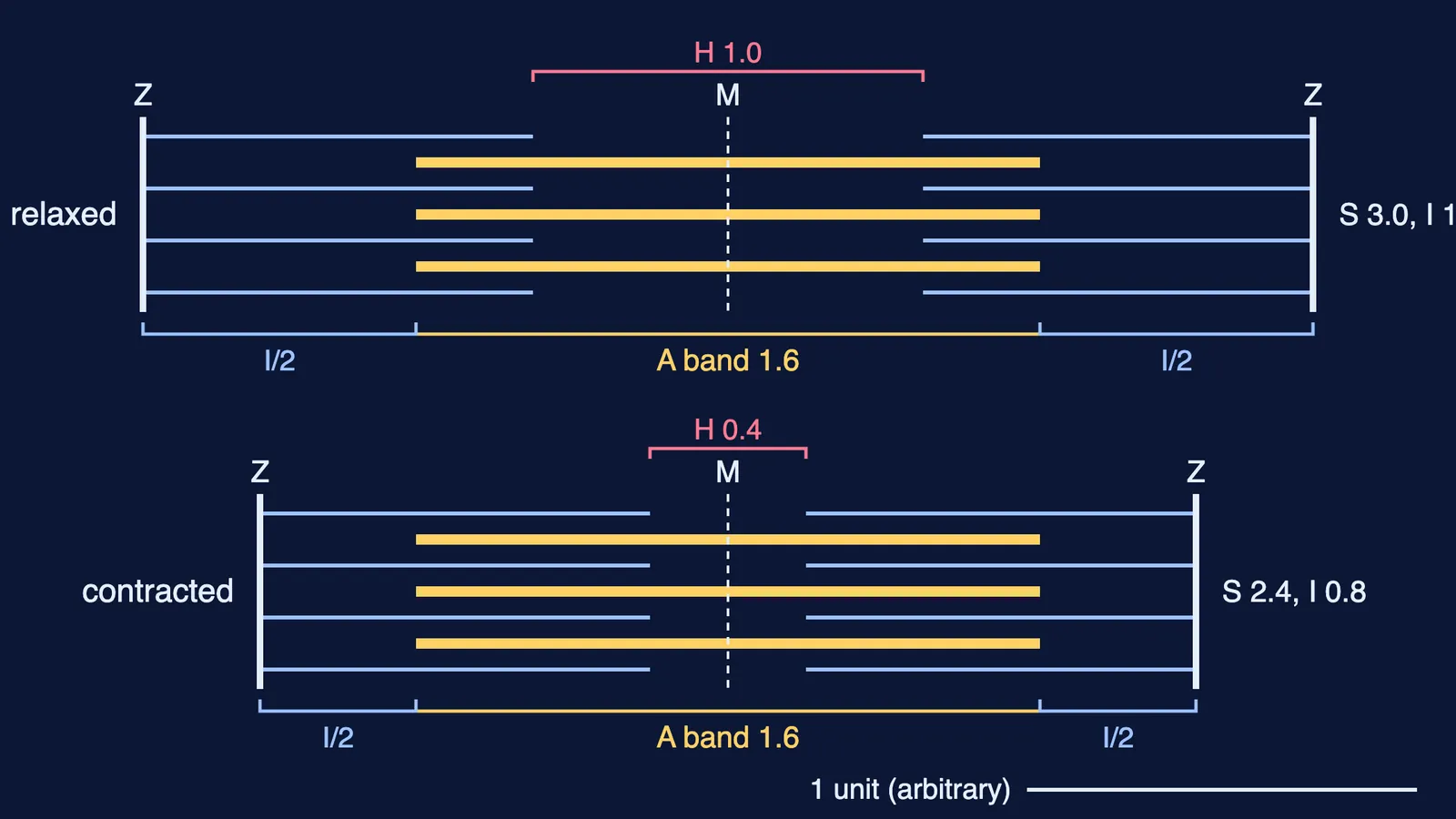
Myofibrils are chains of sarcomeres, the functional units between two Z lines. Thin actin filaments form the light I band, thick myosin the dark A band; the H zone is the part of the A band actin does not reach.
By the sliding filament theory, a fibre contracts as thin filaments slide over thick ones. Steps from the NCERT chapter:
Acetylcholine at the neuromuscular junction triggers an action potential in the sarcolemma.
Released Ca++ binds troponin, unmasking myosin's binding sites on actin.
Powered by ATP hydrolysis, the myosin head forms a cross bridge and pulls actin towards the A band's centre.
A new ATP breaks the bridge; the cycle repeats.
Ca++ returns to the sarcoplasmic reticulum, and the muscle relaxes.
Worked example (our numbers, arbitrary units). Thick filaments are 1.6; thin filaments run 1.0 from each Z line. A sarcomere shortens from 3.0 to 2.4.
A band = thick filament length = 1.6, before and after.
I band = sarcomere − A band: 3.0 − 1.6 = 1.4, then 2.4 − 1.6 = 0.8.
H zone = sarcomere − both thin filaments: 3.0 − 2.0 = 1.0, then 2.4 − 2.0 = 0.4.
I and H shrink; A stays constant, as the diagram above shows to scale. Red fibres are rich in myoglobin and mitochondria (aerobic); white fibres are anaerobic. Lactic acid build-up causes fatigue.
How is the human skeleton organised, and what are joints?
The counts come from the NCERT chapter; the group sums are ours.
Axial (80): skull 22 (8 cranial, 14 facial), hyoid 1, ear ossicles 6, vertebrae 26, sternum 1, ribs 24.
Limbs (120): 30 each. Arm: humerus, radius, ulna, 8 carpals, 5 metacarpals, 14 phalanges. Leg: femur, tibia, fibula, patella, 7 tarsals, 5 metatarsals, 14 phalanges.
Girdles (6): 2 clavicles, 2 scapulae, 2 coxal bones.
Total: 80 + 120 + 6 = 206.
Vertebrae: cervical 7, thoracic 12, lumbar 5, sacral 1, coccygeal 1. Rib pairs: 7 true, 3 vertebrochondral, 2 floating.
Joints are fibrous (skull sutures, immovable), cartilaginous (vertebrae, limited) or synovial (fluid-filled: ball and socket, hinge, pivot, gliding, saddle). Learn one line on each disorder: myasthenia gravis, muscular dystrophy, tetany, arthritis, osteoporosis and gout.
What practice questions should you try?
Marks are ours; formats follow the Class XII Biology sample paper for 2026-27, as no Class XI paper exists.
(1 mark) Which part of a sarcomere keeps its length during contraction?
(1 mark) Assertion: cardiac muscle is involuntary even though it is striated. Reason: its activity is not under direct nervous control. Does the reason explain the assertion?
(2 marks) A toxin blocks acetylcholine release at the neuromuscular junction. Predict the effect.
(3 marks) A sarcomere of 3.2 units shortens to 2.6 (thick 1.6, thin 1.0 from each Z line). Find A, I and H before and after.
(4 marks) Which fibre type suits long-distance running? Give three reasons, and the cause of fatigue.
(5 marks) Account for all 80 axial bones by group, and explain why the skull is dicondylic.
Answers: 1. A band. 2. Both true; the reason explains why it is involuntary. 3. No action potential or Ca++ release, so no contraction. 4. Before 1.6, 1.6, 1.2; after 1.6, 1.0, 0.6. 5. Red: more myoglobin, more mitochondria, aerobic ATP; lactic acid. 6. 22 + 1 + 6 + 26 + 1 + 24; two occipital condyles meet the atlas.
How should you revise this chapter?
Redraw both sarcomeres and rebuild the 206 count. Pair this with Structural Organisation in Animals for Class 11. For NEET, read Human Physiology for NEET.
Not sure where to start? Fermi's AI tutor works out what you already know and builds a plan for the session.