On this page
NCERT Class 11 Biology covers Excretory Products and their Elimination in Chapter 16 (Reprint 2026-27); the NEET (UG) 2026 syllabus puts it in Unit 5, Human Physiology. Every order below is NCERT's own, with its section. The 12 questions are ours, not past or predicted items. Haemodialysis appears only as NCERT describes it: a study summary, not medical advice.
Which sequences does NCERT give in Excretory Products?
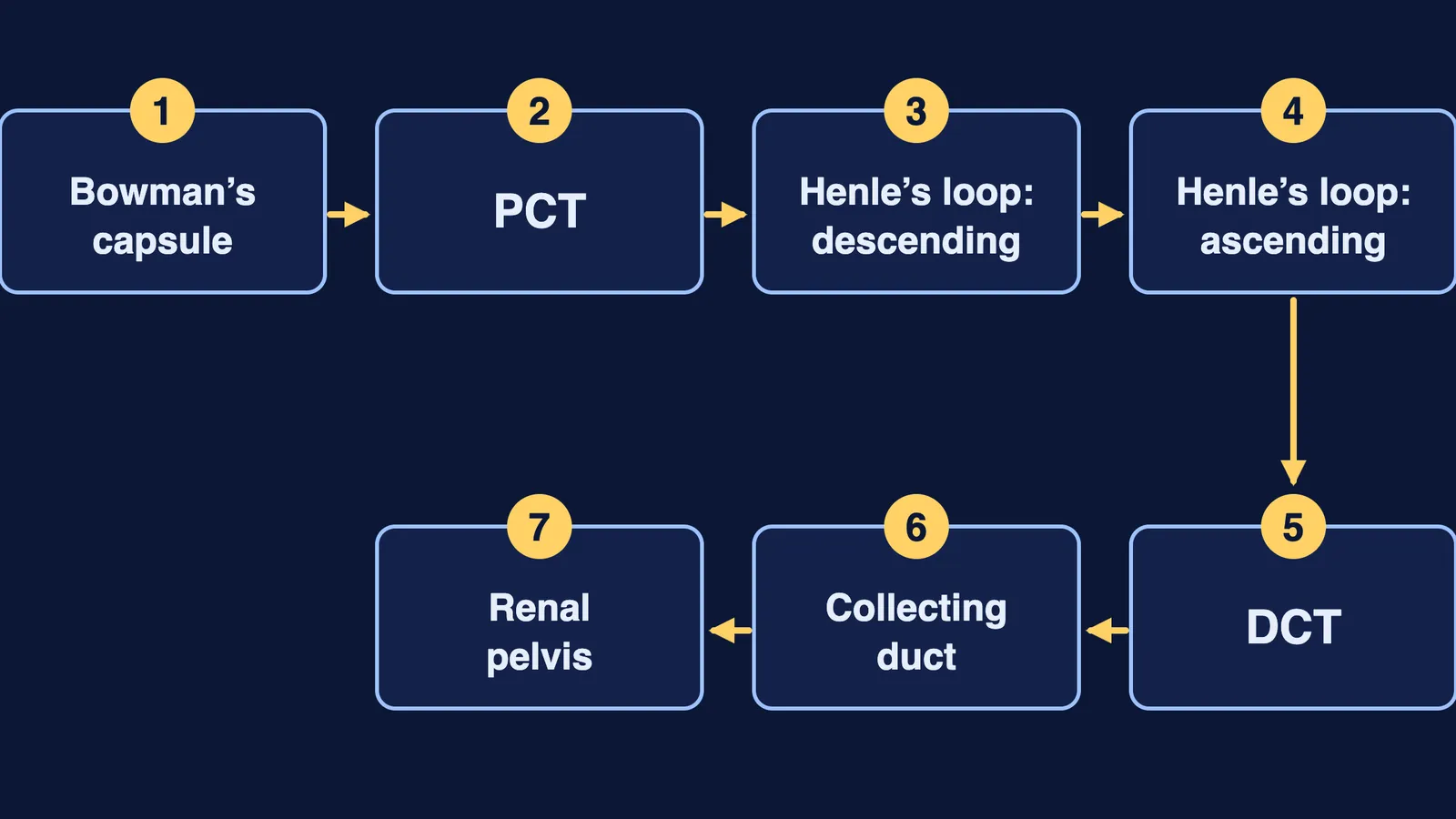
Filtrate route (16.1): Bowman's capsule → PCT → descending limb of Henle's loop → ascending limb → DCT → collecting duct → renal pelvis.
Blood route (16.1): renal artery → afferent arteriole → glomerulus → efferent arteriole → peritubular capillaries.
Urea route in ureotelic animals (chapter opening): ammonia from metabolism → urea made in the liver → blood → filtered by the kidneys → excreted.
Filtrate in the loop and duct (16.3, 16.4): water leaves the descending limb (concentrating) → electrolytes leave the ascending limb (diluting) → DCT → water leaves the collecting duct.
ADH loop (16.5): fluid loss → osmoreceptors activated → hypothalamus → ADH from the neurohypophysis → water reabsorbed in the latter tubule.
Renin-angiotensin (16.5): drop in glomerular flow, pressure or GFR → renin from JG cells → angiotensinogen to angiotensin I → angiotensin II → aldosterone from the adrenal cortex → Na+ and water reabsorbed distally.
Micturition (16.6): bladder stretches → stretch receptors signal the CNS → motor messages → bladder muscle contracts as the urethral sphincter relaxes → urine released.
Haemodialysis (16.8): blood from an artery → heparin, then the dialysing unit → wastes cross the cellophane → anti-heparin → return through a vein.
How do you attack arrange-in-order questions?
Pin the ends first: which step needs nothing before it, and which closes the chain? Strike options that disagree, then check the first position where the survivors differ.
Arrange-in-order questions
Q1. Order the parts the filtrate passes through: A. DCT B. PCT C. Ascending limb of Henle's loop D. Bowman's capsule E. Descending limb of Henle's loop. (1) D, B, E, C, A (2) D, B, C, E, A (3) B, D, E, C, A (4) D, E, B, C, A
Answer: (1). The ascending limb continues as the DCT (16.1).
Q2. Order the blood's path: A. Efferent arteriole B. Renal artery C. Glomerulus D. Peritubular capillaries E. Afferent arteriole. (1) B, C, E, A, D (2) E, B, C, A, D (3) B, E, C, A, D (4) B, E, C, D, A
Answer: (3). The afferent arteriole, a renal artery branch, forms the glomerulus; the efferent drains it (16.1).
Q3. Order renin-angiotensin: A. Angiotensin II forms B. JG cells release renin C. Adrenal cortex releases aldosterone D. Angiotensinogen becomes angiotensin I E. Glomerular blood pressure falls. (1) E, D, B, A, C (2) E, B, D, A, C (3) B, E, D, A, C (4) E, B, D, C, A
Answer: (2). Angiotensin II, formed from angiotensin I, acts on the adrenal cortex (16.5).
Q4. Order the ADH response: A. Hypothalamus is stimulated B. Neurohypophysis releases ADH C. Osmoreceptors are activated D. Excess fluid is lost E. More water is reabsorbed from the latter tubule. (1) D, A, C, B, E (2) C, D, A, B, E (3) D, C, A, E, B (4) D, C, A, B, E
Answer: (4). The receptors stimulate the hypothalamus before ADH is released (16.5).
Q5. Order micturition: A. Stretch receptors signal the CNS B. Filling stretches the bladder C. Bladder muscle contracts, urethral sphincter relaxes D. CNS sends motor messages E. Urine is released. (1) A, B, D, C, E (2) B, D, A, C, E (3) B, A, D, C, E (4) B, A, C, D, E
Answer: (3). Stretching starts the signal; the CNS reply comes next (16.6).
Q6. Order the filtrate's changes after the PCT: A. Electrolytes leave the ascending limb B. Water leaves the descending limb C. Water passes from the collecting duct into the medulla D. Filtrate flows through the DCT. (1) B, A, D, C (2) A, B, D, C (3) B, D, A, C (4) B, A, C, D
Answer: (1). Concentrated going down, diluted coming up, concentrated again in the duct (16.3, 16.4).
Q7. Order the urea route in ureotelic animals: A. Kidneys filter blood B. Liver turns ammonia into urea C. Metabolism makes ammonia D. Urea enters the blood E. Urea is excreted. (1) C, B, D, A, E (2) C, D, B, A, E (3) B, C, D, A, E (4) C, B, A, D, E
Answer: (1). Urea forms in the liver, then travels in blood to the kidneys (chapter opening).
Before, after and out-of-place questions
Q8. What comes immediately after angiotensin I forms? (1) Angiotensin II forms (2) JG cells release renin (3) Aldosterone acts on the distal tubule (4) Glomerular blood flow falls
Answer: (1). Angiotensin I becomes angiotensin II; renin acts earlier, aldosterone later (16.5).
Q9. What comes immediately after stretch receptors signal the CNS? (1) Bladder stretches (2) CNS sends motor messages (3) Urine is released (4) Urethral sphincter relaxes
Answer: (2). Contraction and sphincter relaxation follow the motor messages (16.6).
Q10. A haemodialysis list: A. Wastes cross the cellophane into the dialysing fluid B. Blood drained from an artery C. Heparin added, blood pumped into the unit D. Anti-heparin added E. Blood returned through a vein. Moving which one step restores NCERT's order? (1) A (2) B (3) C (4) D
Answer: (1). Wastes leave inside the unit, after heparin and before anti-heparin (16.8).
Two-statement questions on order
Key: (a) I and II true (b) I and II false (c) I true, II false (d) I false, II true.
Q11. I: In the renal tubule, the DCT comes before Henle's loop. II: Filtrate reaches the PCT before Henle's loop.
Answer: (d). PCT, then Henle's loop, then DCT (16.1).
Q12. I: Urine stays in the bladder until the CNS gives a voluntary signal. II: Reabsorption is the first step of urine formation.
Answer: (c). NCERT names glomerular filtration first (16.2, 16.6).
What should you do after the set?
Redraw sequences 1, 6 and 7 from memory; tag each miss as a wrong start, wrong end or swapped pair. Then try the excretion statement and match-the-list questions, the excretory products diagram-based questions and the assertion-reason questions on excretory products.
Which sequence keeps tangling? Fermi's AI tutor works out what you already know and builds a plan for the session.