

On this page
Excretory Products and their Elimination is Chapter 16 of NCERT Class 11 Biology, and the NEET (UG) 2026 syllabus places it in Unit 5: Human Physiology. Below are 13 original questions, each with an answer and a one-line NCERT reason. None is a past or predicted question. Items on disorders, diabetes and dialysis are a study summary of NCERT, not medical advice.
How do you attack Statement I and Statement II questions?
Judge each statement alone, noting the NCERT word that decides it, then read the key.
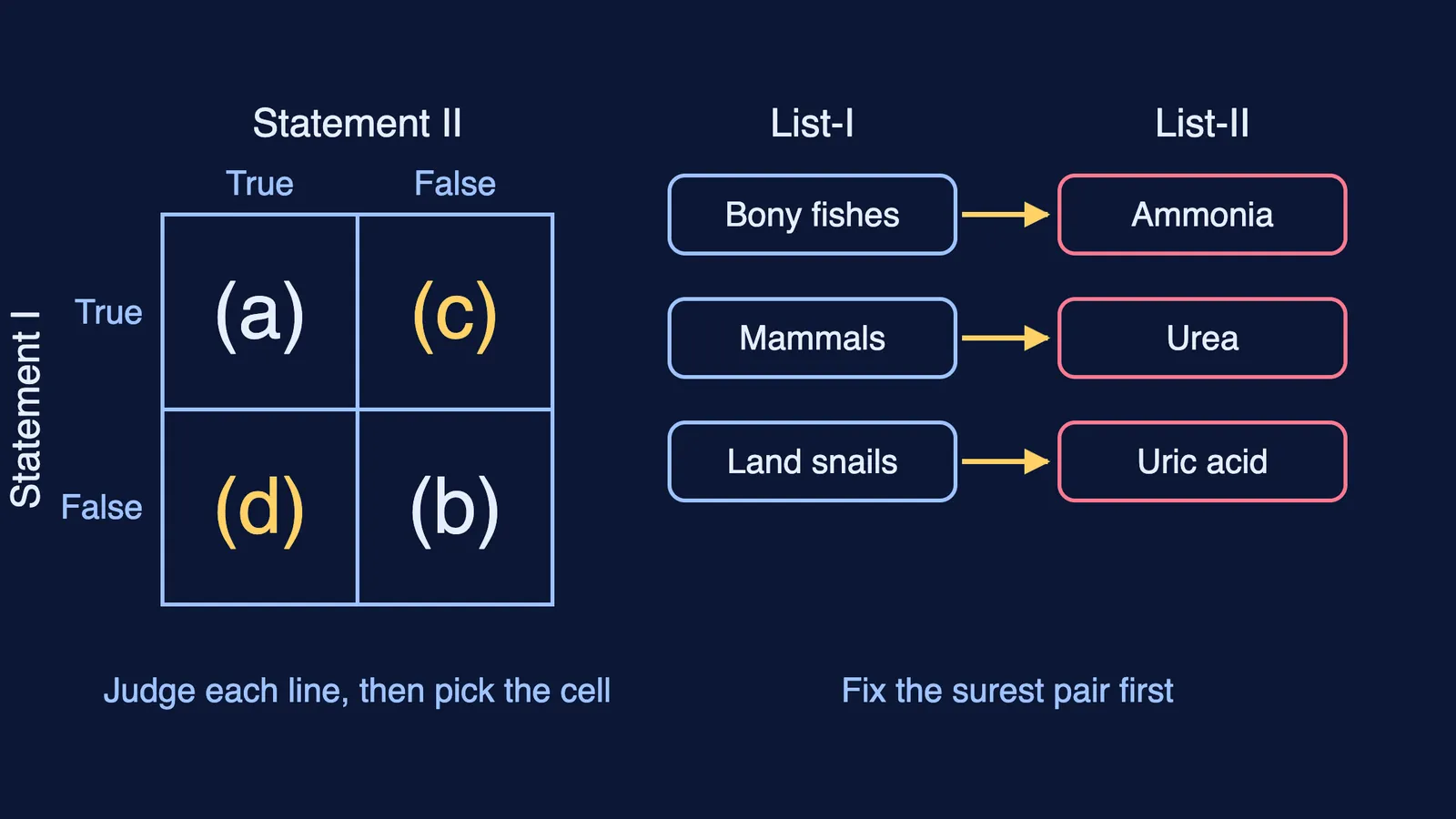
Key for Q1 to Q5: (a) both correct; (b) both incorrect; (c) only Statement I correct; (d) only Statement II correct.
Q1. Statement I: Flame cells of Planaria mainly handle osmoregulation. Statement II: Green glands are the excretory organs of insects such as cockroaches.
Answer: (c). Green glands serve crustaceans like prawns; cockroaches use Malpighian tubules.
Q2. Statement I: Marine fishes mainly excrete urea. Statement II: Some ureotelic animals retain a little urea in the kidney matrix for osmolarity.
Answer: (a). NCERT lists marine fishes as ureotelic and notes this urea retention.
Q3. Statement I: Reabsorption is greatest in the ascending limb of Henle's loop. Statement II: The columns of Bertini are medulla extending between cortical lobes.
Answer: (b). Reabsorption is minimum there, and the columns are cortex between medullary pyramids.
Q4. Statement I: Nearly all essential nutrients are reabsorbed in the DCT. Statement II: The DCT can reabsorb HCO3– and secrete H+ and K+ ions.
Answer: (d). The PCT reclaims almost all essential nutrients.
Q5. Statement I: ADH also constricts blood vessels, raising blood pressure and GFR. Statement II: ANF is released when blood flow to the atria falls.
Answer: (c). ANF follows a rise in atrial blood flow.
How do you attack match-the-list questions?
Look at the coded rows before the lists. Lock in the pairing you know cold, cross out rows that contradict it, then check one pairing where the remaining rows differ. Our guide to match-the-list questions in NEET explains more.
Q6. List-I: (A) Hilum (B) Calyces (C) Podocytes (D) Vasa recta. List-II: (I) Notch where the ureter, vessels and nerves enter (II) Projections of the renal pelvis (III) U-shaped vessel beside Henle's loop (IV) Capsule cells leaving filtration slits.
Options: (1) A-I, B-II, C-IV, D-III (2) A-II, B-I, C-IV, D-III (3) A-I, B-II, C-III, D-IV (4) A-III, B-II, C-IV, D-I
Answer: (1). Podocytes line Bowman's capsule; vasa recta belongs to the peritubular network.
Q7. List-I: (A) Renin (B) Angiotensin II (C) Aldosterone (D) ANF. List-II: (I) Vasodilation (II) Starts converting angiotensinogen (III) Na+ and water reabsorption in distal tubule parts (IV) Strong vasoconstrictor that also acts on the adrenal cortex.
Options: (1) A-IV, B-II, C-III, D-I (2) A-II, B-III, C-IV, D-I (3) A-II, B-IV, C-III, D-I (4) A-II, B-IV, C-I, D-III
Answer: (3). Angiotensin II narrows vessels and triggers aldosterone; ANF widens vessels.
Q8. List-I: (A) Lungs (B) Liver (C) Sweat glands (D) Sebaceous glands. List-II: (I) Sterols, hydrocarbons and waxes (II) NaCl, some urea, lactic acid (III) About 200 mL of CO2 a minute (IV) Bilirubin and biliverdin in bile.
Options: (1) A-IV, B-III, C-II, D-I (2) A-III, B-IV, C-I, D-II (3) A-III, B-II, C-IV, D-I (4) A-III, B-IV, C-II, D-I
Answer: (4). Sebum carries waxes; sweat carries salts.
Q9. List-I: (A) Uremia (B) Renal calculi (C) Glomerulonephritis (D) Ketonuria. List-II: (I) Inflamed glomeruli (II) Ketone bodies in urine (III) Urea building up in blood (IV) Insoluble mass of crystallised salts such as oxalates.
Options: (1) A-IV, B-III, C-I, D-II (2) A-III, B-IV, C-I, D-II (3) A-III, B-I, C-IV, D-II (4) A-II, B-IV, C-I, D-III
Answer: (2). Each term matches NCERT sections 16.6 and 16.8.
How do you attack "which of these are correct" questions?
Treat the list as four true-or-false items; settle one and drop options that disagree. Our statement-based questions guide lists more word traps.
Q10. Counter-current: (A) NaCl and urea mainly build the medullary gradient. (B) NaCl leaving the ascending limb of Henle's loop passes to the descending limb of vasa recta. (C) The descending portion of vasa recta returns NaCl to the interstitium. (D) Urea entering the thin ascending limb goes back to the interstitium through the collecting tubule.
Options: (1) A, B and D only (2) A and C only (3) B, C and D only (4) A, B, C and D
Answer: (1). The ascending portion of vasa recta returns NaCl.
Q11. Haemodialysis: (A) Heparin is added before blood enters the dialysing unit. (B) Cleared blood returns to the body through an artery. (C) Anti-heparin is added before the blood goes back. (D) Molecules cross the cellophane membrane along a concentration gradient.
Options: (1) A and B only (2) B and D only (3) A, C and D only (4) A, B, C and D
Answer: (3). Blood leaves from an artery but returns through a vein.
Q12. Urine and micturition: (A) Stretch receptors in the bladder wall signal the CNS. (B) The urethral sphincter contracts along with the bladder muscle. (C) Urine is slightly acidic, near pH 6.0. (D) Glucose and ketone bodies in urine indicate diabetes insipidus.
Options: (1) A, B and C only (2) C and D only (3) B and D only (4) A and C only
Answer: (4). The sphincter relaxes, and NCERT ties glycosuria and ketonuria to diabetes mellitus. This is a study summary of NCERT, not medical advice.
For a single-answer item, rule out options one NCERT line at a time until one stands.
Q13. Juxta medullary nephrons: (1) make up most nephrons (2) have a Henle's loop running deep into the medulla (3) have vasa recta absent or highly reduced (4) have their Malpighian corpuscle in the medulla.
Answer: (2). Options 1 and 3 describe cortical nephrons; Malpighian corpuscles sit in the cortex.
What should you do after the set?
Note which format cost you most.
For each miss, find the deciding line in Chapter 16 and underline the word that flips it.
Then try our excretory products assertion-reason set.
Not sure which part of the chapter to fix first? Fermi's AI tutor works out what you already know and builds a plan for the session.


