On this page
Ask a class whether a loaded truck takes longer to stop than a car, and almost everyone says yes. On the road they are often right; in the textbook equation they are wrong. The trick: keep speed, road and tyres the same, change only the mass, and follow it through each equation.
Why does mass cancel out of the stopping distance?
The largest friction force the road can give is μN, where N is the normal force and μ is the coefficient of friction (OpenStax University Physics, section 6.2). On level ground N = mg, so the friction force is μmg.
Newton's second law turns that force into a deceleration: a = μmg / m = μg. A heavier vehicle is pushed back harder, but it resists slowing by exactly the same factor, so mass cancels.
Put a = μg into v² = 2ad and you get the friction-limited stopping distance, d = v² / (2μg). Speed and the road are in that formula; mass is not. Speed is squared, which is why doubling your speed makes the braking distance four times longer. The same cancelling explains why a heavier block does not slide down a slope faster.
Worked example: a car and a loaded truck at 72 km/h
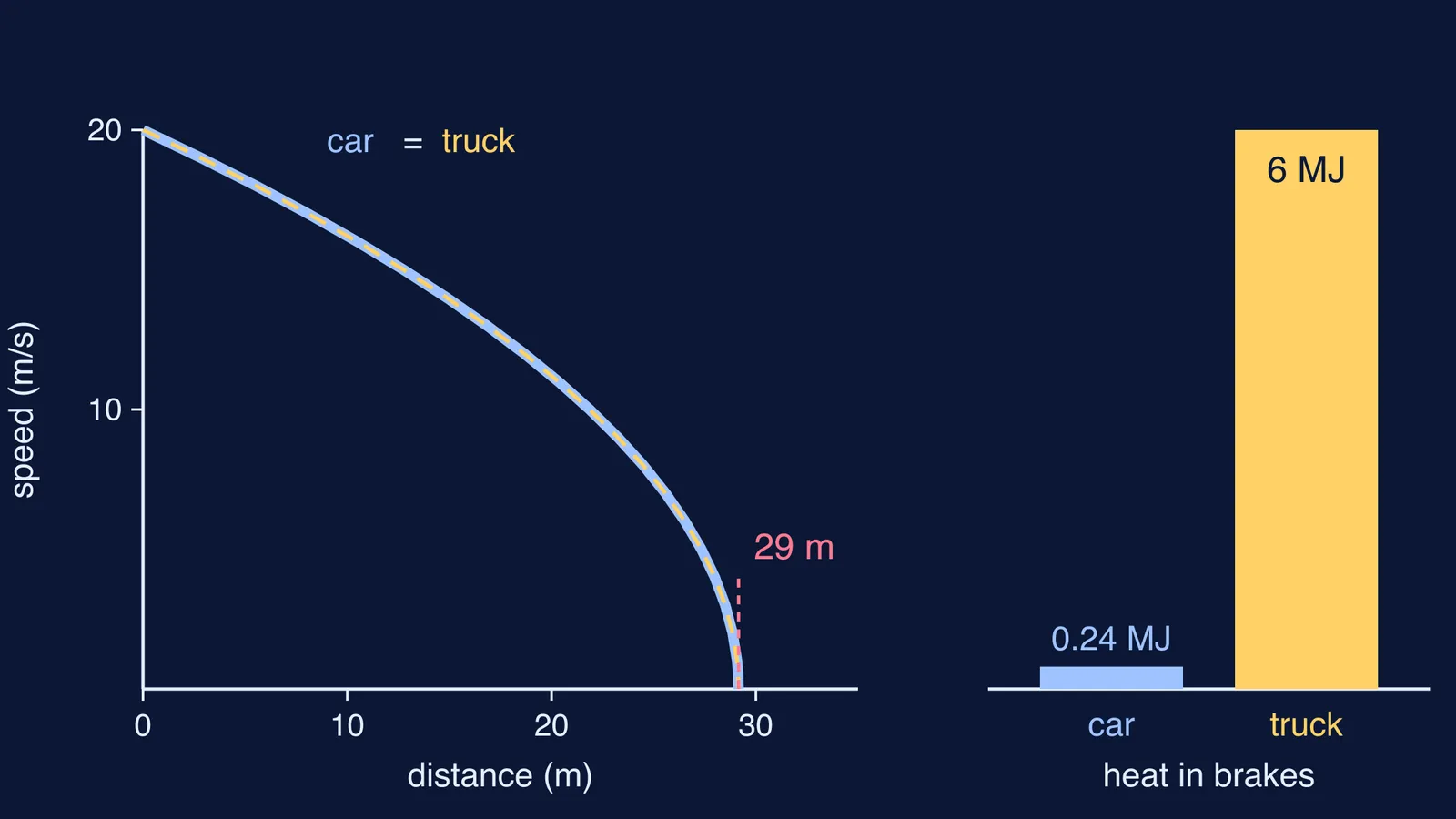
Take a 1,200 kg car and a 30,000 kg loaded truck, both at 72 km/h (20 m/s); the masses are illustrative. For the road, use μ = 0.7, the kinetic (skidding) friction coefficient OpenStax lists for rubber on dry concrete, and g = 9.8 m/s².
Deceleration: a = 0.7 × 9.8 = 6.86 m/s² for both vehicles.
Stopping distance: d = 20² / (2 × 6.86) = 400 / 13.72 ≈ 29 m for both.
Friction force needed: car 0.7 × 1,200 × 9.8 ≈ 8,200 N; truck 0.7 × 30,000 × 9.8 ≈ 206,000 N.
Kinetic energy to remove: car ½ × 1,200 × 20² = 240,000 J; truck ½ × 30,000 × 20² = 6,000,000 J.
Same distance; 25 times the force and energy. Reaction distance ignores mass too: a one-second reaction at 20 m/s costs both vehicles 20 m.
How much hotter do a truck's brakes get?
Braking turns kinetic energy into heat in the discs or drums. Cast iron has a specific heat of about 460 J per kg per kelvin (Engineering ToolBox). The temperature rise is ΔT = E / (m_brake × c).
Assume, just for the sum, that the car has 30 kg of iron in its brakes and the truck has 300 kg. In one stop, ignoring cooling, the car's brakes warm by 240,000 / (30 × 460) ≈ 17 °C. The truck's brakes warm by 6,000,000 / (300 × 460) ≈ 43 °C. The truck puts 25 times the energy into 10 times the metal, so its brakes heat 2.5 times as much, and repeated stops or long descents add up.
Hot brakes grip less. In a Great Dane article on brake fade, a Hendrickson braking engineer explains that a superheated drum expands, so the brake can no longer make adequate contact and the truck may fail to slow or stop.
So does a heavier vehicle take longer to stop in real life?
Often, yes, but because real trucks have different tyres and brakes and far more heat to shed, not because mass appears in d = v²/2μg. The US brake standard for passenger cars and light vehicles requires a stop from 100 km/h within 70 m in its cold-brake test (FMVSS 135, 49 CFR 571.135). It also heats the brakes with 15 brake applications ("snubs") before a hot-brake test.
For heavy trucks, a 2009 US rule cut the limit for most loaded truck tractors from 355 feet to 250 feet (about 108 m to 76 m) when stopping from 60 mph, and set 310 feet for a small number of very heavy tractors (NHTSA final rule, Federal Register). NHTSA expected makers to meet this 30 percent cut with improved brakes, such as larger drum brakes or disc brakes that resist fade; truck mass did not change.
Which equation should you use in an exam?
Check what the question says sets the limit:
"Wheels lock", "maximum friction" or "coefficient μ between tyres and road": use a = μg. Mass cancels, d = v²/2μg.
"A constant braking force F": use a = F/m, so d = mv²/2F. Now mass matters. If a 150,000 N braking force acts on the 30,000 kg truck, a = 5 m/s² and d = 400/10 = 40 m, not 29 m.
"Heat produced" or "work done by the brakes": use ½mv², which grows in proportion to mass.
Mixing up the first two is a common mistake. The Fermi Problem Library has worked problems with a step-by-step solver that explains the reasoning, so you can see where the force came from before you divide by m. To work backwards from a skid, see how to find the coefficient of friction from stopping distance.
Try this next: rework the example with μ = 0.4 (OpenStax lists 0.3 to 0.5 for rubber on wet concrete) and check that the car and truck still stop together.