

On this page
Does a heavier block slide down faster on a frictionless slope?
When releasing two blocks of different masses from the top of a smooth ramp, intuition suggests the heavier block will reach the bottom first. Earth exerts ten times more gravitational pull on a 10 kg block than on a 1 kg block. Yet on a frictionless incline, both cross the finish line together.
For a block of mass m on a slope tilted at angle θ, gravity acts downward with magnitude m × g, where g ≈ 9.8 m/s². As detailed in OpenStax University Physics, resolving gravity parallel to the incline gives driving force F_parallel = m g sin θ. By Newton's second law:
a = F_net / m = (m g sin θ) / m = g sin θ
Because mass m appears in numerator and denominator, it cancels completely. As shown in Galileo's inclined plane experiments, slowing motion on a ramp demonstrates that all objects accelerate identically under gravity regardless of weight.
Does friction make the heavier block slide slower or faster?
Many students accept that frictionless slopes cancel mass, but assume surface roughness breaks the tie. A heavier block presses harder against the ramp, creating greater friction. Does that extra drag slow it down?
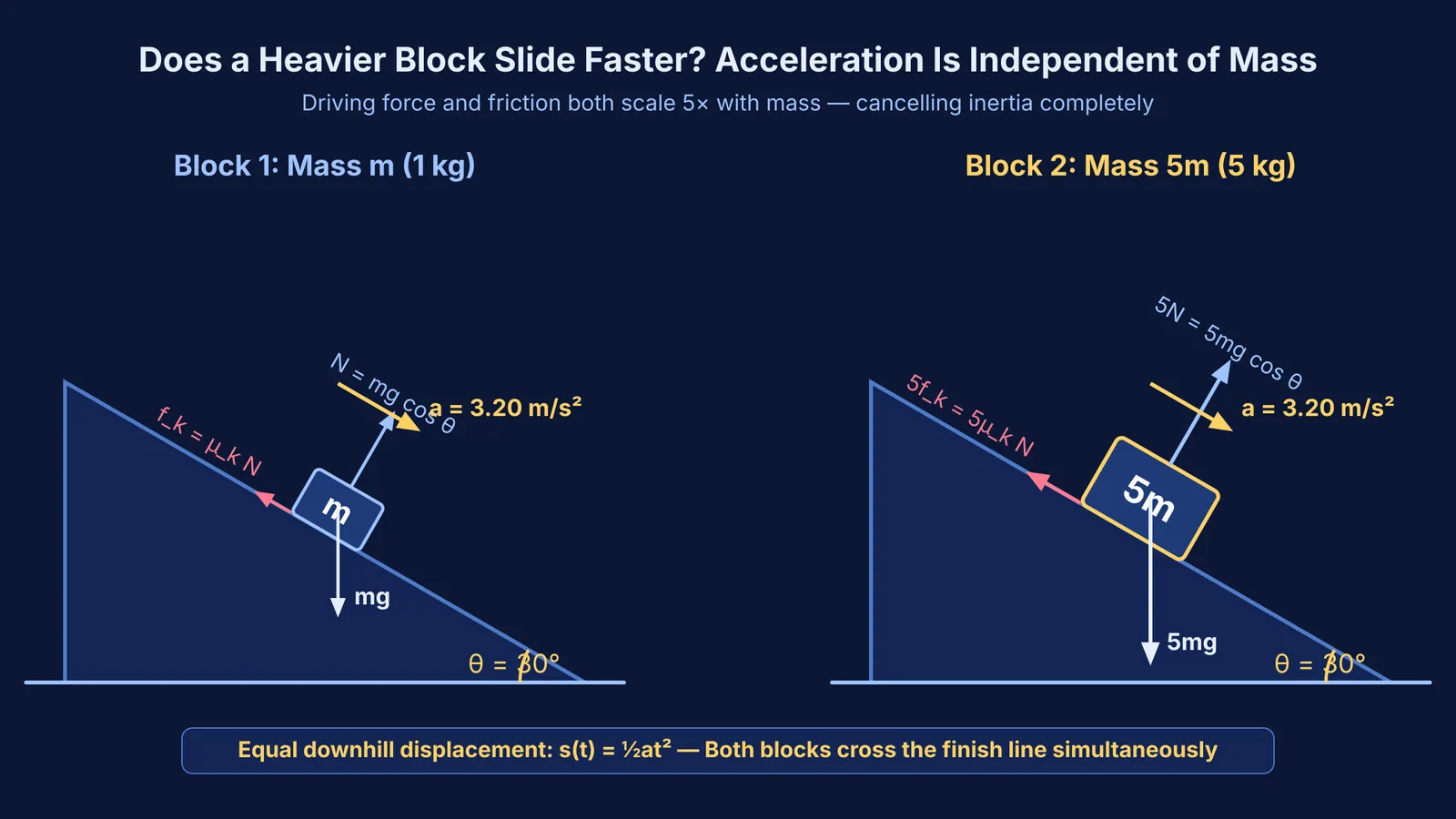
Under Coulomb's friction model in OpenStax University Physics, kinetic friction is f_k = μ_k N. On an incline, balancing perpendicular forces gives normal force N = m g cos θ, so friction is f_k = μ_k m g cos θ. Net downhill force is:
F_net = m g sin θ − μ_k m g cos θ = m g (sin θ − μ_k cos θ)
Newton's second law gives downhill acceleration:
a = F_net / m = g (sin θ − μ_k cos θ)
Mass cancels out of friction just as it does from gravity. A 10 kg block experiences ten times more friction, but possesses ten times more downhill pull and ten times the inertia. As shown in our guide on the time for a block to slide down a rough incline, both blocks accelerate identically.
How do different masses compare in a worked race?
Using incline mechanics from OpenStax University Physics, compare a 1 kg block and a 10 kg block on a 5.0-metre ramp inclined at θ = 30°, with friction coefficient μ_k = 0.20 and g = 9.8 m/s²:
For the 1 kg block: Downhill gravity is 1 kg × 9.8 m/s² × sin 30° = 4.90 N. Friction is f_k = 0.20 × 8.49 N = 1.70 N. Net force is 4.90 N − 1.70 N = 3.20 N, yielding acceleration a = 3.20 N / 1 kg = 3.20 m/s².
For the 10 kg block: Downhill gravity is 10 kg × 9.8 m/s² × sin 30° = 49.0 N. Friction is f_k = 0.20 × 84.87 N = 16.97 N. Net force is 49.0 N − 16.97 N = 32.03 N, yielding acceleration a = 32.03 N / 10 kg = 3.20 m/s².
Slide time: With L = (1/2) a t², slide duration is t = √(2L / a) = √(10.0 m / 3.20 m/s²) = 1.77 seconds for both blocks.
Ten times the force driving ten times the inertia yields identical acceleration.
Why does everyday intuition insist the heavier block wins?
In a 1992 study in *The Physics Teacher* (Hestenes et al., 1992), David Hestenes, Malcolm Wells, and Gregg Swackhamer cataloged student mechanics misconceptions, identifying misconception G3: that heavier objects fall or accelerate faster. As noted in our analysis of the Force Concept Inventory, students intuitively conflate greater gravitational force with greater acceleration.
Everyday experience reinforces this mistake. An adult slides faster than a child on a playground slide because air resistance and clothing friction become noticeable. Air drag scales with frontal area, while mass scales with volume. A heavier body has a higher mass-to-area ratio, so drag removes a smaller share of its momentum. On laboratory ramps at normal speeds, air drag is negligible and Coulomb friction dominates.
How can active prediction fix physics misconceptions?
Passively watching a demonstration rarely corrects intuitive beliefs. In the *American Journal of Physics* (Crouch et al., 2004), Catherine Crouch, Adam Fagen, J. Paul Callan, and Eric Mazur showed that students passively observing demonstrations explained concepts no better than those seeing none (24% vs 22% correct explanations). Requiring students to predict outcomes beforehand raised performance to 77% for outcomes and 30% for explanations (and 82% and 32% with peer discussion).
In *Science*, Carl Wieman, Wendy Adams, and Katherine Perkins (Wieman et al., 2008) confirmed that interactive simulations help students isolate variables and test conceptual models.
The Fermi Simulation Lab provides interactive simulations for ideas that are easier to see than to read. When solving mechanics problems where forces interact, the Fermi Problem Library offers worked problems with a step-by-step solver that explains the reasoning rather than printing an answer.
To apply this active approach when studying:
Predict: Write down your predicted winner and physical reasoning before solving or simulating.
Observe: Run the simulation or experiment while holding other variables constant.
Reconcile: If the outcome contradicts your expectation, write out the free-body equations to pinpoint where intuition broke down.


