On this page
Every order here comes from NCERT Class 11 Biology, Chapter 15 (Reprint 2026-27). The chapter sits in Unit 5, Human Physiology, of the NMC's NEET (UG) 2026 syllabus. The questions are our own, not past-paper items or predictions.
Which sequences in Body Fluids and Circulation should you know?
Impulse conduction (15.3.1): SAN, AVN, AV bundle, right and left bundles, Purkinje fibres.
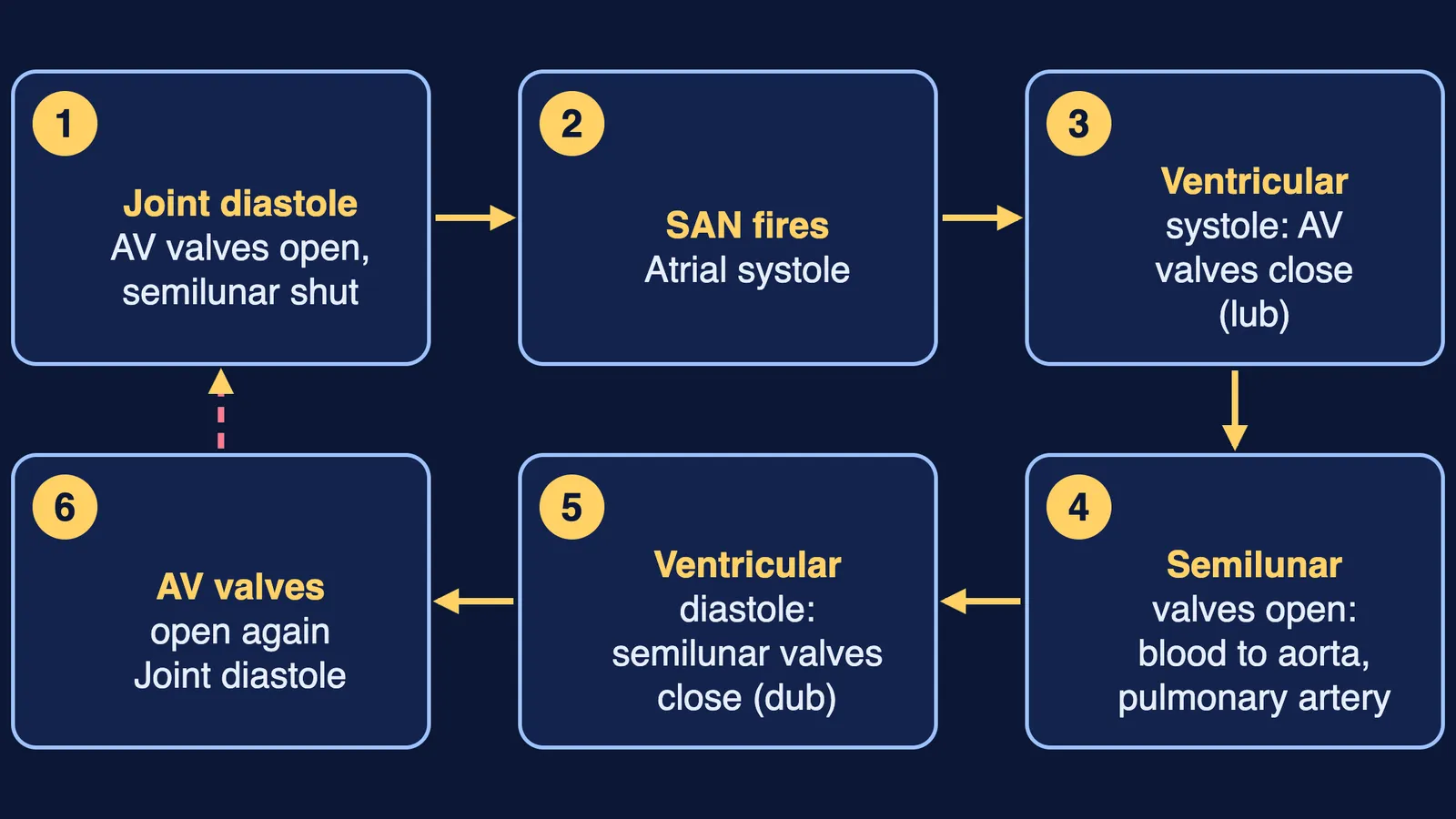
Cardiac cycle (15.3.2): joint diastole; SAN fires, atria contract; ventricular systole shuts the AV valves (lub); semilunar valves open; ventricular diastole shuts them (dub); AV valves open; joint diastole again.
ECG (15.3.3): P-wave (atria depolarise, then contract); QRS complex (ventricles depolarise, contraction starting shortly after Q); T-wave (ventricles repolarise; its end closes systole).
Clotting (15.1.4): injury; platelets and injured tissue release factors; a cascade forms thrombokinase; prothrombin becomes thrombin; thrombin turns fibrinogen into fibrin threads.
Tissue fluid and lymph (15.2): in tissue capillaries, water and small solutes move out as interstitial fluid (the cells' exchange medium); lymphatics collect it as lymph; lymph drains into major veins.
Pulmonary circulation (15.4): right ventricle, pulmonary artery, lungs, pulmonary veins, left atrium.
Systemic circulation (15.4): left ventricle, aorta, arteries, arterioles, capillaries in tissues, venules, veins, vena cava, right atrium.
Rh mismatch in pregnancy (15.1.3.2): the placenta separates the bloods in a first pregnancy; Rh-positive foetal blood may reach the Rh-negative mother at delivery; she makes anti-Rh antibodies; in a later pregnancy these may destroy an Rh-positive foetus's RBCs.
Study summary, not medical advice: item 8 and Q8 follow NCERT's account of Rh incompatibility. For health questions, ask a doctor.
How do you attack arrange-in-order questions?
Arrange in the correct order: 8 practice questions
Q1. Arrange the path of the impulse: A. AV bundle; B. SAN; C. Purkinje fibres; D. AVN; E. Right and left bundles. (1) B, A, D, E, C (2) B, D, A, E, C (3) D, B, A, E, C (4) B, D, E, A, C
Answer: (2). The AV bundle leaves the AVN and splits; the branches give rise to Purkinje fibres.
Q2. Starting from joint diastole, arrange: A. Semilunar valves forced open; B. Atrial systole; C. Tricuspid and bicuspid valves close; D. Ventricular systole begins; E. SAN generates an action potential. (1) E, B, C, D, A (2) B, E, D, C, A (3) E, B, D, C, A (4) E, D, B, C, A
Answer: (3). AV valves shut first; only a further pressure rise opens the semilunar valves.
Q3. Arrange the second half of the cycle: A. Semilunar valves forced open; B. Ventricles relax and their pressure falls; C. Semilunar valves close; D. Tricuspid and bicuspid valves pushed open. (1) A, B, C, D (2) A, C, B, D (3) B, A, C, D (4) A, B, D, C
Answer: (1). Falling ventricular pressure shuts the semilunar valves; a further fall lets atrial blood open the AV valves.
Q4. Arrange these standard-ECG points and events: A. Q of the QRS complex; B. End of the T-wave; C. P-wave; D. Ventricular contraction begins. (1) C, A, D, B (2) A, C, D, B (3) C, A, B, D (4) C, B, A, D
Answer: (1). Atrial excitation (P) comes first; contraction starts shortly after Q; the T-wave's end closes systole.
Q5. From the left ventricle, arrange: A. Venules; B. Arterioles; C. Aorta; D. Vena cava; E. Capillaries. (1) C, E, B, A, D (2) C, B, E, A, D (3) C, B, E, D, A (4) B, C, E, A, D
Answer: (2). Arterioles feed capillaries; venules collect from them.
Q6. From the vena cava, arrange: A. Right ventricle; B. Pulmonary artery; C. Right atrium; D. Lungs; E. Pulmonary veins. (1) A, C, B, D, E (2) C, A, D, B, E (3) C, A, B, D, E (4) C, B, A, D, E
Answer: (3). The vena cava empties into the right atrium, then the right ventricle pumps into the pulmonary artery.
Q7. Arrange: A. Lymphatic vessels collect the fluid; B. Water and small solutes move out into the spaces between cells; C. Lymph drains into major veins; D. Blood passes through capillaries in the tissues. (1) D, B, A, C (2) B, D, A, C (3) D, A, B, C (4) D, B, C, A
Answer: (1). Fluid leaves blood in tissue capillaries; the lymphatic system collects it and returns it to the veins.
Q8. Rh-negative mother, Rh-positive foetuses. Arrange: A. Mother makes anti-Rh antibodies; B. Foetal blood reaches her during the first delivery; C. In a later pregnancy, her antibodies leak into the foetus; D. Foetal RBCs are destroyed. (1) B, A, C, D (2) A, B, C, D (3) B, C, A, D (4) B, A, D, C
Answer: (1). Exposure at delivery comes first; the result is erythroblastosis foetalis.
Before-after, out-of-place and two-statement items
Q9. In the cardiac cycle, which event comes immediately before the semilunar valves are forced open? (1) Atrial systole (2) Closure of the tricuspid and bicuspid valves (3) Ventricular diastole (4) Joint diastole
Answer: (2). Rising ventricular pressure shuts the AV valves, then opens the semilunar ones.
Q10. A student writes: injury; fibrinogen becomes fibrin; platelets release factors; thrombokinase forms; prothrombin becomes thrombin. Which step is out of place? (1) Platelets release factors (2) Thrombokinase forms (3) Fibrinogen becomes fibrin (4) Prothrombin becomes thrombin
Answer: (3). Thrombin makes fibrin, so fibrin comes last.
Options for Q11 and Q12: (1) both correct (2) both incorrect (3) only I correct (4) only II correct.
Q11. Statement I: The atria relax while the ventricles contract. Statement II: Blood enters the ventricles only after atrial systole begins.
Answer: (3). Atrial diastole coincides with ventricular systole; blood already flows through the open AV valves during joint diastole.
Q12. Statement I: Thrombokinase forms before prothrombin is converted into thrombin. Statement II: The SAN generates an action potential before both atria contract.
Answer: (1). NCERT says thrombokinase is needed for that conversion; the SAN impulse triggers atrial systole.
How should you practise with this set?
Mark all 12 with answers covered; for each miss, note the flipped pair and redraw that sequence next day. For other formats, try the statement and match-the-list set, the diagram-based circulation questions and the NCERT exceptions and odd-one-out set.
Which sequence keeps tripping you? Fermi's AI tutor works out what you already know and builds a plan for the session.