On this page
In the early 1920s most chemists believed a carbon ring with more than eight atoms could hardly exist. Leopold Ružička then showed that civetone, the musk compound from the civet, is a ring of seventeen carbon atoms. He did it with reactions you meet in Class 11 and 12: oxidative cleavage of a C=C, hydrogenation and Wolff–Kishner reduction. This post follows his reasoning from his own Nobel lecture, and turns it into a method for reading ring size from cleavage products.
Who was Leopold Ružička?
His Nobel biography records that he was born on 13 September 1887 in Vukovar, Croatia. He began chemistry at Karlsruhe in 1906 and did his doctorate with Hermann Staudinger, whom he followed to the ETH in Zürich in 1912. In 1921 the Geneva perfume makers Chuit, Naef & Firmenich asked him to work with them, and the musks civetone and muscone became, in the biography's words, "by far the most important fruits collected in the perfumery garden". He was professor at Utrecht from 1926 to 1929, then returned to the ETH. He died on 26 September 1976.
He shared the 1939 Nobel Prize in Chemistry with Adolf Butenandt, "for his work on polymethylenes and higher terpenes". War postponed his lecture, "Multimembered rings, higher terpene compounds and male sex hormones", until 12 December 1945. The quotes below are from that lecture.
Why did chemists think large rings could not exist?
Baeyer's strain theory assumed every ring is flat, so the bond angles of a large ring would be pushed far from 109.5° (the angle arithmetic is in Adolf von Baeyer and the strain in small rings). Ružička recalls that Baeyer, Emil Fischer and Viktor Meyer had told W. H. Perkin Jr. that rings other than 5- and 6-membered ones could "hardly be capable of existence". Perkin made 3- to 5-membered rings anyway. Rings of 7 and 8 followed, but attempts at a 9-membered ring failed, so the belief that larger rings were impossible stayed.
Ružička admits he shared it. In the civetone work he "was hindered less by the caprices of the substance itself than by the general prejudice, shared by myself, against the probability of the existence of a 15- and a 17-membered ring". A footnote says his proposed formula "did not progress in one step from the 6-membered to the 17-membered ring".
What did oxidising civetone show?
The lecture gives civetone as C₁₇H₃₀O and muscone as C₁₆H₃₀O.
Harsh oxidation. A large amount of KMnO₄, or ozone followed by hypobromite, gave a mixture of straight-chain dicarboxylic acids: azelaic (C₉), suberic (C₈), pimelic (C₇), adipic (C₆) and succinic (C₄). Long unbranched CH₂ chains were present, but harsh oxidation chews chains down, so the mixture alone could not fix the structure. His first guess had a 6-membered ring.
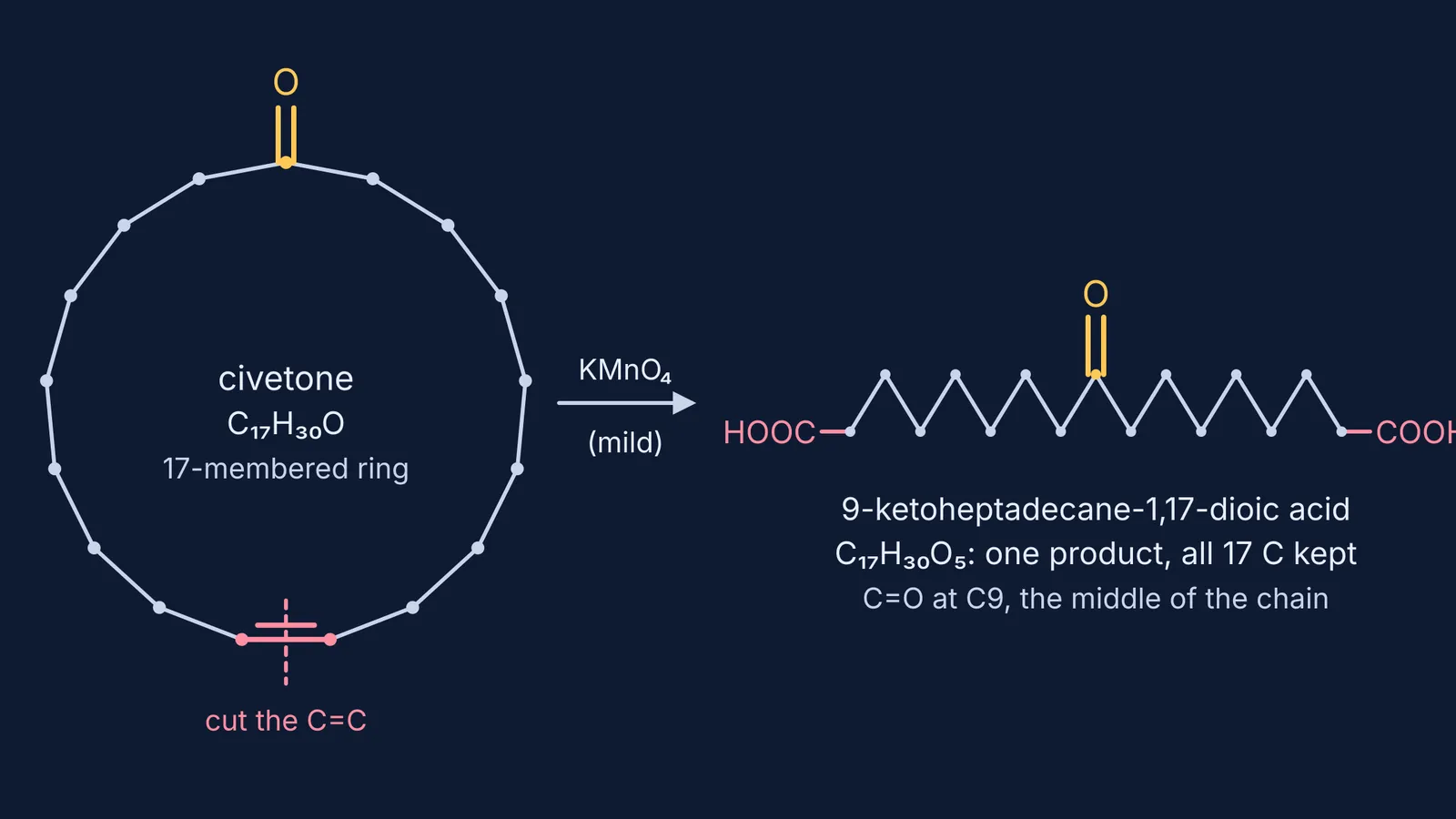
Mild oxidation. A small amount of KMnO₄ or ozone gave a keto dicarboxylic acid, written in the lecture as "C₁₆H₂₈O₅ or C₁₇H₃₀O₅". The two candidate formulas differ by one CH₂.
Hydrogenation and Wolff–Kishner. Hydrogenating the C=C gave dihydrocivetone. Wolff–Kishner reduction of the C=O gave an unsaturated hydrocarbon. Oxidised, "both ... give the same dicarboxylic acid C₁₇H₃₂O₄". It proved to be heptadecane-1,17-dioic acid, HOOC(CH₂)₁₅COOH, matched against a synthetic sample.
That third result is what forced him to the "completely symmetrical" formula: a 17-membered ring with C=O and C=C on opposite sides. PubChem names civetone (9Z)-cycloheptadec-9-en-1-one. The keto acid was 9-ketoheptadecane-1,17-dioic acid, made independently by heating a monoester of azelaic acid with iron. For good measure, he made dihydrocivetone by closing the ring of octadecane-1,18-dioic acid.
Worked example: reading the ring from formulas
Use the degree of unsaturation, DU = (2C + 2 − H) ÷ 2, ignoring oxygen. Each ring, C=C or C=O counts 1.
Civetone, C₁₇H₃₀O. (36 − 30) ÷ 2 = 3. Three units to place.
Hydrogenation: C₁₇H₃₀O + H₂ → C₁₇H₃₂O. DU = 2. One C=C used up, so civetone has exactly one C=C.
Wolff–Kishner: C₁₇H₃₀O + N₂H₄ → C₁₇H₃₂ + N₂ + H₂O. DU = 2. The C=O became CH₂ and the C=C survived, so there is one C=O. Atoms balance: C 17, H 34, O 1, N 2 on each side.
What is left? 3 − 1 (C=C) − 1 (C=O) = 1. The last unit must be a ring.
Mild cleavage: C₁₇H₃₀O + 4[O] → C₁₇H₃₀O₅. Each =CH− becomes −COOH. DU stays 3: the ring and the C=C are lost, two new COOH appear, and the C=O stays.
The key test. Cutting a C=C in an open chain gives two molecules whose carbons add up to the total. Here all 17 carbons stay in one molecule, so the C=C must be in the ring, and a ring that opens into one 17-carbon chain had 17 members.
Where is the C=O? The keto acid has its C=O at C9 of 17, the middle. So the C=O sits opposite the C=C in the ring.
Cross-check with the diacids. Cleaving the keto acid next to its C=O gives C₁₇H₃₀O₅ + 3[O] → C₉H₁₆O₄ + C₈H₁₄O₄, which are azelaic and suberic acid. Both appear in his list.
Muscone, C₁₆H₃₀O, has DU = 2: one ring and one C=O, no C=C. Because muscone is optically active, Ružička argued it could hold at most a 15-membered ring with a methyl side chain. PubChem gives (3R)-3-methylcyclopentadecan-1-one.
Wolff–Kishner itself is compared with Clemmensen in Clemmensen vs Wolff–Kishner. Its basic conditions leave the C=C untouched, which is what Ružička needed.
If you want more structure-from-products problems like this, the Fermi Problem Library has a step-by-step solver that explains the reasoning at each stage.
How were other large rings made, and are they strained?
The lecture describes a modified version of the old method of heating salts of dicarboxylic acids to give cyclic ketones, with thorium or cerium salts in place of calcium. It produced every cyclic ketone from the 9-membered ring to beyond the 30-membered ring. The yield fell from about 70% for the 6-membered ring to about 0.1% for the 10-membered ring. It then rose again to a maximum of about 5% for the 16-membered ring.
Low yield did not mean strain. The large rings survived heating to 400°. Their heats of combustion per CH₂ did not rise beyond the 6-membered ring. For the 30-membered ring the value was "about 156 kcal", about 653 kJ, the figure for an open-chain CH₂. Large rings are puckered, not flat, so their bond angles stay near tetrahedral. Ružička notes that the low yields are not due to any instability. The usual explanation is that the two ends of a long chain rarely meet.
What should you remember?
Civetone is C₁₇H₃₀O with DU = 3: one ring, one C=C, one C=O.
Hydrogenation and Wolff–Kishner each remove one unit and give the same C₁₇ diacid on oxidation.
One cleavage product with all the carbons means the C=C is in a ring; the chain length gives the ring size.
Baeyer's flat-ring assumption fails for large rings; they are puckered and nearly strain-free.
For JEE practice that mixes reductions and ozonolysis, Fermi's AI tutor for JEE prep can work out where your reasoning stops and build a plan from there.