On this page
The NMC's NEET (UG) 2026 syllabus places respiration in Unit 4, Plant Physiology. We took each order from the Respiration in Plants chapter of the NCERT Class 11 Biology book, 2026-27 reprint, and give the section or figure. All 13 questions are original.
Which sequences in Respiration in Plants does NCERT give in order?
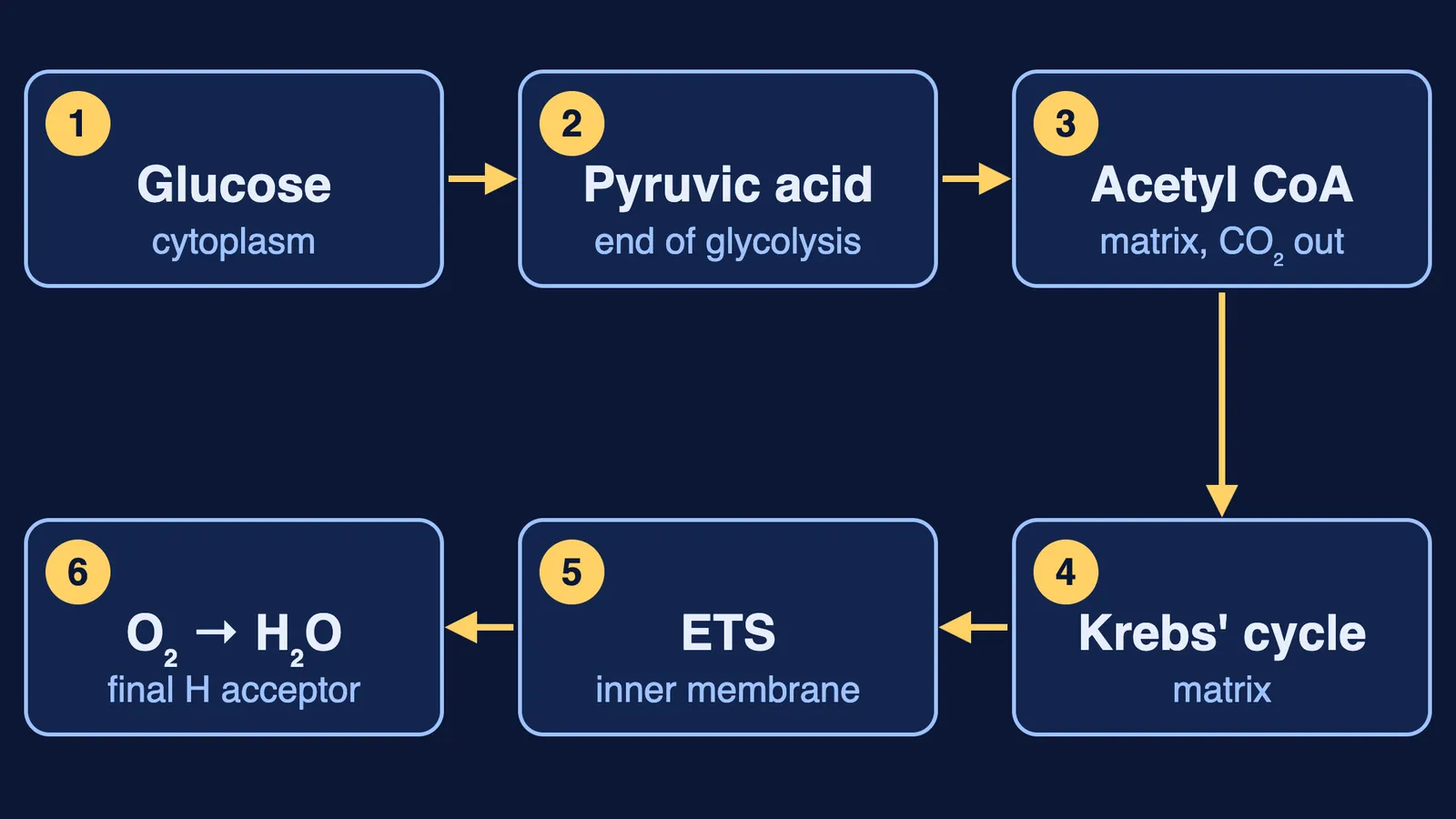
Glycolysis (12.2, Figure 12.1): glucose → glucose-6-phosphate → fructose-6-phosphate → fructose 1,6-bisphosphate → DHAP and PGAL → BPGA → 3-phosphoglyceric acid (PGA) → 2-phosphoglycerate → phosphoenolpyruvate (PEP) → pyruvic acid.
Energy events in glycolysis (12.2): ATP spent on glucose; ATP spent on fructose-6-phosphate; NADH + H⁺ made as PGAL becomes BPGA; ATP made as BPGA becomes PGA; ATP made as PEP becomes pyruvic acid.
Anaerobic route (12.3, Figure 12.2): glucose → glyceraldehyde 3-phosphate → 3-phosphoglyceric acid → phosphoenol pyruvic acid → pyruvic acid → ethanol + CO₂ (yeast) or lactic acid.
Pyruvate to the TCA cycle (12.4): pyruvate made in the cytosol → moved into the mitochondrial matrix → oxidative decarboxylation by pyruvic dehydrogenase → acetyl CoA → TCA cycle.
TCA cycle (12.4.1 text with Figure 12.3): acetyl CoA + OAA + water → citric acid → isocitrate → α-ketoglutaric acid → succinyl-CoA → succinic acid (GTP made) → malic acid → OAA.
Electron transport (12.4.2): NADH → complex I → ubiquinone (FADH₂ feeds in here via complex II) → complex III → cytochrome c → complex IV → O₂, which becomes water.
ATP synthesis (12.4.2): electrons flow through complexes I to IV → redox energy builds a proton gradient → protons pass through F0 into the matrix → F1 makes ATP.
Other substrates (12.6): fats → glycerol and fatty acids; fatty acids → acetyl CoA → pathway; glycerol → PGAL. Proteins → amino acids (proteases) → deamination → entry within the Krebs' cycle, at pyruvate or at acetyl CoA.
How do you attack arrange-in-order questions?
Pin the ends first: decide which labelled step opens the chain and which closes it, and strike options that disagree. Usually two survive; find the adjacent pair where they differ and ask which step NCERT puts first.
Can you put these respiration steps in order?
Q1. Glycolytic order: A. Fructose 1,6-bisphosphate B. Glucose-6-phosphate C. 3-phosphoglyceric acid D. Fructose-6-phosphate E. 1,3-bisphosphoglycerate (BPGA) (1) B-D-A-E-C (2) D-B-A-E-C (3) B-D-E-A-C (4) B-D-A-C-E
Answer: (1). Isomerisation comes before the second phosphorylation; BPGA precedes PGA (Figure 12.1).
Q2. Glycolysis events in order: A. NAD⁺ reduced to NADH + H⁺ B. ATP spent on fructose-6-phosphate C. ATP made as PEP becomes pyruvic acid D. ATP spent on glucose E. ATP made as BPGA becomes PGA (1) D-B-E-A-C (2) B-D-A-E-C (3) D-B-A-C-E (4) D-B-A-E-C
Answer: (4). Both ATP-spending steps come first; NADH forms before either ATP-making step (12.2).
Q3. The anaerobic route of Figure 12.2: A. Pyruvic acid B. 3-phosphoglyceric acid C. Ethanol + CO₂ D. Glyceraldehyde 3-phosphate E. Phosphoenol pyruvic acid (1) D-E-B-A-C (2) D-B-E-A-C (3) B-D-E-A-C (4) D-B-A-E-C
Answer: (2). PEP comes just before pyruvic acid, which yeast turns into ethanol and CO₂ (12.3).
Q4. From glucose to the TCA cycle: A. Acetyl CoA enters the TCA cycle B. Pyruvate moves from cytoplasm into mitochondria C. Glycolysis forms pyruvate in the cytoplasm D. Pyruvic dehydrogenase decarboxylates pyruvate in the matrix (1) C-D-B-A (2) C-B-D-A (3) B-C-D-A (4) C-B-A-D
Answer: (2). Pyruvate must reach the matrix before pyruvic dehydrogenase acts on it (12.4).
Q5. TCA intermediates in order: A. Isocitrate B. Succinic acid C. Citric acid D. Succinyl-CoA E. α-ketoglutaric acid (1) C-E-A-D-B (2) C-A-E-B-D (3) C-A-E-D-B (4) A-C-E-D-B
Answer: (3). Isomerisation, two decarboxylations, then GTP as succinyl-CoA becomes succinic acid (12.4.1).
Q6. Carriers an electron from matrix NADH passes through: A. Cytochrome c B. Complex I C. Complex IV D. Ubiquinone E. Complex III (1) B-D-E-A-C (2) B-E-D-A-C (3) B-D-A-E-C (4) D-B-E-A-C
Answer: (1). Cytochrome c is the mobile link between complexes III and IV (12.4.2).
Q7. Oxidative phosphorylation in order: A. ATP forms at the F1 site B. Electrons pass along complexes I to IV C. Protons cross F0 into the matrix D. Redox energy sets up a proton gradient (1) D-B-C-A (2) B-D-A-C (3) B-C-D-A (4) B-D-C-A
Answer: (4). Proton passage through F0 drives the F1 catalytic site (12.4.2).
Q8. From stored fat to isocitrate: A. Acetyl CoA condenses with OAA B. Fat splits into glycerol and fatty acids C. Fatty acids are degraded to acetyl CoA D. Citrate is isomerised (1) C-B-A-D (2) B-C-A-D (3) B-A-C-D (4) B-C-D-A
Answer: (2). Fatty acids enter as acetyl CoA, which first forms citric acid (12.4.1, 12.6).
Which steps come before or after, or sit out of place?
Q9. In Figure 12.1, which compound forms immediately after 3-phosphoglyceric acid? (1) Phosphoenolpyruvate (2) 2-phosphoglycerate (3) 1,3-bisphosphoglycerate (4) Pyruvic acid
Answer: (2). PGA becomes 2-phosphoglycerate; water then leaves to give PEP (Figure 12.1).
Q10. Which step comes immediately after proteases release amino acids? (1) Entry into the Krebs' cycle (2) Deamination (3) Entry as pyruvate (4) Entry as acetyl CoA
Answer: (2). Amino acids enter the pathway only after deamination (12.6).
Q11. A student's order: A. Invertase splits sucrose B. Hexokinase makes glucose-6-phosphate C. Fructose 1,6-bisphosphate forms D. Fructose-6-phosphate forms E. Fructose 1,6-bisphosphate splits into DHAP and PGAL. Which swap corrects it? (1) A and B (2) C and D (3) D and E (4) B and C
Answer: (2). Glucose-6-phosphate isomerises to fructose-6-phosphate before the second ATP is spent (12.2).
Codes for Q12 and Q13: (1) I and II both true (2) I and II both false (3) Only I is true (4) Only II is true.
Q12. I: The balance-sheet count assumes glycolysis, the TCA cycle and the ETS run one after another. II: NCERT says living cells really do run them one after another.
Answer: (3). NCERT says all pathways actually work simultaneously (12.5).
Q13. I: CoA is released only after citrate becomes isocitrate. II: Fructose 1,6-bisphosphate splits before any glycolytic NADH + H⁺ forms.
Answer: (4). CoA leaves at the citrate synthase condensation (12.4.1); NADH forms later, at PGAL to BPGA (12.2).
What should you redo after this set?
Missed Q1 to Q3, Q9, Q11 or Q13: write glycolysis out with its ATP and NADH steps. Missed Q4, Q5 or Q8: redraw the TCA cycle. Missed Q6, Q7, Q10 or Q12: list complexes I to V; reread 12.5 and 12.6. Other formats: the respiration diagram-based questions, the statement and match-the-list set, or our chapter notes with the ATP count.
Which pathway should you drill first? Fermi's AI tutor works out what you already know and builds a plan for the session.