

On this page
Respiration in Plants sits in Biology Unit 4, Plant Physiology, of the NMC's NEET (UG)-2026 syllabus. These 12 original practice questions, not predictions, follow NCERT Class 11 Biology Chapter 12 (Reprint 2026-27). For the ATP count, see our Respiration in Plants Class 11 notes.
How do you attack Statement I and Statement II questions?
Judge each statement alone; one wrong word makes it false.
Options for Q1-Q5: (1) Both correct (2) Both incorrect (3) I correct, II incorrect (4) I incorrect, II correct
Q1. Statement I: For anaerobic organisms, glycolysis is the whole of respiration. Statement II: In eukaryotes, glycolysis runs in the mitochondrial matrix.
Answer: (3). Glycolysis is anaerobes' only respiratory process, but NCERT places it in the cytoplasm.
Q2. Statement I: Phosphofructokinase converts glucose to glucose-6-phosphate. Statement II: Fructose 1,6-bisphosphate splits into dihydroxyacetone phosphate and PGAL.
Answer: (4). NCERT names hexokinase for this step; Statement II is correct.
Q3. Statement I: Plant organs respire far more slowly than animals. Statement II: Loosely packed parenchyma forms a connected network of air spaces.
Answer: (1). Both are NCERT reasons plants need no respiratory organs.
Q4. Statement I: Acetyl CoA is where fatty acids enter respiration and is withdrawn to make fatty acids. Statement II: Oxidative phosphorylation is so named because light builds the proton gradient.
Answer: (3). That two-way use makes the pathway amphibolic; redox energy, not light, builds the gradient.
Q5. Statement I: NADH is reoxidised faster in fermentation than in aerobic respiration. Statement II: When fats are the respiratory substrate, the RQ is more than 1.
Answer: (2). NCERT says NADH oxidation is slow in fermentation, and gives fats an RQ below 1 (0.7 for tripalmitin).
How do you solve match-the-list questions on respiration?
Lock your surest pair and strike options without it.
Q6. Match enzyme and reaction.
List-I: A. Hexokinase; B. Pyruvic acid decarboxylase; C. Pyruvate dehydrogenase; D. Lactate dehydrogenase.
List-II: I. Pyruvic acid to lactic acid; II. Pyruvic acid to acetyl CoA in the matrix; III. Glucose to glucose-6-phosphate; IV. Works with alcohol dehydrogenase in yeast fermentation.
(1) A-III, B-I, C-II, D-IV (2) A-II, B-IV, C-III, D-I (3) A-III, B-IV, C-II, D-I (4) A-IV, B-III, C-I, D-II
Answer: (3). All four pairs are in NCERT sections 12.2-12.4.
Q7. Match complex and description.
List-I: A. Complex I; B. Complex II; C. Complex III; D. Complex V.
List-II: I. Cytochrome bc1 complex; II. Passes FADH2's reducing equivalents to ubiquinone; III. ATP synthase; IV. NADH dehydrogenase.
(1) A-IV, B-I, C-II, D-III (2) A-IV, B-II, C-I, D-III (3) A-II, B-IV, C-I, D-III (4) A-IV, B-II, C-III, D-I
Answer: (2). NCERT section 12.4.2 names each complex this way.
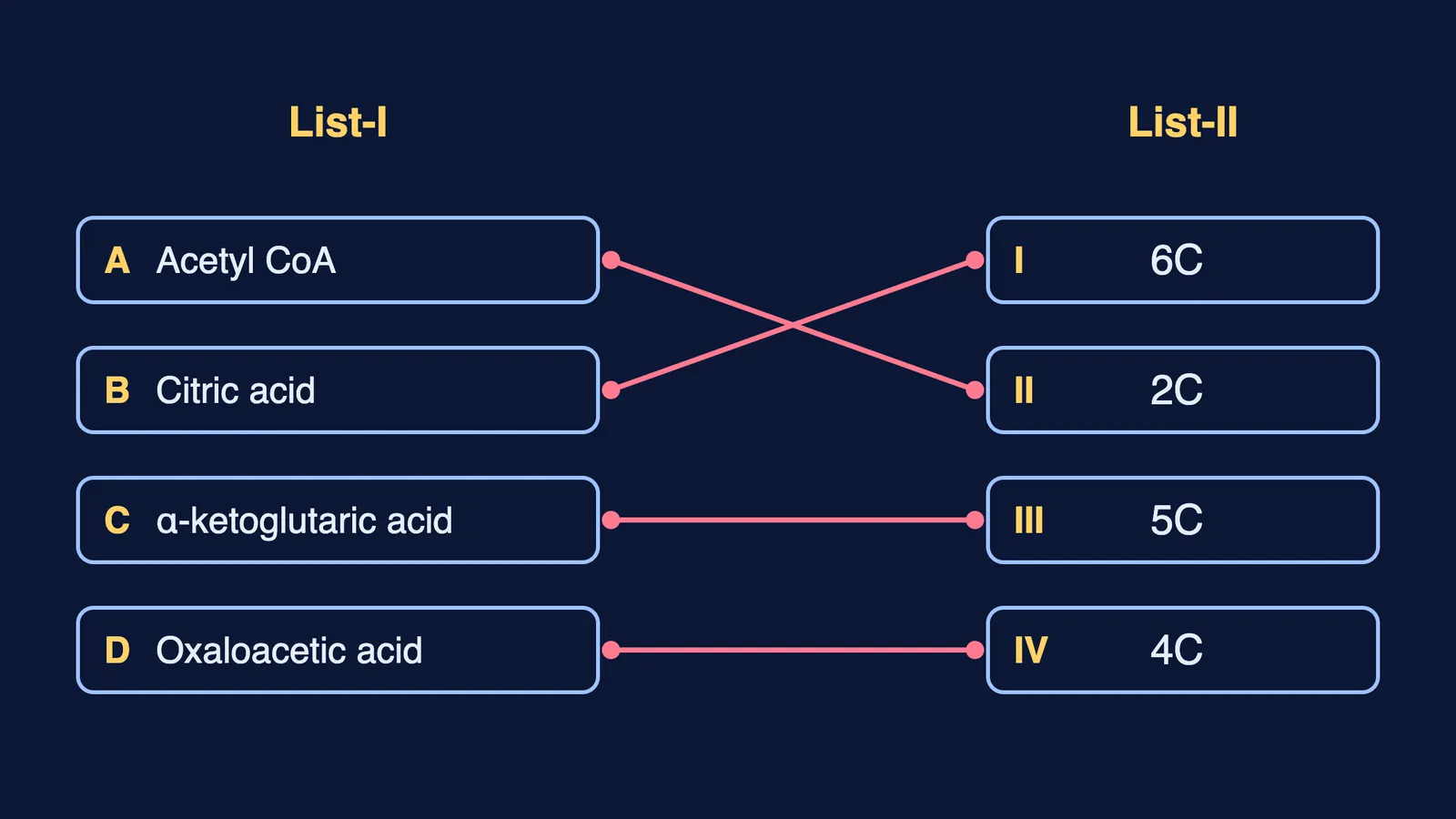
Q8. Match compound and carbon count.
List-I: A. Acetyl CoA; B. Citric acid; C. α-ketoglutaric acid; D. Oxaloacetic acid.
List-II: I. 6C; II. 2C; III. 5C; IV. 4C.
(1) A-IV, B-I, C-III, D-II (2) A-II, B-III, C-I, D-IV (3) A-I, B-II, C-III, D-IV (4) A-II, B-I, C-III, D-IV
Answer: (4). Per NCERT Figure 12.3, 2C plus 4C gives 6C citric acid; one decarboxylation leaves 5C.
Q9. Match item and NCERT number.
List-I: A. Reactions in glycolysis; B. NADH + H+ per glucose from pyruvate oxidation and the TCA cycle; C. NAD+ reduction points per TCA turn; D. Theoretical aerobic net ATP per glucose.
List-II: I. 3; II. 38; III. 10; IV. 8.
(1) A-III, B-IV, C-I, D-II (2) A-IV, B-III, C-I, D-II (3) A-III, B-I, C-IV, D-II (4) A-III, B-IV, C-II, D-I
Answer: (1). Ten reactions; 2 + 6 = 8 NADH; three NAD+ points per turn; 38 ATP.
Q10. Match process and where NCERT places it.
List-I: A. Alcoholic fermentation; B. Lactic acid formation in animals; C. Glycolysis as sole respiratory process; D. Electron transport system.
List-II: I. Inner mitochondrial membrane; II. Yeast; III. Anaerobic organisms; IV. Oxygen-short muscle cells.
(1) A-II, B-III, C-IV, D-I (2) A-IV, B-II, C-III, D-I (3) A-II, B-IV, C-III, D-I (4) A-II, B-IV, C-I, D-III
Answer: (3). Each pairing follows NCERT sections 12.2-12.4.
Which single-correct questions check ATP counting?
Circle NOT or net, then eliminate before calculating.
Q11. Which is NOT one of NCERT's assumptions behind the 38 ATP count?
(1) Glycolytic NADH is oxidised in mitochondria (2) No intermediate is used for synthesis (3) Only glucose is respired (4) Cells spend ATP whenever they need it
Answer: (4). NCERT gives this as real-cell behaviour, a reason the count is theoretical.
Q12. By NCERT's figures, how many H+ pass through F0 to make the ATP from oxidising one NADH?
(1) 3 (2) 4 (3) 8 (4) 12
Answer: (4). One NADH gives 3 ATP and each ATP needs 4 H+ through F0: 3 × 4 = 12. Option (3) is the FADH2 figure (2 × 4).
What should you revise after this set?
Missed Q1, Q2, Q6 or Q8: redraw NCERT Figures 12.1 and 12.3.
Missed Q4, Q7 or Q12: list complexes I to V with one role each.
Missed Q5, Q9 or Q11: redo the per-glucose count and RQ values.
For more practice, try our respiration in plants assertion-reason questions, or for mixed Unit 4 MCQs, our Plant Physiology NEET practice questions with solutions.
Not sure what to fix first? Fermi's AI tutor works out what you already know and builds a plan for the session.


