On this page
Respiration in Plants is Chapter 12 of the CBSE 2026-27 Class XI Biology syllabus, covering glycolysis, fermentation, the TCA cycle, the electron transport system, amphibolic pathways and respiratory quotient. Every statement below was checked against Chapter 12 of NCERT Class 11 Biology (Reprint 2026-27). This set is practice, not a prediction of any paper. For the theory first, read our Respiration in Plants Class 11 guide.
How do you answer assertion-reason questions on respiration?
Judge each statement alone. Only when both are true, read "A, because R", and ask whether NCERT gives R as the cause of A. Our assertion-reason question strategy has the full routine.
Assertion-reason keys:
(A) Both A and R are true and R is the correct explanation of A.
(B) Both A and R are true but R is NOT the correct explanation of A.
(C) A is true but R is false.
(D) A is false but R is true.
Statement I / Statement II keys:
(A) Both statements are correct.
(B) Both statements are incorrect.
(C) Statement I is correct, Statement II is incorrect.
(D) Statement I is incorrect, Statement II is correct.
Respiration in plants assertion-reason questions with answers
All facts and numbers here are from NCERT Class 11 Biology, Chapter 12.
Q1 (easy). Assertion (A): In plants, sucrose formed in photosynthesis can be fed into glycolysis. Reason (R): Invertase splits sucrose into glucose and fructose, and both of these sugars readily enter the glycolytic pathway.
Answer: (A). Both are true, and the invertase step is exactly how sucrose gets into glycolysis.
Trap: thinking only glucose itself can ever enter glycolysis.
Q2 (easy). Assertion (A): ATP is called the energy currency of the cell. Reason (R): The energy released when respiratory substrates are oxidised is used directly by the cell, without first being stored in another molecule.
Answer: (C). A is true. R is false: NCERT says this energy cannot be used directly; it is first used to make ATP, which is broken down wherever energy is needed.
Trap: skimming R and marking it true.
Q3 (medium). Assertion (A): In both alcoholic and lactic acid fermentation, NADH + H+ is reoxidised to NAD+. Reason (R): Fermentation releases less than seven per cent of the energy in glucose.
Answer: (B). Both are true. The small energy yield does not cause the reoxidation of NADH; R is a separate fact about the same process.
Trap: linking them because both are about fermentation.
Q4 (medium). Assertion (A): In aerobic respiration, oxygen takes part at every stage, from glycolysis to the electron transport system. Reason (R): Oxygen is the final hydrogen acceptor in respiration and is reduced to water.
Answer: (D). A is false: NCERT limits the role of oxygen to the terminal stage, and glycolysis runs without it. R is true.
Trap: reading "needs oxygen" as "every step uses oxygen".
Q5 (medium). Assertion (A): The respiratory pathway is better described as amphibolic than as purely catabolic. Reason (R): Compounds such as acetyl CoA, through which substrates like fatty acids enter the pathway, are also withdrawn from it to synthesise those substrates.
Answer: (A). Both are true, and R is NCERT's own argument: the pathway serves both breakdown and synthesis.
Trap: choosing (C) because respiration "breaks things down".
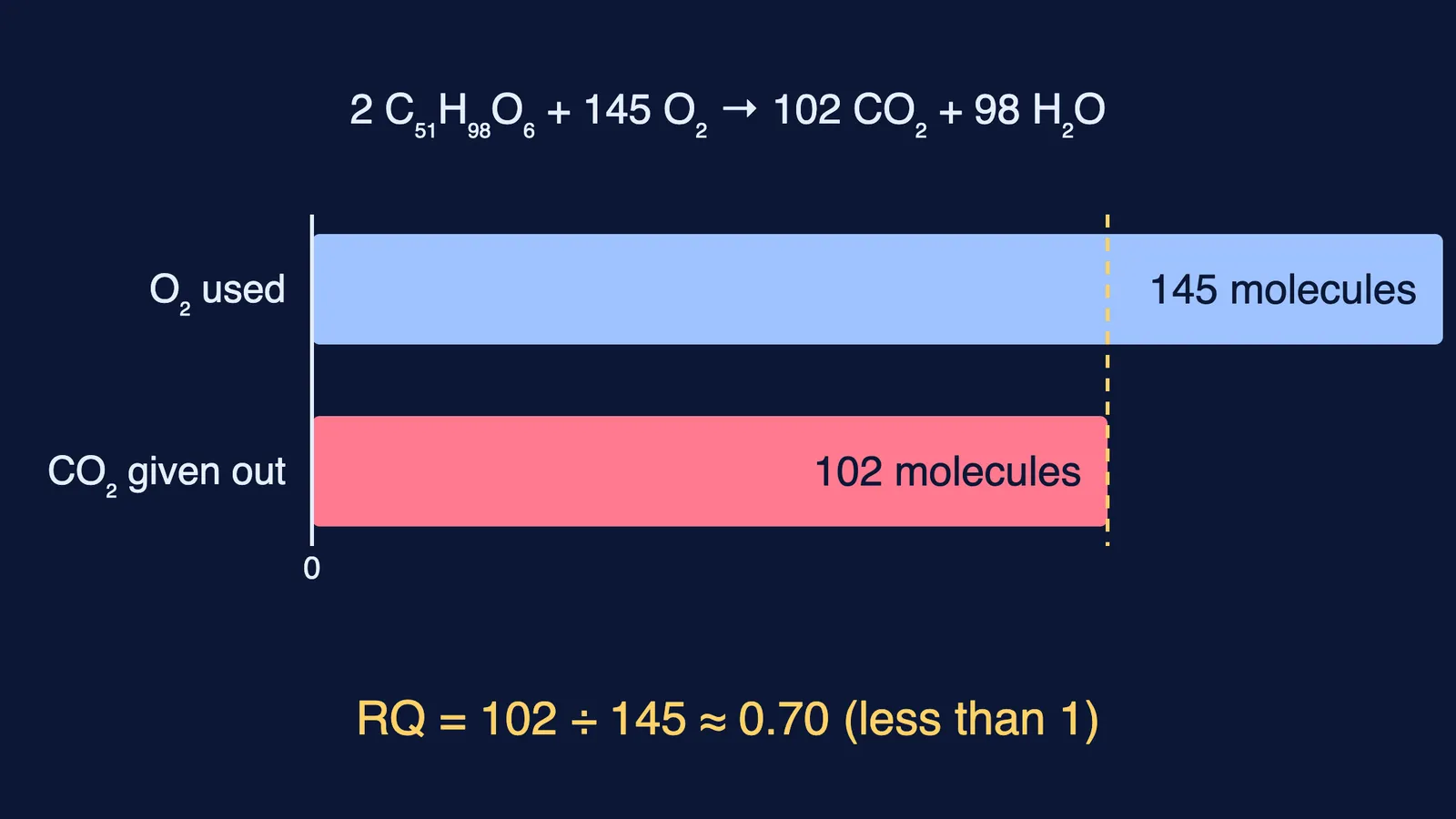
Q6 (hard). Assertion (A): When tripalmitin is the respiratory substrate, the respiratory quotient is about 1.4. Reason (R): In the complete oxidation of two molecules of tripalmitin, 145 molecules of O2 are consumed and 102 molecules of CO2 are released.
Answer: (D). RQ is CO2 evolved divided by O2 consumed, so 102 ÷ 145 ≈ 0.70, which is less than 1. A is false (1.4 is O2 ÷ CO2); R matches the NCERT equation.
Trap: putting O2 on top of the fraction.
Respiration in plants Statement I / Statement II questions
These statements are also judged against NCERT Class 11 Biology, Chapter 12.
Q7 (medium). Statement I: The TCA cycle begins when an acetyl group condenses with oxaloacetic acid and water to form citric acid, a step catalysed by citrate synthase. Statement II: When succinyl-CoA is converted to succinic acid, one GTP is formed by substrate-level phosphorylation.
Answer: (A). Both are correct.
Trap: assuming every ATP in respiration comes from the electron transport system.
Q8 (medium). Statement I: Glycerol from fats enters the respiratory pathway after being converted to acetyl CoA. Statement II: Fatty acids enter the respiratory pathway after being converted to PGAL.
Answer: (B). Both are incorrect; the entry points are swapped. Glycerol enters as PGAL, and fatty acids are degraded to acetyl CoA.
Trap: knowing both entry points but not which is which.
Q9 (hard). Statement I: Cytochrome c is a small protein on the outer surface of the inner mitochondrial membrane that carries electrons between complexes III and IV. Statement II: Complex IV, cytochrome c oxidase, contains cytochromes b and c1 and two copper centres.
Answer: (C). Statement I is correct. Statement II is incorrect: complex IV contains cytochromes a and a3; "bc1" is the name of complex III.
Trap: mixing up the cytochromes of complexes III and IV.
Q10 (hard). Statement I: In ATP synthase, F0 is the peripheral headpiece that contains the site where ATP is made from ADP and inorganic phosphate. Statement II: For each ATP produced, 4 H+ pass through F0 from the intermembrane space into the matrix.
Answer: (D). Statement I is incorrect: that describes F1. F0 is the integral membrane part that forms the proton channel. Statement II is correct.
Trap: swapping F0 and F1.
How should you use this set?
Sort each miss into a bin:
Fact slip (Q2, Q4, Q7, Q8, Q9, Q10): redraw the ETS and the entry points from memory, then check NCERT Figures 12.4 to 12.6.
Number slip (Q6): write the ratio as "CO2 out over O2 in" before you put numbers in.
Causal link (Q1, Q3, Q5): say NCERT's reason aloud before you read R.
For items that set respiration against photosynthesis, try our photosynthesis and respiration assertion-reason set.
If the electron transport system still feels like a list of names, the Fermi Concept Library covers every concept in biology, each with its own lesson and its place in the map.