On this page
Every order below comes from NCERT Class 12 Biology, Chapter 5, Molecular Basis of Inheritance (Reprint 2026-27), with its section number. The NEET (UG) 2026 syllabus lists the chapter under Unit 7, Genetics and Evolution. All 13 questions are ours, not past-paper items.
Which sequences in this chapter does NCERT give in order?
DNA packaging (5.1.2): histone octamer, DNA wrapped into a nucleosome, beads-on-string chromatin, chromatin fibres, then chromosomes condensed at metaphase.
Hershey-Chase experiment (5.2.1): label phages with radioactive phosphorus or sulfur, let them attach to *E. coli*, blend off the coats, centrifuge, test the bacteria for radioactivity.
Meselson-Stahl experiment (5.4.1): grow *E. coli* on 15NH4Cl for many generations, move it to 14NH4Cl, sample at intervals, spin each sample's DNA in a CsCl gradient.
Bacterial transcription (5.5.3): RNA polymerase binds the promoter (with σ), elongates, reaches the terminator, and the RNA and polymerase fall off (with ρ).
Eukaryotic mRNA route (5.5.3): RNA polymerase II makes hnRNA, it is spliced, capped and tailed, then the mRNA leaves the nucleus for translation. NCERT gives no order among splicing, capping and tailing.
Translation (5.7): charging of tRNA, ribosome binds mRNA at AUG with the initiator tRNA, elongation codon by codon, release factor binds the stop codon, polypeptide released.
Lac operon switching on (5.8.1): lactose is transported in by permease, the inducer inactivates the repressor, RNA polymerase gains access to the promoter, transcription proceeds.
Human Genome Project sequencing (5.9): random fragments, cloning in BAC or YAC hosts, automated sequencing, alignment by overlaps, annotation.
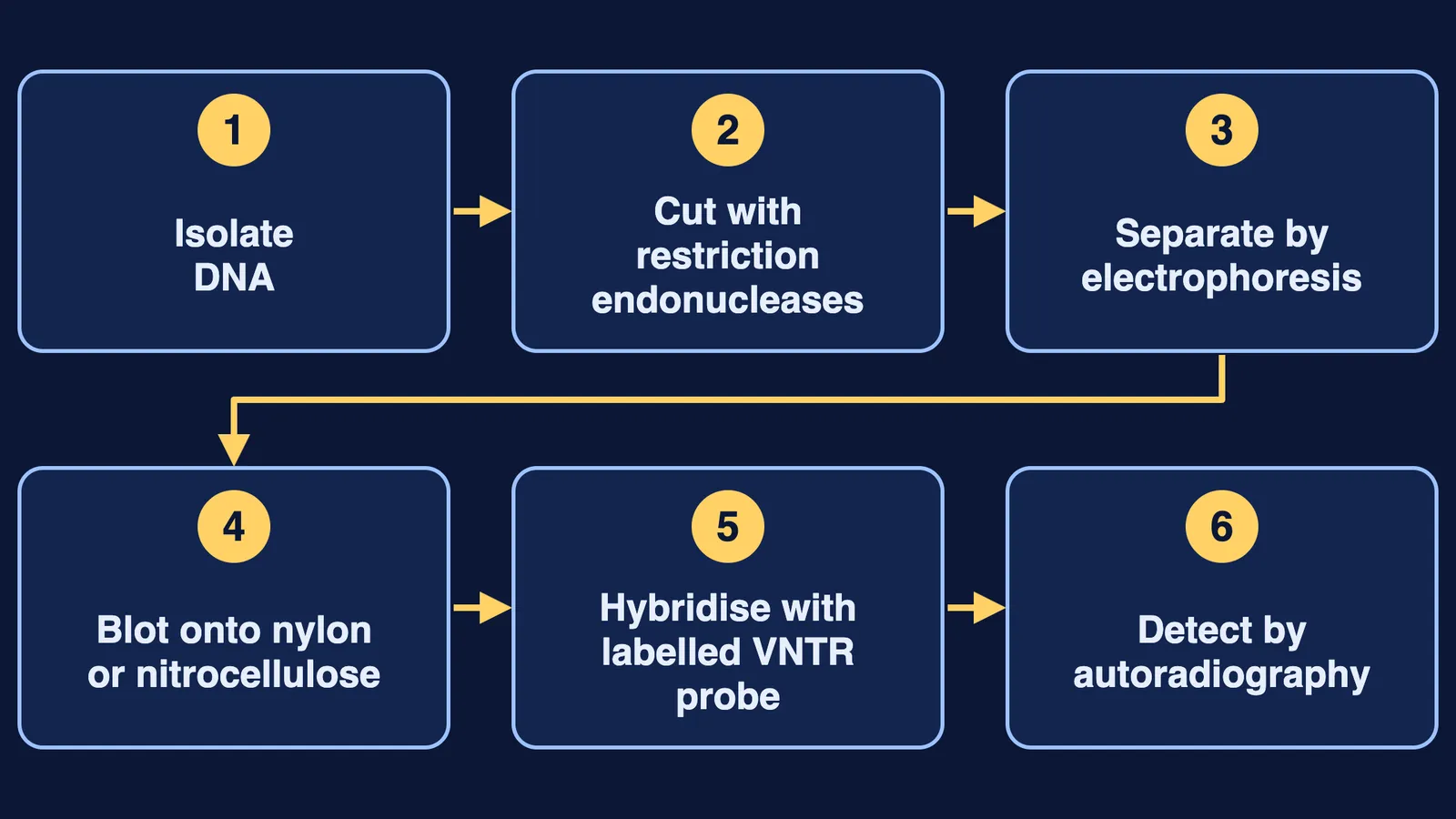
DNA fingerprinting (5.10) is the six-step flow in the hero above.
How do you attack arrange-in-order questions?
Fix the first and last steps from memory and strike options that disagree. Then test the one adjacent pair where the survivors differ.
Can you put these steps in NCERT's order?
Q1. A. Nucleosomes repeat as beads-on-string chromatin B. Histone octamer forms C. Fibres coil and condense into chromosomes D. DNA wraps around the octamer E. Chromatin is packaged into fibres. (1) B-D-A-E-C (2) D-B-A-E-C (3) B-D-E-A-C (4) B-A-D-E-C
Q2. A. Phages attach to *E. coli* B. Centrifuging separates virus particles from bacteria C. Phages are grown with radioactive phosphorus or sulfur D. Blending removes viral coats from the bacteria. (1) C-A-B-D (2) A-C-D-B (3) C-A-D-B (4) C-D-A-B
Q3. A. Cells moved to 14NH4Cl B. *E. coli* grown on 15NH4Cl for many generations C. Samples taken at set intervals and DNA extracted D. DNA separated in a CsCl gradient. (1) B-A-D-C (2) B-A-C-D (3) A-B-C-D (4) B-C-A-D
Q4. A. RNA and polymerase fall off B. RNA polymerase binds the promoter C. Polymerase reaches the terminator D. Polymerase opens the helix and elongates. (1) B-C-D-A (2) D-B-C-A (3) B-D-C-A (4) B-D-A-C
Q5. A. Release factor binds the stop codon B. Amino acid activated and linked to its tRNA C. Ribosome binds mRNA at AUG D. Ribosome moves codon to codon as charged tRNAs pair E. Polypeptide leaves the ribosome. (1) C-B-D-A-E (2) B-C-D-A-E (3) B-C-D-E-A (4) B-D-C-A-E
Q6. A. RNA polymerase gains access to the promoter B. Lactose is transported into the cell by permease C. The inducer interacts with the repressor and inactivates it D. Transcription of the operon proceeds. (1) B-A-C-D (2) C-B-A-D (3) B-C-D-A (4) B-C-A-D
Q7. A. Fragments cloned in BAC or YAC hosts B. Total DNA cut into random fragments C. Sequences aligned by overlaps D. Fragments run through automated sequencers E. Sequences annotated and assigned to chromosomes. (1) B-D-A-C-E (2) B-A-D-C-E (3) A-B-D-C-E (4) B-A-D-E-C
Q8. By year: A. Hershey and Chase's blender experiment B. Griffith's transformation C. Meselson and Stahl's nitrogen experiment D. Avery, MacLeod and McCarty's work E. Watson and Crick's double helix. (1) B-A-D-E-C (2) D-B-A-E-C (3) B-D-E-A-C (4) B-D-A-E-C
Answers. 1: (1). DNA wraps the octamer to make nucleosomes, the unit of chromatin (5.1.2). 2: (3). Coats are blended off before spinning (5.2.1). 3: (2). Sampling comes before each sample is run on CsCl (5.4.1). 4: (3). Elongation runs until the terminator (5.5.3). 5: (2). Charging is the first phase; release follows the release factor (5.7). 6: (4). Only an inactivated repressor lets RNA polymerase reach the promoter (5.8.1). 7: (2). Cloning amplifies each fragment so it can be sequenced (5.9). 8: (4). 1928, 1933-44, 1952, 1953, 1958 (5.1.1, 5.2, 5.2.1, 5.4.1).
Which before, after and out-of-place questions test the same orders?
Q9. In translation, which event comes immediately before a release factor binds the stop codon? (1) Charging of tRNA (2) Ribosome binds the mRNA at AUG (3) Ribosome moves codon to codon, adding amino acids (4) Polypeptide leaves the ribosome
Q10. In Human Genome Project sequencing, which step comes immediately after the fragments were cloned in BAC or YAC hosts? (1) Alignment by overlapping regions (2) Sequencing in automated sequencers (3) Cutting total DNA into random fragments (4) Annotation
Q11. One step is misplaced: isolation of DNA, electrophoresis, blotting, hybridisation, autoradiography, restriction digestion. Which single step must move? (1) Electrophoresis (2) Blotting (3) Restriction digestion (4) Autoradiography
For Q12 and Q13: (1) Both I and II are correct (2) Both I and II are incorrect (3) I is correct, II is incorrect (4) I is incorrect, II is correct.
Q12. I: In NCERT's account of packaging, chromatin fibres form first and are then arranged as beads-on-string. II: In the Human Genome Project, fragments were cloned in BAC or YAC hosts before being sequenced.
Q13. I: Hershey and Chase labelled their phages before letting them attach to *E. coli*. II: In bacteria, RNA polymerase binds the promoter before elongation begins.
Answers. 9: (3). Elongation runs codon by codon until the stop codon meets a release factor (5.7). 10: (2). Cloning amplifies each piece so it can then be sequenced (5.9). 11: (3). Digestion comes second, before electrophoresis (5.10). 12: (4). Beads-on-string is packaged into fibres, not the reverse; cloning precedes sequencing (5.1.2, 5.9). 13: (1). Labelling comes first; initiation at the promoter precedes elongation (5.2.1, 5.5.3).
Where should you practise next?
For other formats, try the statement and match-the-list set, the diagram-based questions and the NCERT exceptions and odd-one-out set.
Not sure which sequence to revise first? Fermi's AI tutor works out what you already know and builds a plan for the session.