On this page
Human Reproduction sits in Unit 6, Reproduction, of the NMC's NEET (UG) 2026 syllabus. Each order here follows NCERT Class 12 Biology, Chapter 2 (Reprint 2026-27); section numbers are in brackets, and "opening" means the chapter's first page before 2.1. All 13 questions are new, not taken from past papers, and none is a forecast. Pregnancy, birth and the menstrual cycle are covered only in NCERT's terms. Treat it as a study summary, not medical advice.
Which sequences does NCERT give in Human Reproduction?
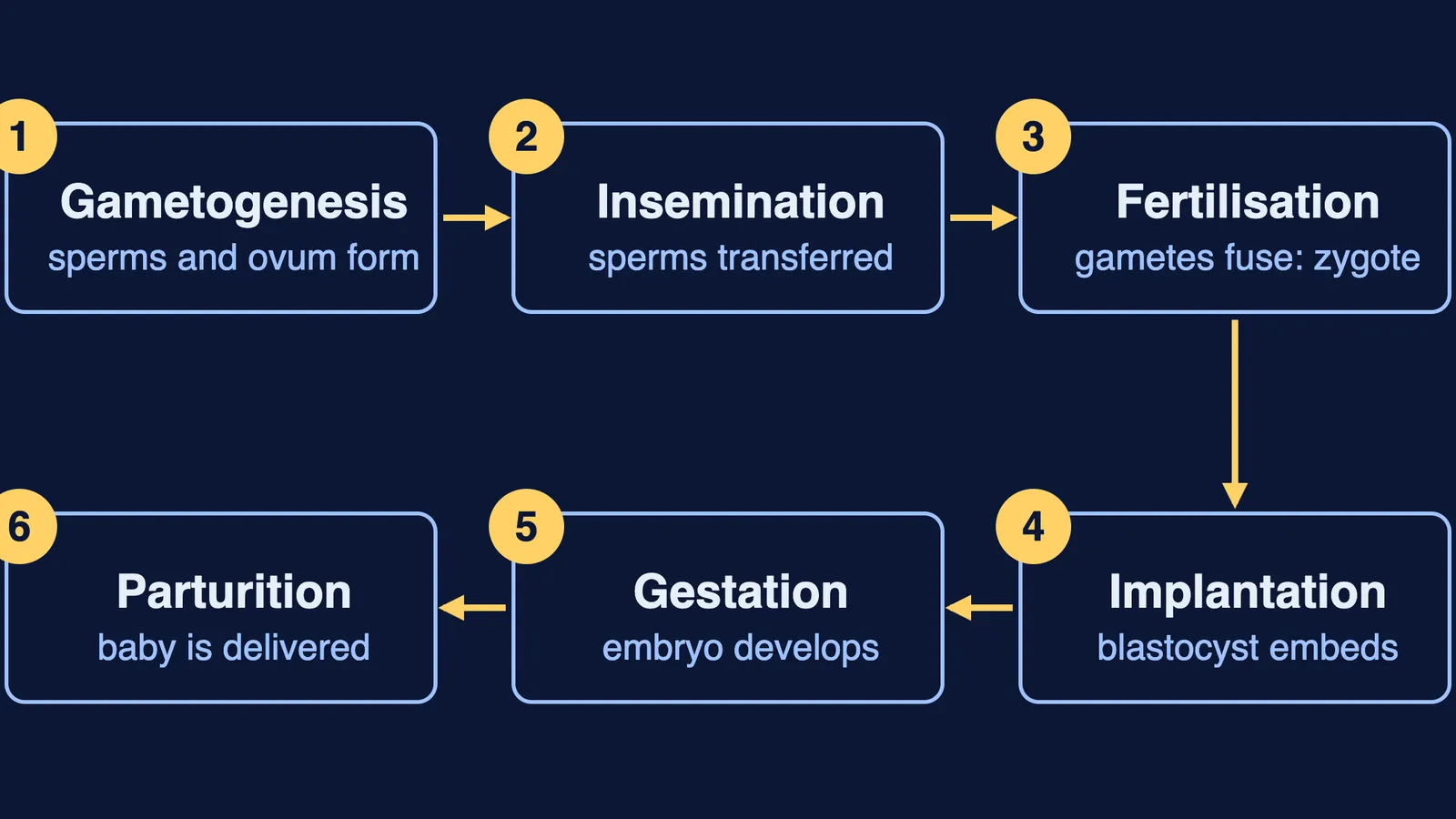
Reproductive events (opening): gametogenesis → insemination → fertilisation → implantation → gestation → parturition.
Sperm route in the male (2.1): seminiferous tubules → rete testis → vasa efferentia → epididymis → vas deferens → ejaculatory duct → urethra.
Spermatogenesis (2.3): spermatogonia → primary spermatocyte → secondary spermatocytes → spermatids → spermatozoa (spermiogenesis) → heads in Sertoli cells → spermiation.
Hormone chain at puberty (2.3): GnRH rises → anterior pituitary secretes LH and FSH → LH acts on Leydig cells → androgens → spermatogenesis.
Oogenesis (2.3): oogonia (fetal ovary) → primary oocyte arrested in prophase I → primary follicle → secondary follicle → tertiary follicle, meiosis I completed → Graafian follicle, zona pellucida → ovulation.
Menstrual cycle (2.4): menstrual phase → follicular phase → ovulatory phase (LH surge) → luteal phase (corpus luteum) → corpus luteum degenerates if there is no fertilisation.
Fertilisation to implantation (2.5): vagina → cervix → uterus → ampullary region; zona pellucida contact → sperm entry → meiosis II completed → zygote → cleavage → morula → blastocyst → trophoblast attaches → implantation.
Pregnancy to birth (2.6, 2.7): chorionic villi after implantation → placenta; heart (month one) → limbs and digits (month two) → most organ systems (12 weeks) → first movements (month five) → eyelids separate (about 24 weeks) → fully developed (nine months); at birth, foetal ejection reflex → oxytocin → stronger contractions → baby, then placenta.
How do you attack arrange-in-order questions?
Fix the first and last steps before reading the options; that usually removes two codes. Then test the middle pair you are surest of.
Can you arrange these steps in the correct order?
Q1. Sperm route from the testis: A. Epididymis B. Rete testis C. Vas deferens D. Vasa efferentia E. Ejaculatory duct (1) D, B, A, C, E (2) B, D, A, C, E (3) B, D, C, A, E (4) B, A, D, C, E Answer: (2). Tubules open into vasa efferentia through the rete testis (2.1).
Q2. Cells in spermatogenesis: A. Spermatid B. Primary spermatocyte C. Spermatogonium D. Secondary spermatocyte (1) C, D, B, A (2) B, C, D, A (3) C, B, A, D (4) C, B, D, A Answer: (4). Meiosis I gives secondary spermatocytes; meiosis II gives spermatids (2.3).
Q3. Control of spermatogenesis: A. LH acts on Leydig cells B. GnRH secretion rises C. Androgens stimulate spermatogenesis D. Anterior pituitary secretes LH and FSH E. Leydig cells secrete androgens (1) B, D, A, E, C (2) D, B, A, E, C (3) B, D, E, A, C (4) B, A, D, E, C Answer: (1). GnRH acts on the pituitary first (2.3).
Q4. Oogenesis: A. Graafian follicle ruptures B. Oogonia form in the fetal ovary C. Primary oocyte completes meiosis I D. Oocyte arrested in prophase I E. Secondary oocyte forms zona pellucida (1) D, B, C, E, A (2) B, D, E, C, A (3) B, D, C, E, A (4) B, C, D, E, A Answer: (3). Meiosis I ends in the tertiary follicle, before the zona pellucida forms (2.3).
Q5. One cycle with no fertilisation, starting after the menstrual flow ends: A. Graafian follicle ruptures B. Endometrium disintegrates, starting a new cycle C. Corpus luteum degenerates D. Follicles grow and secrete estrogens E. Corpus luteum forms (1) D, A, E, C, B (2) D, E, A, C, B (3) D, A, C, E, B (4) A, D, E, C, B Answer: (1). Without fertilisation the corpus luteum degenerates, and that makes the endometrium disintegrate (2.4).
Q6. After insemination: A. Sperms enter the uterus B. Semen is released into the vagina C. Sperms reach the ampullary region D. Sperms pass through the cervix (1) B, A, D, C (2) B, D, C, A (3) B, D, A, C (4) D, B, A, C Answer: (3). Sperms swim through the cervix and uterus to the ampulla (2.5).
Q7. Parturition: A. Oxytocin acts on the uterine muscle B. Foetal ejection reflex (mild contractions) C. Placenta is expelled D. Baby leaves through the birth canal E. Maternal pituitary releases oxytocin (1) B, E, A, D, C (2) E, B, A, D, C (3) B, A, E, D, C (4) B, E, A, C, D Answer: (1). The reflex triggers oxytocin release; the placenta follows the baby (2.7).
Q8. Foetal development: A. Most major organ systems formed; external genital organs well developed B. Body covered with fine hair; eyelashes formed C. Heart formed D. Foetus fully developed, ready for delivery (1) C, A, B, D (2) A, C, B, D (3) C, B, A, D (4) C, A, D, B Answer: (1). One month, 12 weeks, about 24 weeks, nine months (2.6).
Can you spot the step before, after or out of place?
Q9. Which comes immediately after the trophoblast attaches to the endometrium? (1) Morula forms (2) Cleavage starts in the isthmus (3) Chorionic villi appear (4) Uterine cells divide rapidly and cover the blastocyst Answer: (4). This embeds the blastocyst (2.5).
Q10. Which comes immediately after the secondary oocyte completes its second meiotic division? (1) Sperm contacts the zona pellucida (2) Haploid nuclei of sperm and ovum fuse (3) Cleavage into blastomeres (4) Acrosome secretions help the sperm enter Answer: (2). Fusion gives the diploid zygote; cleavage comes later (2.5).
Q11. A student writes: primary follicle → tertiary follicle → Graafian follicle → secondary follicle → ovulation. Which step is out of place? (1) Tertiary follicle (2) Graafian follicle (3) Secondary follicle (4) Ovulation Answer: (3). It belongs after the primary follicle (2.3).
Codes for Q12 and Q13: (1) Both true (2) Both false (3) Only I true (4) Only II true
Q12. I: Follicles grow into a Graafian follicle in the same phase as the endometrium regenerates. II: Chorionic villi appear on the trophoblast before the blastocyst is embedded. Answer: (3). Both changes run together in the follicular phase (2.4); villi appear after implantation (2.6).
Q13. I: In NCERT's list of reproductive events, gestation comes before implantation. II: The blastocyst forms before implantation. Answer: (4). Implantation is the blastocyst attaching to the uterine wall, and gestation follows it (opening).
What should you do after this set?
For each miss, rewrite that sequence from memory and check its NCERT section. Then try other formats: the human reproduction statement and match-the-list items, the diagram-based human reproduction questions and the worked NEET practice questions on this chapter.
Which sequence keeps flipping in your head? Fermi's AI tutor works out what you already know and builds a plan for the session.