

On this page
Most oxides pick a side. Sodium oxide behaves as a base, sulphur trioxide as an acid. A small group refuses to choose, and it turns up in Class 10 questions such as the NCERT Exemplar thermite problem worked below. Here are the two examples to know, their equations, and a method for predicting the rest.
What is an amphoteric oxide?
Amphoteric species are molecules or ions that can react as an acid as well as a base, and the word comes from the Greek for "both" (LibreTexts, Amphoteric Behavior/07%3A_Acids_bases_and_ions_in_aqueous_solution/7.08%3A_Amphoteric_Oxides_and_Hydroxides/7.8A%3A_Amphoteric_Behavior)). An amphoteric oxide therefore reacts with an acid the way a base would, and with a base the way an acid would, forming a salt and water each time.
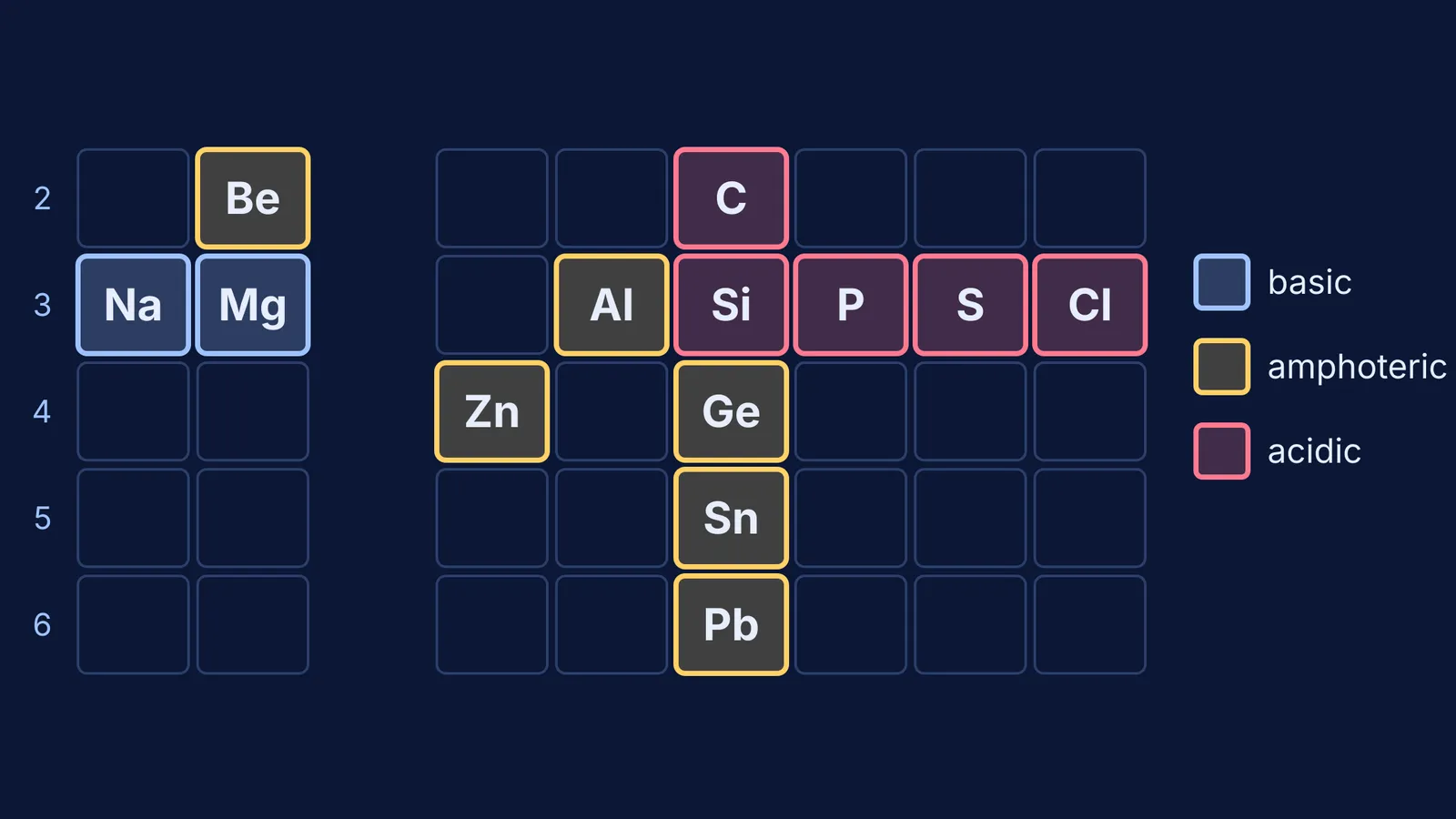
The same LibreTexts page lists the metals that form amphoteric oxides or hydroxides: copper, zinc, tin, lead, aluminium and beryllium.
How does Al₂O₃ react with acids and bases?
Aluminium oxide is insoluble in water, so unlike sodium oxide and magnesium oxide it does not react with water (LibreTexts, Period 3 oxides). The same page gives its two reactions:
As a base, with hot dilute hydrochloric acid: Al₂O₃ + 6HCl → 2AlCl₃ + 3H₂O
As an acid, with hot concentrated sodium hydroxide: Al₂O₃ + 2NaOH + 3H₂O → 2NaAl(OH)₄
Class 10 answers usually write the second reaction in a shorter form, Al₂O₃ + 2NaOH → 2NaAlO₂ + H₂O, giving sodium aluminate. A worked answer to an NCERT Exemplar Class 10 question uses this shorter form.
How does ZnO react with acids and bases?
Zinc oxide follows the same pattern. LibreTexts writes its two reactions as ionic equations (LibreTexts, Amphoteric Behavior/07%3A_Acids_bases_and_ions_in_aqueous_solution/7.08%3A_Amphoteric_Oxides_and_Hydroxides/7.8A%3A_Amphoteric_Behavior)):
In acid: ZnO + 2H⁺ → Zn²⁺ + H₂O, which with hydrochloric acid is ZnO + 2HCl → ZnCl₂ + H₂O
In base: ZnO + 2OH⁻ + H₂O → [Zn(OH)₄]²⁻, the zincate ion
School textbooks often write the base reaction as ZnO + 2NaOH → Na₂ZnO₂ + H₂O, sodium zincate. That shorter form has the same shape chemguide uses for tin(II) and lead(II) oxides, XO + 2OH⁻ → XO₂²⁻ + H₂O (chemguide, Group 4 oxides).
This matters in the lab too: zinc(II) dissolves in base and manganese(II) does not, so the two can be separated, as the LibreTexts page notes. Our guide to identifying metal ions with NaOH and NH₄OH in ICSE analytical chemistry uses the same idea with sodium hydroxide tests.
How do you spot amphoteric oxides in the periodic table?
Four clues beat memorising a long list.
Look at the diagonal. Amphoteric oxides sit along the diagonal line between the basic and acidic extremes (LibreTexts, Amphoteric Behavior/07%3A_Acids_bases_and_ions_in_aqueous_solution/7.08%3A_Amphoteric_Oxides_and_Hydroxides/7.8A%3A_Amphoteric_Behavior)).
Walk across a period. In period 3, Na₂O and MgO are basic, Al₂O₃ is amphoteric, and SiO₂, P₄O₁₀, SO₃ and Cl₂O₇ are acidic (LibreTexts, Period 3 oxides). Electronegativity explains the switch: silicon is too close to oxygen to form ionic bonds, so SiO₂ has no basic properties.
Walk down a group. In group 14, CO₂ and SiO₂ are weakly acidic, while the monoxides and dioxides of germanium, tin and lead are amphoteric, getting more basic lower down without fully losing their acidic character (chemguide, Group 4 oxides).
Check the oxidation state. For the same element, acidity rises as the oxidation state rises, as in MnO < Mn₂O₃ < MnO₂ < Mn₂O₇ (LibreTexts, linked above).
The usual exceptions to these trends are collected in our post on periodic trends and their exceptions.
Worked example: the thermite question
The NCERT Exemplar question linked above: a metal used in the thermite process gives an amphoteric oxide when heated in oxygen. Identify both and write the oxide's reactions with HCl and NaOH.
Spot the clue. The thermite process uses aluminium, so the metal is Al and the oxide is Al₂O₃.
Write the acid reaction: Al₂O₃ + 6HCl → 2AlCl₃ + 3H₂O.
Write the base reaction: Al₂O₃ + 2NaOH → 2NaAlO₂ + H₂O.
Name the products: aluminium chloride, and sodium aluminate.
Check the balance. Count 2 Al, 6 Cl, 6 H and 3 O on both sides of step 2, and 2 Na, 2 Al, 2 H and 5 O on both sides of step 3.
Run this checklist on any amphoteric-oxide answer:
Did you show both reactions, one with an acid and one with a base?
Is the product of the base reaction a named salt (aluminate, zincate), not a hydroxide?
Are the atoms balanced on both sides?
Did you write "amphoteric", not "neutral"? An amphoteric oxide reacts with acids and bases alike.
If your equations keep coming out unbalanced, the Fermi Problem Library has worked problems with a step-by-step solver that explains the reasoning rather than printing an answer. For the period and group trends behind all this, the Fermi Concept Library gives each concept its own lesson and its place in the map.
Next, write the two SnO equations from memory and check them against chemguide.


