

On this page
Every element leaves a fingerprint of bright lines in its spectrum. In 1868 astronomers looking at the Sun found a yellow line that matched no element known on Earth. Norman Lockyer decided it belonged to a new element and called it helium. Nobody could find helium on Earth for more than 25 years. This post covers how that happened, a short calculation on the lines involved, and what Lockyer's career shows about following an odd result.
Who was Norman Lockyer?
According to Nature's own history of the journal, Lockyer was born in Rugby, England, on 17 May 1836. He worked as a clerk in the government's War Office and was a keen amateur astronomer. He later founded Nature: its first issue appeared on 4 November 1869, Lockyer was its first editor, and he wrote 66 editorials for it between 1869 and 1919. Obituaries such as the one in The Astrophysical Journal give his dates as 1836 to 1920.
What happened at the 1868 eclipse?
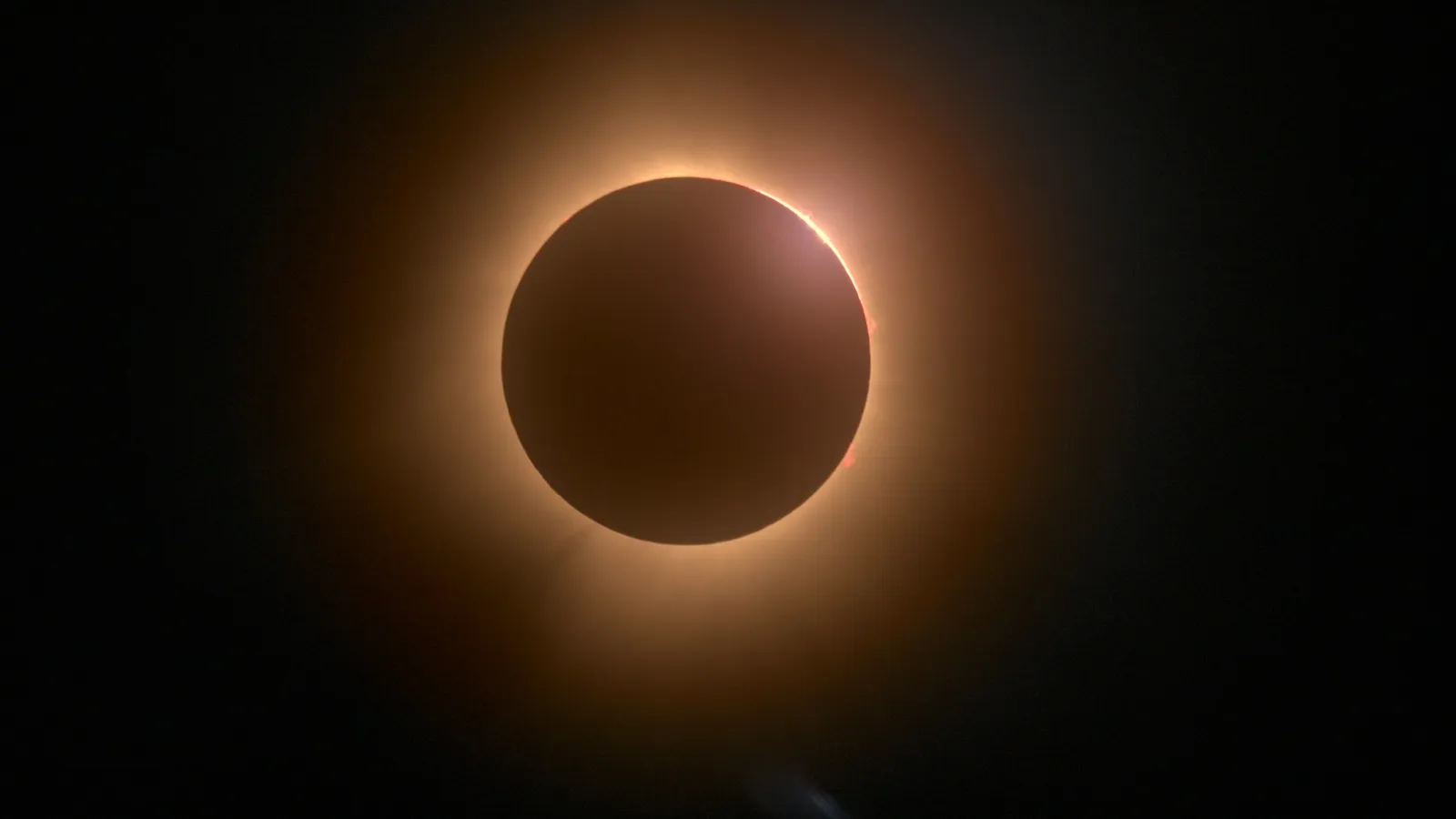
Solar prominences are huge glowing clouds above the Sun's edge. Before 1868 they could be seen only in the few minutes of a total eclipse, when the Moon blocks the glare.
The long total eclipse of 18 August 1868 was visible from India. A paper in the Journal of Astronomical History and Heritage describes how the French physicist Jules Janssen observed it from Guntoor (now Guntur, in Andhra Pradesh). He saw the hydrogen lines he was looking for, and he realised that the prominence lines could be observed at any time, without waiting for an eclipse. Lockyer found the same method independently in England, and the French Académie des Sciences struck a medal in honour of both men.
Lockyer's letter to the Royal Society, printed in its Proceedings, begins: "after a number of failures, which made the attempt seem hopeless, I have this morning perfectly succeeded in obtaining and observing part of the spectrum of a solar prominence." He reported three bright lines.
Why did one yellow line mean a new element?
The Royal Society of Chemistry's periodic table page on helium explains that Janssen saw a new yellow line in 1868 and Lockyer recorded the same line. It sat close to the familiar yellow lines of sodium but did not match them or any other known metal. Lockyer proposed that it came from a new metal and named it helium, after Helios, the Greek personification of the Sun. The RSC notes that this is why helium, a gas, has the "-ium" ending used for metals.
Worked example: how close is the helium line to sodium?
Here are the wavelengths from the NIST Atomic Spectra Database tables for helium and sodium:
Helium yellow line (the D3 line): about 587.56 nm
Sodium D2: 588.995 nm
Sodium D1: 589.592 nm
Step 1: photon energies. Use E = hc/λ with hc = 1239.84 eV nm.
Helium: 1239.84 / 587.56 = 2.110 eV
Sodium D2: 1239.84 / 588.995 = 2.105 eV
The photons differ by only about 0.005 eV, so the colours look almost the same to the eye.
Step 2: how much resolving power do you need? A spectroscope's resolving power is R = λ/Δλ.
To separate helium from sodium D2: Δλ = 588.995 − 587.56 = 1.43 nm, so R ≈ 589 / 1.43 ≈ 410.
To split the two sodium lines: Δλ = 589.592 − 588.995 = 0.597 nm, so R ≈ 589.3 / 0.597 ≈ 990.
Any spectroscope good enough to show sodium's two lines could easily separate the helium line from them. The hard part in 1868 was not resolution. It was seeing a faint prominence beside the blazing Sun, which is exactly what the new method solved.
Common mistakes:
Forgetting units in E = hc/λ. With hc in eV nm, λ must be in nm.
Reading a small energy difference as "no difference". A 0.2% shift in wavelength is easy for a spectroscope even when the eye cannot tell.
Assuming an unmatched line must be a new element. It could also be a known element in unusual conditions. Lockyer's claim was a hypothesis until someone found the gas.
The same E = hc/λ step is the core of hydrogen spectrum problems using the Bohr model, and the idea of spectral fingerprints goes back to Gustav Kirchhoff's work on spectroscopy.
How was helium found on Earth?
In 1895 William Ramsay, working on argon, boiled a uranium mineral with acid and collected the gas. His note in the Proceedings of the Royal Society is titled "On a gas showing the spectrum of helium, the reputed cause of D3, one of the lines in the coronal spectrum." The RSC explains that this helium had formed by radioactive decay and been trapped in the rock. Lockyer's element was real, but it was an unreactive gas, not a metal. Ramsay received the 1904 Nobel Prize in Chemistry for discovering the noble gases. Read more in our post on William Ramsay and the noble gases.
What can a student take from Lockyer?
Keep trying the method. His own letter mentions "a number of failures" before success.
Take the odd result seriously, but label it. He named helium while being clear that it was found only in the Sun.
Build something that outlasts you. Nature, the journal he started in 1869, is still publishing new research today.
If spectra feel abstract, start from the idea of energy levels. The Fermi Concept Library covers every concept in physics, chemistry, biology, mathematics and computing, so you can revise photon energy and atomic spectra one idea at a time.
This week, calculate the photon energies of the two sodium D lines yourself and check them against the numbers above.


