On this page
Human Health and Disease (Chapter 7, NCERT Class 12 Biology) packs pathogens, immunity, cancer and drugs into a few pages. Below, its terms follow the chapter's order, each with an example and, where useful, a "Don't confuse with" pair. It follows the NCERT chapter (Reprint 2026-27) and the CBSE Biology curriculum for 2026-27. To practise answers, pair it with our Human Health and Disease Class 12 board exam guide.
This is a study glossary, not medical advice; for any real symptom, see a doctor.
What are health, disease and pathogens?
Health: complete physical, mental and social well-being, not just the absence of disease.
Infectious disease: a disease that passes easily from one person to another. Example: the common cold. Don't confuse with: non-infectious disease, which does not spread between people. Example: cancer.
Pathogen: any organism that causes disease, such as a bacterium, virus, fungus, protozoan or helminth (parasitic worm). Example: *Salmonella typhi*, which causes typhoid.
Vector: an organism that carries a pathogen between hosts. Example: the female *Anopheles* mosquito carries *Plasmodium*, the malaria parasite.
Haemozoin: a toxin released when *Plasmodium* bursts red blood cells; NCERT links it to malaria's chills and fever recurring every three to four days.
Elephantiasis (filariasis): chronic inflammation, usually of the lymphatic vessels of the legs, caused by filarial worms (*Wuchereria*) spread by mosquitoes. Don't confuse with: ascariasis, caused by the roundworm *Ascaris* living in the intestine.
Ringworm: a fungal skin infection (*Microsporum*, *Trichophyton*, *Epidermophyton*) with dry, scaly, itchy patches.
What is the difference between innate and acquired immunity?
Innate immunity: non-specific defence present from birth, built from four barriers: physical (skin, mucus), physiological (stomach acid, saliva, tears), cellular (phagocytic white blood cells such as neutrophils and macrophages) and cytokine (interferons). Don't confuse with: acquired immunity, which targets one specific pathogen and has memory.
Interferons: proteins released by a cell after a virus infects it; they help neighbouring healthy cells resist that virus.
Primary response: the low-intensity response on first meeting a pathogen. Don't confuse with: secondary (anamnestic) response, the much stronger response on meeting the same pathogen again.
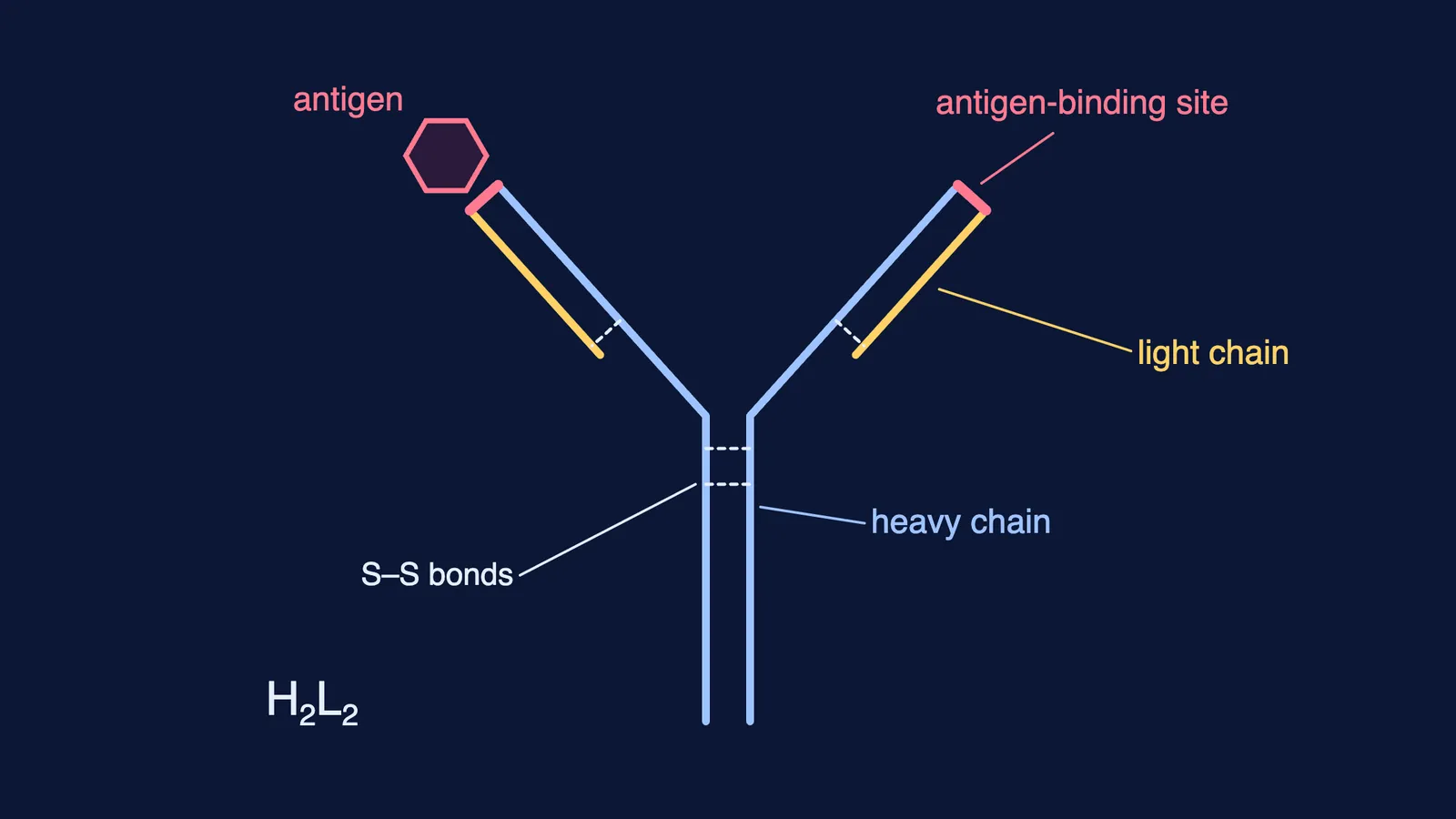
Antigen: a foreign substance, such as a microbe or its proteins, that makes the body produce antibodies.
Antibody: a protein made by B-lymphocytes against a pathogen, built from two heavy and two light chains, so it is written H2L2. Examples: IgA, IgM, IgE, IgG.
Humoral immune response: the antibody-mediated response, named so because antibodies are in the blood. Don't confuse with: cell-mediated immunity (CMI), carried out by T-lymphocytes, which is the reason a transplanted organ can be rejected.
How do vaccines, allergies and lymphoid organs fit in?
Active immunity: your own body makes antibodies after meeting an antigen, through infection or a vaccine; it is slow to build. Don't confuse with: passive immunity, where ready-made antibodies are given. Examples: IgA in colostrum (a mother's first milk), antitoxin for tetanus, antivenom for snakebite.
Vaccination: giving antigenic proteins or a weakened or inactivated pathogen so the body makes antibodies and memory B and T cells. Example: the hepatitis B vaccine made in yeast using recombinant DNA technology.
Allergy: an immune reaction far stronger than needed against harmless particles in the surroundings, called allergens (dust mites, pollen, animal dander). It involves IgE antibodies and the release of histamine and serotonin from mast cells.
Autoimmunity: when the body attacks its own cells. Example: rheumatoid arthritis.
Primary lymphoid organs: bone marrow and thymus, where lymphocytes are formed and mature until they can recognise antigens. Don't confuse with: secondary lymphoid organs (spleen, lymph nodes, tonsils, Peyer's patches, appendix), where lymphocytes meet antigens and multiply.
MALT: mucosa-associated lymphoid tissue lining the respiratory, digestive and urogenital tracts; it is about 50 per cent of the body's lymphoid tissue, per NCERT.
For a NEET-style view, see our post on pathogens, immunity and vaccines.
Which terms explain HIV, AIDS and cancer?
AIDS: Acquired Immuno Deficiency Syndrome, an immune deficiency acquired during life (not present at birth), caused by HIV.
Retrovirus: an enveloped virus whose RNA genome is copied into DNA inside the host. Example: HIV.
Reverse transcriptase: the enzyme HIV uses to make viral DNA from its RNA; that DNA joins the host cell's DNA, and helper T cell numbers fall over time.
ELISA: enzyme-linked immunosorbent assay, the lab test NCERT names for diagnosing HIV infection and AIDS.
Contact inhibition: the way normal cells stop dividing when they touch other cells. Cancer cells have lost it.
Benign tumour: a mass of cells that stays where it started. Don't confuse with: malignant tumour, whose cells grow fast, invade nearby tissue and can spread.
Metastasis: cells from a malignant tumour travelling through the blood and starting new tumours elsewhere.
Carcinogen: a physical, chemical or biological agent that can turn normal cells cancerous. Examples: X-rays, UV radiation, chemicals in tobacco smoke.
Proto-oncogenes (cellular oncogenes): genes in normal cells that can cause cancer if activated under certain conditions. Don't confuse with: viral oncogenes, which are carried by cancer-causing viruses.
What do addiction and dependence mean?
Opioids: drugs that bind opioid receptors in the central nervous system and gut. Example: heroin (smack), made by acetylating morphine from the poppy *Papaver somniferum*; it is a depressant.
Cocaine (coca alkaloid): a stimulant from *Erythroxylum coca* that interferes with dopamine transport.
Addiction: a mental pull towards the feelings a drug or alcohol gives, such as euphoria, that keeps someone using it despite harm. Don't confuse with: dependence, where the body shows a withdrawal syndrome (anxiety, shakiness, nausea, sweating) if regular use stops suddenly. With repeated use, receptors also need higher doses (tolerance), which pushes intake up.
If you or a friend is struggling with drugs or alcohol, talk to a parent, teacher, school counsellor or doctor.
How to learn these terms
Learn the pairs together. Write each "Don't confuse with" pair side by side with one difference.
Make a pathogen chart by hand. Disease, pathogen, group and spread, from memory.
Draw two diagrams. Sketch the labelled antibody (H2L2) and HIV replication (Figure 7.6) until you can do both unaided.
Say the definition, then the example. Cover the list and explain each term aloud.
If a term still feels hazy, the Fermi Concept Library gives every concept in biology its own lesson and its place in the map.