

On this page
Marcellin Berthelot, a 19th-century French chemist, changed how we study chemical energy. By inventing the bomb calorimeter in 1881, he made it possible to measure the heat released by burning a substance precisely. His work bridged the gap between organic synthesis and physical chemistry, proving that the chemical reactions in living things are driven by the exact same physical forces that govern the rest of the universe.
How did Berthelot synthesise organic compounds from elements?
Before Berthelot's experiments, many chemists adhered to "vitalism"—the belief that only living organisms possessed the "vital force" necessary to create organic compounds. Berthelot systematically dismantled this theory by building complex organic molecules directly from inorganic elements.
He synthesised ethanol in 1854, methane in 1856, and acetylene in 1860, combining elements like carbon and hydrogen in the laboratory without any biological intervention. By 1866, he achieved a landmark breakthrough by showing that heating acetylene in a glass tube caused it to polymerise into benzene. His 1860 book, *Chimie organique fondée sur la synthèse* (Organic Chemistry Based on Synthesis), established organic chemistry as a creative science rather than just an analytical one.
To understand these synthetic reactions deeply, he needed to know exactly how much energy they absorbed or released. Berthelot tracked the thermal energy of thousands of reactions and introduced the fundamental terms "exothermic" for reactions that release heat and "endothermic" for those that absorb it.
How does a bomb calorimeter work?
To measure the energy in fuels, explosives, and even foods accurately, Berthelot and his collaborator Paul Vieille invented the "calorimetric bomb" in 1881. Earlier calorimeters were open to the air, which allowed gases to escape and made measurements notoriously inaccurate for volatile substances.
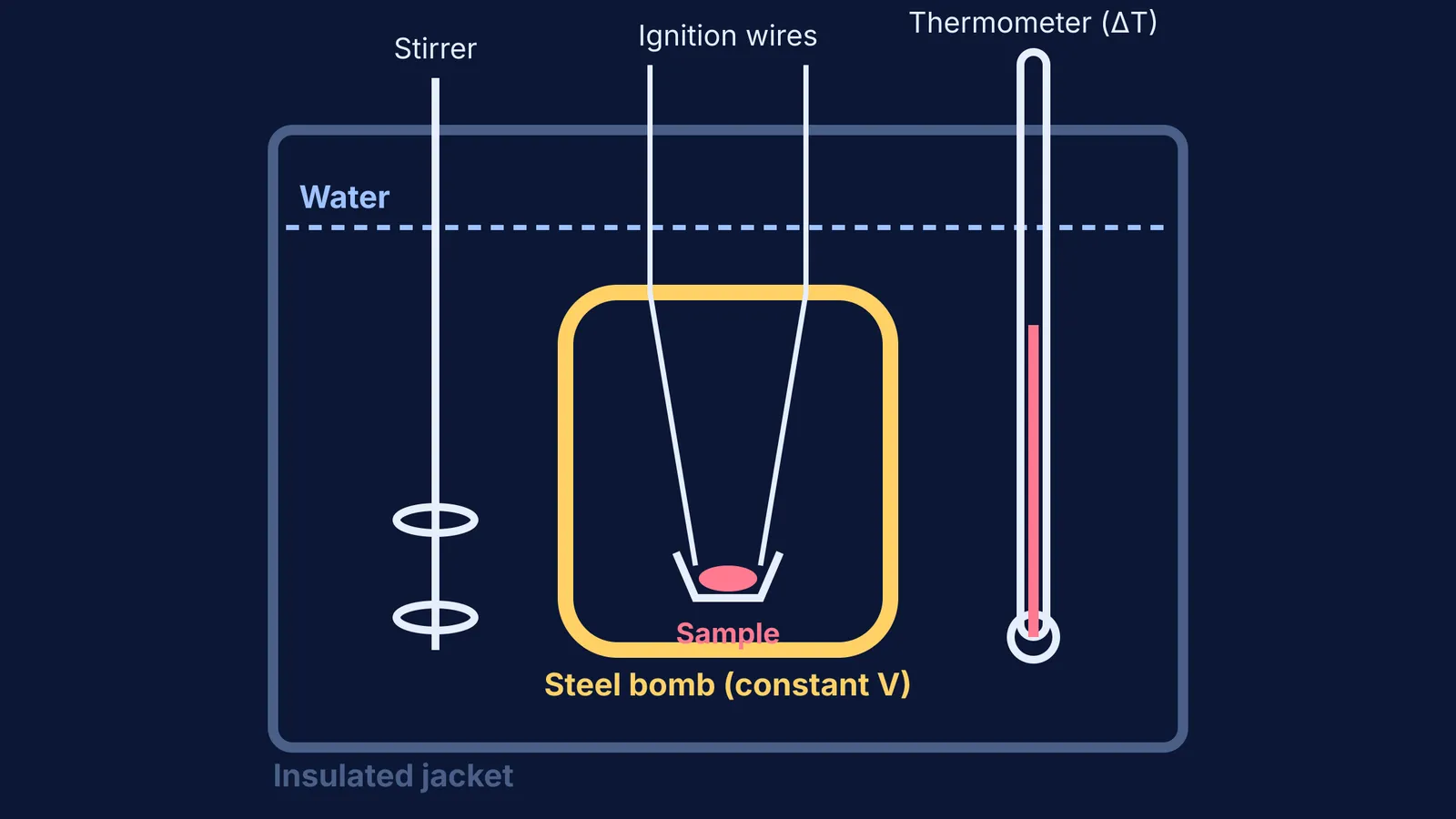
The modern bomb calorimeter still follows Berthelot's original principles closely:
The steel bomb: A heavy, thick-walled steel or alloy vessel holds the sample. It is engineered to withstand internal pressures of 25 to 30 atmospheres without expanding or bursting.
Pressurised oxygen: The sealed vessel is filled with pure oxygen to ensure the sample burns rapidly and completely.
The water jacket: The pressurised bomb is submerged in a known mass of water inside an insulated outer container, preventing heat from escaping into the room.
Ignition and measurement: An electric current heats a fine fuse wire, igniting the sample. A motorised stirrer keeps the water moving to distribute the heat evenly, while a highly precise thermometer measures the maximum temperature rise (ΔT).
By knowing the precise heat capacity of the water and the steel components, you can calculate the exact amount of thermal energy released by the combustion.
If you are studying thermodynamics, calculating the energy from a calorimeter experiment can be confusing. The Fermi Problem Library has worked problems with a step-by-step solver that explains the reasoning rather than printing an answer.
Why does a bomb calorimeter measure internal energy, not enthalpy?
Because the bomb is a rigid, sealed container, the volume of the system is strictly constant (ΔV = 0).
When a gas expands, it does work on its surroundings. In an open container (a constant-pressure process), the heat measured is the change in enthalpy (ΔH). But inside the bomb calorimeter, the gas cannot push the walls outward to expand. No work is done (PΔV = 0). According to the first law of thermodynamics, all the heat released at constant volume (q_v) goes directly into changing the internal energy (ΔU) of the system.
This is why ΔU = nCvΔT holds for every ideal gas process at constant volume. To find the enthalpy change (ΔH) from a bomb calorimeter experiment, you have to measure the internal energy change first, then mathematically correct for the change in the number of moles of gas using the formula ΔH = ΔU + Δn_g RT.
When you solve these problems, it helps to visualise the pressure and volume changes. Fermi's AI tutor works out what you already know, builds a plan for the session, and teaches through it by drawing the figures and running the simulations you need to understand the thermodynamics.
How do you solve a bomb calorimeter numerical?
When you face a bomb calorimeter question in a chemistry or physics exam, follow this four-step framework:
Find the total heat absorbed by the calorimeter: Use the formula q = C × ΔT, where C is the total heat capacity of the calorimeter (often given as the "water equivalent") and ΔT is the observed temperature rise.
Calculate the heat released by the sample: Because energy is conserved, the heat absorbed by the water exactly equals the heat released by the sample. So, heat released = −q.
Find the molar internal energy change (ΔU): Divide the heat released by the number of moles of the sample burned. Because the experiment takes place at constant volume, this value gives you ΔU.
Convert internal energy to enthalpy (ΔH): Use the equation ΔH = ΔU + Δn_g RT. Write out the balanced chemical equation, count the moles of gaseous products, and subtract the moles of gaseous reactants to find Δn_g. Remember to use the universal gas constant R and the absolute temperature T in Kelvin.
If you are trying to understand why rapid compression causes heating while slow compression does not, reading about it is not always enough. The Fermi Simulation Lab has interactive simulations for the ideas that are easier to see than to read. You can compress a gas and read the PV graph to see the difference between adiabatic and isothermal changes.


