

On this page
Natural rubber stretches and snaps back. Gutta-percha, a latex from Palaquium trees in South-East Asia, is hard and leathery at room temperature and softens only in hot water. Yet both are made of the same repeat unit, (C₅H₈)n, and both are poly(isoprene). The only difference is the shape around each C=C double bond in the chain: cis in rubber, trans in gutta-percha. That one detail of geometric isomerism decides whether you get a tyre or a hard, mouldable solid.
What is the repeat unit of natural rubber?
The monomer is isoprene, 2-methylbuta-1,3-diene: CH₂=C(CH₃)–CH=CH₂, formula C₅H₈. It is a conjugated diene. When it polymerises by 1,4-addition, the two end carbons (C1 and C4) link to neighbouring units and a new double bond forms between C2 and C3:
–CH₂–C(CH₃)=CH–CH₂–
So every repeat unit still has one C=C in the middle of the chain. That double bond cannot rotate, and each of its carbons carries two different groups: C2 has CH₃ and a chain CH₂, and C3 has H and a chain CH₂. Those are exactly the conditions for geometric isomerism.
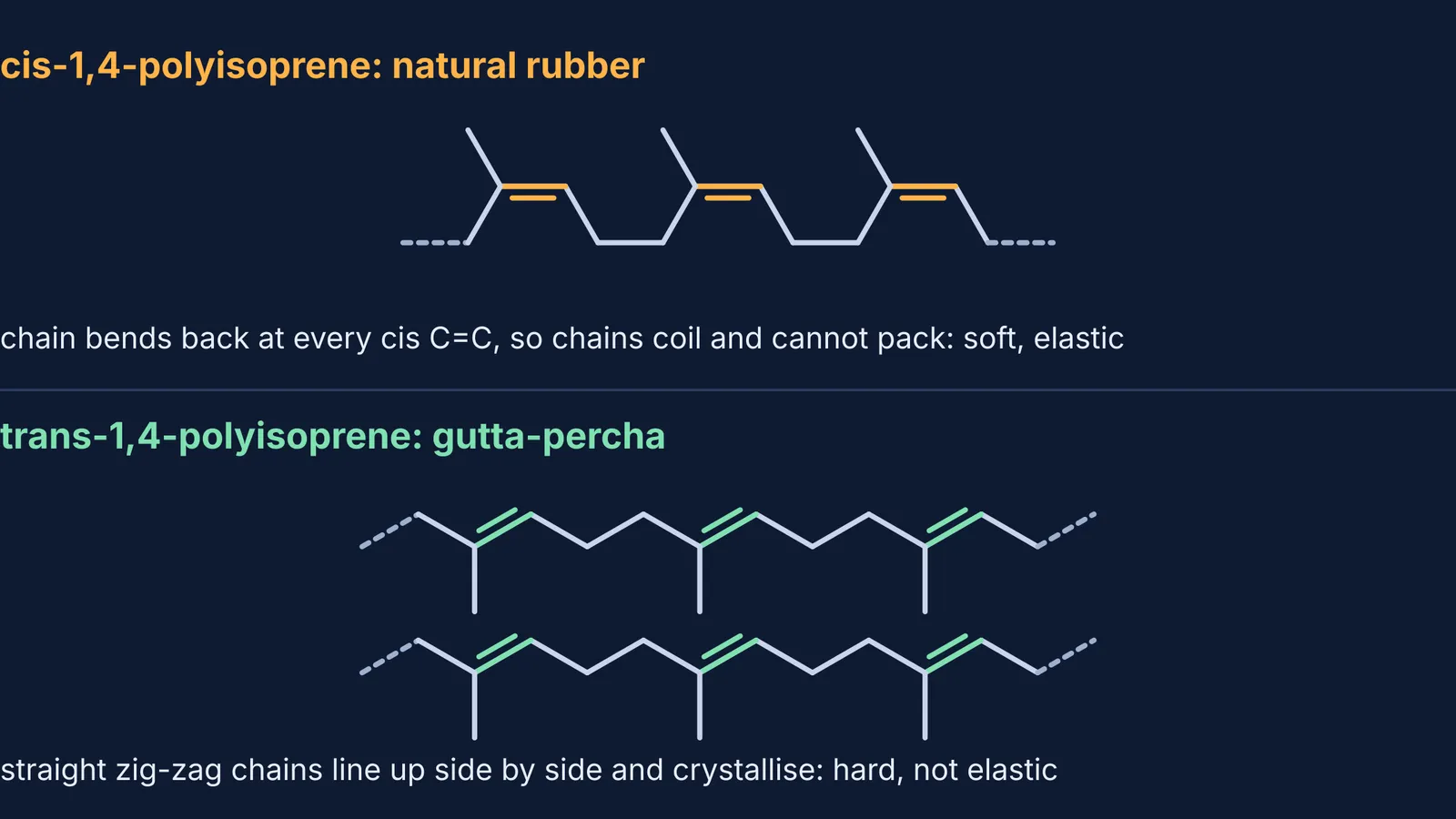
cis-1,4-polyisoprene: the two chain CH₂ groups sit on the same side of each double bond. This is natural rubber from the Hevea tree, and it is almost 100% cis. In E/Z terms it is the Z isomer, because the chain CH₂ outranks CH₃ on C2 and outranks H on C3.
trans-1,4-polyisoprene: the two chain CH₂ groups sit on opposite sides. This is gutta-percha (and also balata).
Why does the cis chain stay soft and elastic?
In a cis unit the chain enters and leaves the double bond from the same side, so the backbone has to turn back on itself at every repeat unit. The chain cannot lie out straight. Long molecules built this way fold into loose, random coils, and coils with irregular bends cannot line up neatly against their neighbours. The forces between chains are only weak van der Waals forces, and with poor packing there are fewer close contacts. So natural rubber is amorphous: no ordered crystalline regions at room temperature.
Elasticity comes from those coils. A coiled chain can take up an enormous number of shapes. Stretching the rubber pulls the chains straighter, which leaves far fewer possible shapes, so entropy falls. Let go and the chains return to random coils, and the sample shrinks back. This is why rubber is classed as an elastomer, the polymer group with the weakest forces between chains, as covered in how elastomers, fibres and plastics differ by intermolecular force.
Raw natural rubber still has problems. The chains can slide past each other, so it goes sticky when warm and brittle when cold. Sulphur cross-links fix that, which is the subject of vulcanisation of rubber, so it is not repeated here.
Why is gutta-percha hard and crystalline?
In a trans unit the chain leaves the double bond on the opposite side from where it entered. The backbone can then take up a regular, extended zig-zag. Straight, regular chains can lie side by side like pencils in a box. That close packing gives many van der Waals contacts along the whole length of each chain, and large parts of the solid become crystalline.
Crystalline regions are stiff. Stretching them means pulling packed chains apart, not just uncoiling them, so gutta-percha does not spring back like rubber. It becomes soft and mouldable when warmed to around 60 °C, when the crystalline regions melt, and sets hard again on cooling.
It is the same idea you meet with small molecules: trans isomers pack better and usually melt higher, as shown in why cis isomers boil higher but trans isomers melt higher. In a polymer the effect is multiplied over thousands of repeat units.
Where are rubber and gutta-percha used?
Natural rubber (vulcanised): tyres, rubber bands, gloves, shock absorbers, anything that must stretch and recover.
Gutta-percha: it insulated the first undersea telegraph cables in the 19th century, because it is waterproof and can be moulded hot. Dentists still use it to fill root canals. Early golf balls were made of it.
Natural rubber also has one trick that links back to packing. When it is stretched hard, the straightened cis chains line up enough to crystallise partly. This strain-induced crystallisation makes stretched rubber much stronger than you might expect, and it relaxes again when the force is removed.
Worked example: counting isoprene units in a rubber sample
A sample of natural rubber has a molar mass of 136,000 g/mol. How many isoprene units does one chain contain, and what mass of bromine will 1.00 g of it add?
Molar mass of the repeat unit. The repeat unit has the same formula as isoprene, C₅H₈. Using C = 12 and H = 1: 5 × 12 + 8 × 1 = 68 g/mol.
Number of units. n = 136,000 ÷ 68 = 2,000 isoprene units per chain. This number is the degree of polymerisation.
Double bonds per chain. Each repeat unit keeps one C=C, so one chain has 2,000 double bonds.
Moles of C=C in 1.00 g. The end groups are negligible in such a long chain, so moles of C=C = 1.00 ÷ 68 ≈ 0.0147 mol.
Bromine needed. Each C=C adds one Br₂ (molar mass about 159.8 g/mol): 0.0147 × 159.8 ≈ 2.35 g of Br₂.
Compare with gutta-percha. A gutta-percha chain of the same molar mass gives exactly the same answers: 2,000 units and 2.35 g Br₂ per gram. Formula, molar mass and bromine uptake cannot tell cis from trans. Only the shape, and properties that depend on shape such as crystallinity and elasticity, can.
Can you make natural rubber in a factory?
Not by simply polymerising isoprene with a free-radical initiator. That gives a random mixture of cis-1,4, trans-1,4, 1,2 and 3,4 units, and the irregular chains behave like neither rubber nor gutta-percha. Making nearly pure cis-1,4-polyisoprene needs a stereospecific catalyst, such as a Ziegler–Natta catalyst, which controls the geometry at every step. The product, synthetic polyisoprene, behaves much like natural rubber. Neoprene, Buna-S and Buna-N take a different route, using other monomers.
If you find it hard to picture how one bent unit turns a whole chain into a coil, the Concept Library explains geometric isomerism and polymer structure one idea at a time.
Quick checklist
Rubber and gutta-percha are both (C₅H₈)n, from 1,4-addition of isoprene.
Each repeat unit keeps one C=C, which can be cis or trans.
Natural rubber is cis-1,4 (Z): chains coil, cannot pack, amorphous, elastic.
Gutta-percha is trans-1,4 (E): straight chains pack, crystalline, hard, softens around 60 °C.
Degree of polymerisation = molar mass ÷ 68 g/mol.
Formula and bromine uptake are identical; only shape-dependent properties differ.


