On this page
Your textbook sorts polymers in several ways: by source, by structure, by how they are made. The one that often trips students up is the classification by molecular forces, because it asks you to connect something invisible (the pull between chains) with something you can feel (stretch, strength, what happens on heating).
What are the four classes of polymers based on molecular forces?
A polymer module from NPTEL, the joint online-course initiative of the IITs and IISc (Module 16, Polymers), lists four classes based on molecular forces: thermoplastic, thermosetting, elastomers and fibres. Long chains lie side by side, and how strongly they hold their neighbours decides how the material behaves.
Elastomer: a randomly arranged polymer that stretches and then returns to its original shape (NPTEL).
Thermoplastic: a polymer held together by relatively weak intermolecular forces, so it softens when heated and returns to its original condition when cooled (LibreTexts, Classification of Polymers/06%3A_Morphology/6.01%3A_Classification_of_Polymers)).
Fibre: a thread-like polymer in which strong intermolecular forces such as hydrogen bonds give high tensile strength (NPTEL).
Thermoset: a polymer that sets irreversibly when heated and cannot be reshaped by heating again (LibreTexts/06%3A_Morphology/6.01%3A_Classification_of_Polymers)).
Which polymer class has the strongest intermolecular forces?
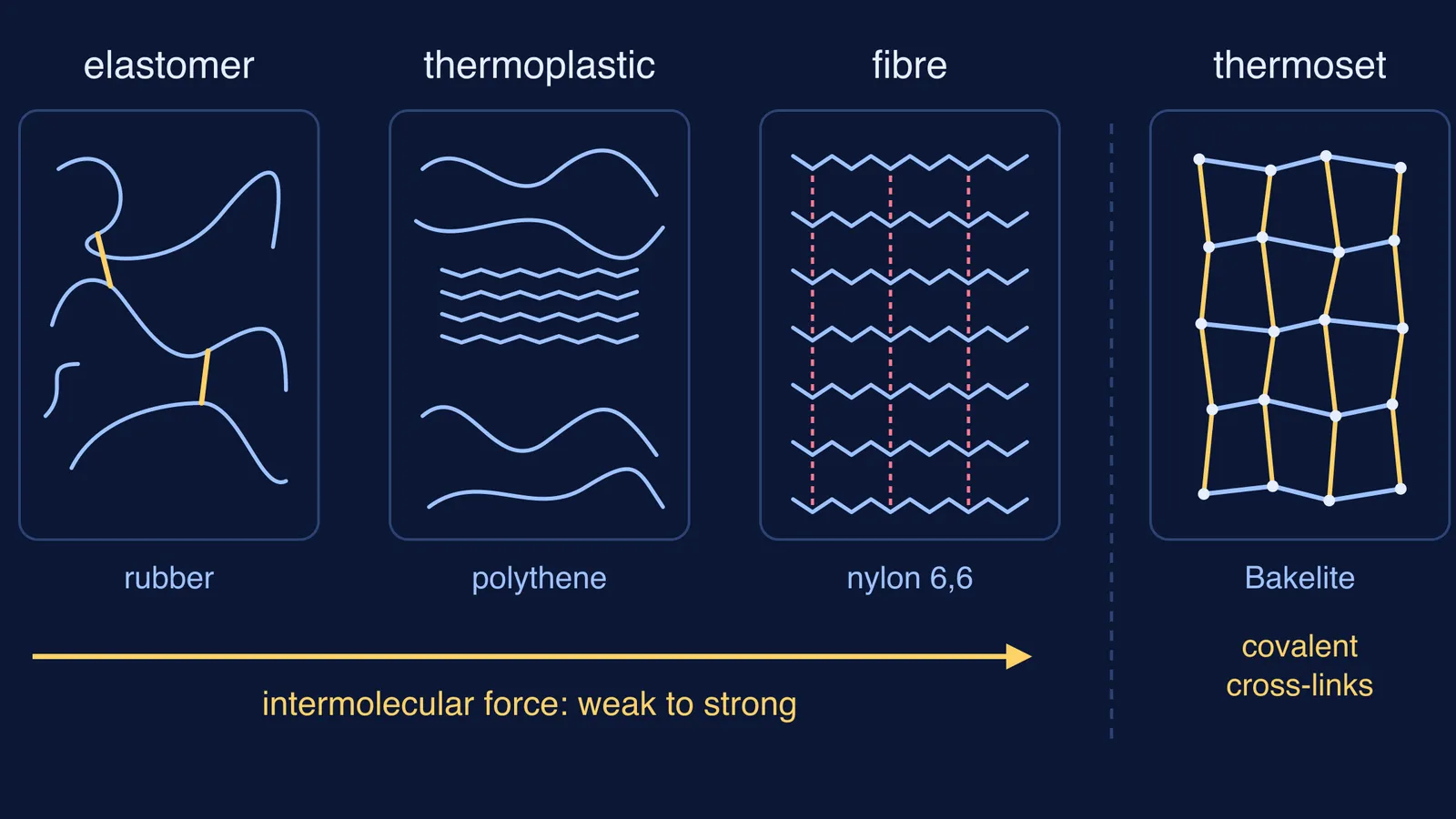
Fibres. Lecture notes on polymer properties from Veer Surendra Sai University of Technology (VSSUT, Module IV) say plastics have cohesive energies higher than those of elastomers but lower than those of fibres. Here is the ladder from weakest to strongest, with one example of each and the property the force gives it.
Elastomers, weakest. Example: rubber. In an elastomer, the van der Waals forces are not strong enough to hold stretched chains in place, so the material returns to its shape when the stress is removed (NPTEL). In natural rubber, the coiled chains straighten when pulled and go back to their random state when released (LibreTexts on rubber/14%3A_Conjugated_Compounds_and_Ultraviolet_Spectroscopy/14.06%3A_Diene_Polymers-_Natural_and_Synthetic_Rubbers)). Property: elasticity.
Thermoplastics, in between. Example: polythene (polyethylene). The chains are held by van der Waals forces, and on heating they slip past one another, so the plastic softens (NPTEL). Polystyrene, polypropene and Teflon belong here too. Property: it can be softened and reshaped again and again.
Fibres, strongest. Example: nylon 6,6. Each N–H group in a nylon chain can hydrogen bond to the oxygen of a C=O group on a neighbouring chain, so the chains cannot slide past one another easily (LibreTexts on condensation polymers/08%3A_Properties_of_Organic_Compounds/8.25%3A_Condensation_Polymers)). Polyethylene, held only by London forces, is not used for thread partly for this reason. Cotton, wool and silk are fibres too. Property: high tensile strength.
Why do thermosetting polymers sit apart from the ranking?
Thermosets are generally stronger than thermoplastics because their chains are joined by covalent cross-links rather than weak van der Waals forces; they are more brittle, their shape is permanent, and once hardened they cannot be recycled (NPTEL). Example: Bakelite. Melmac, a highly cross-linked polymer of melamine and formaldehyde used for lightweight dishes, is another, and so are polyurethanes. Property: it cannot be softened and reshaped by heating. Our post on why cooker handles are made of Bakelite shows why that matters in your kitchen.
Draw thermosets on a separate step, as the diagram at the top does.
How do you classify a polymer in an exam?
Ask three questions, in this order.
Are the chains joined by many covalent cross-links into a rigid network that does not soften on heating? Then it is a thermoset.
Does it stretch a long way and spring back? Then it is an elastomer.
Is it a strong thread, with hydrogen bonds or similar strong forces between chains? Then it is a fibre. If none of these fit, it is a thermoplastic.
Now try them on four examples.
Teflon: no network, no stretch-and-return, not a hydrogen-bonded thread. Thermoplastic.
Melmac: a highly cross-linked network. Thermoset.
Silk: a strong natural thread. Fibre.
Vulcanised rubber: the tricky one. Vulcanisation forms carbon–sulphur bonds between rubber chains and stiffens the polymer (LibreTexts on rubber/14%3A_Conjugated_Compounds_and_Ultraviolet_Spectroscopy/14.06%3A_Diene_Polymers-_Natural_and_Synthetic_Rubbers)). It still fails question 1, because elastomers have a low cross-link density (LibreTexts/06%3A_Morphology/6.01%3A_Classification_of_Polymers)), and it passes question 2. Elastomer. Our explainer on vulcanisation of rubber walks through the process.
Where should you go from here?
This is one of several ways to classify polymers. The other one examiners love, by how the polymer is made, is covered in addition and condensation polymers.
If the link between intermolecular forces and properties still feels shaky, the Fermi Concept Library has a lesson for every concept in chemistry, each placed in the map, so you can revisit hydrogen bonding and van der Waals forces first. When you practise classification questions, the Fermi Problem Library has worked problems with a step-by-step solver that explains the reasoning rather than printing an answer.
Syllabi change, so check that polymers are in your board's or exam's current syllabus, then draw the ladder from memory once before your next test.