

On this page
If you look at the top of a building or a street pole, you might have noticed more mobile phone antennas appearing recently. This is the physical reality of upgrading from 4G to 5G networks. While 5G promises much faster download speeds and higher capacity, those benefits come with a trade-off dictated by physics: the signal does not travel as far.
How does frequency affect data speed?
Mobile networks use radio waves to transmit data. The fundamental difference between 4G and the fastest forms of 5G is the frequency of these waves.
4G LTE typically operates on lower frequencies, generally between 600 MHz and 3 GHz. These are known as "decimeter waves".
In contrast, while 5G uses some of these lower bands for basic coverage, its true multi-gigabit speeds rely on Frequency Range 2 (FR2). This range operates between 24.25 GHz and 71 GHz, known as "millimeter waves" or mmWave. A higher frequency means more waves arrive per second, which allows the network to carry significantly more data. However, higher frequencies lose their energy faster as they travel through the air.
If you're studying the relationship between frequency, wavelength, and the energy of a photon for your exams, Fermi's AI tutor can work out what you already know and build a plan for the session.
Why can't 5G bend around buildings?
The shorter range of 5G is not just about losing energy in the air; it is about how waves interact with obstacles. This is governed by diffraction.
All waves diffract, or bend, around obstacles. However, the amount of bending depends on the size of the obstacle compared to the wavelength of the wave. When an obstacle is close in size to the wavelength, the wave bends significantly.
The speed of light (c) is equal to the frequency (f) multiplied by the wavelength (λ). Because 5G mmWave has a much higher frequency than 4G, its wavelength is much shorter—measured in millimeters rather than centimeters.
A 4G wave, with a wavelength of around 30 centimetres, can diffract around the edges of buildings and penetrate walls. A 5G millimeter wave acts more like a beam of light. It travels in a straight line and is easily blocked by physical objects. High-band signals can lose over 100 dB of strength when trying to pass through common building materials. Even heavy rain or a single pane of energy-efficient glass can disrupt a mmWave signal.
To visualise how wavefronts bend around obstacles of different sizes, you can experiment in the Fermi Simulation Lab.
Why does 5G need more towers than 4G?
Because of these physical limits, a single 5G mmWave tower cannot cover a whole neighbourhood.
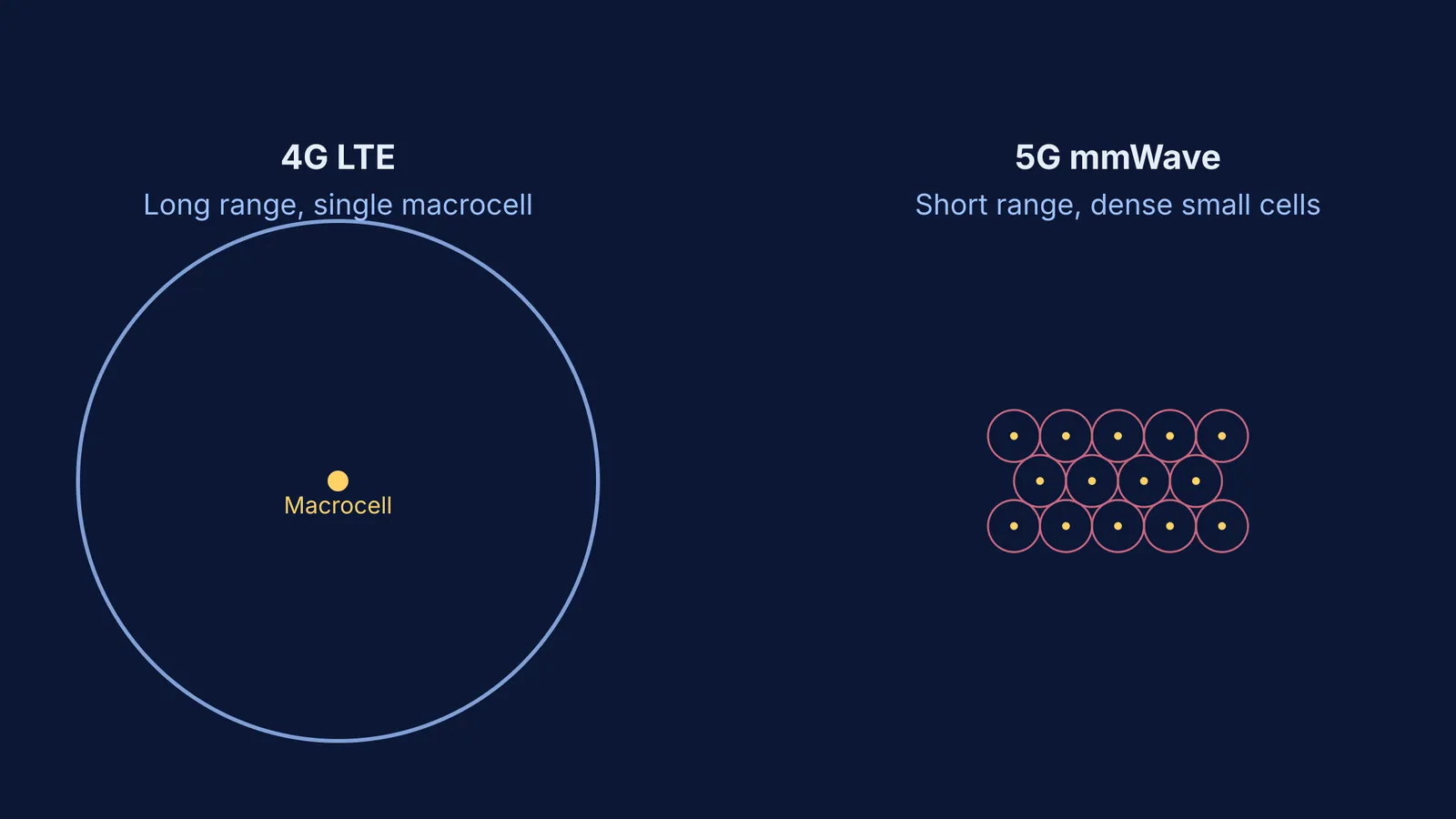
A traditional 4G macrocell tower can transmit its signal for several kilometres, providing coverage to a wide area. In contrast, a 5G mmWave signal typically only travels a few hundred metres.
To provide continuous coverage without dead zones, telecommunications companies must use a "small cell" architecture. Instead of relying on a few massive towers, 5G requires a dense network of smaller antennas placed close together—often on streetlights, utility poles, and the corners of buildings. This ensures that your phone always has a direct line of sight to an antenna before the signal degrades or gets blocked.
Understanding the physics of path difference and wavelength helps explain why network architecture has to change. Higher speeds demand higher frequencies, but the unyielding rules of diffraction mean those frequencies can only be delivered over short distances.


