

On this page
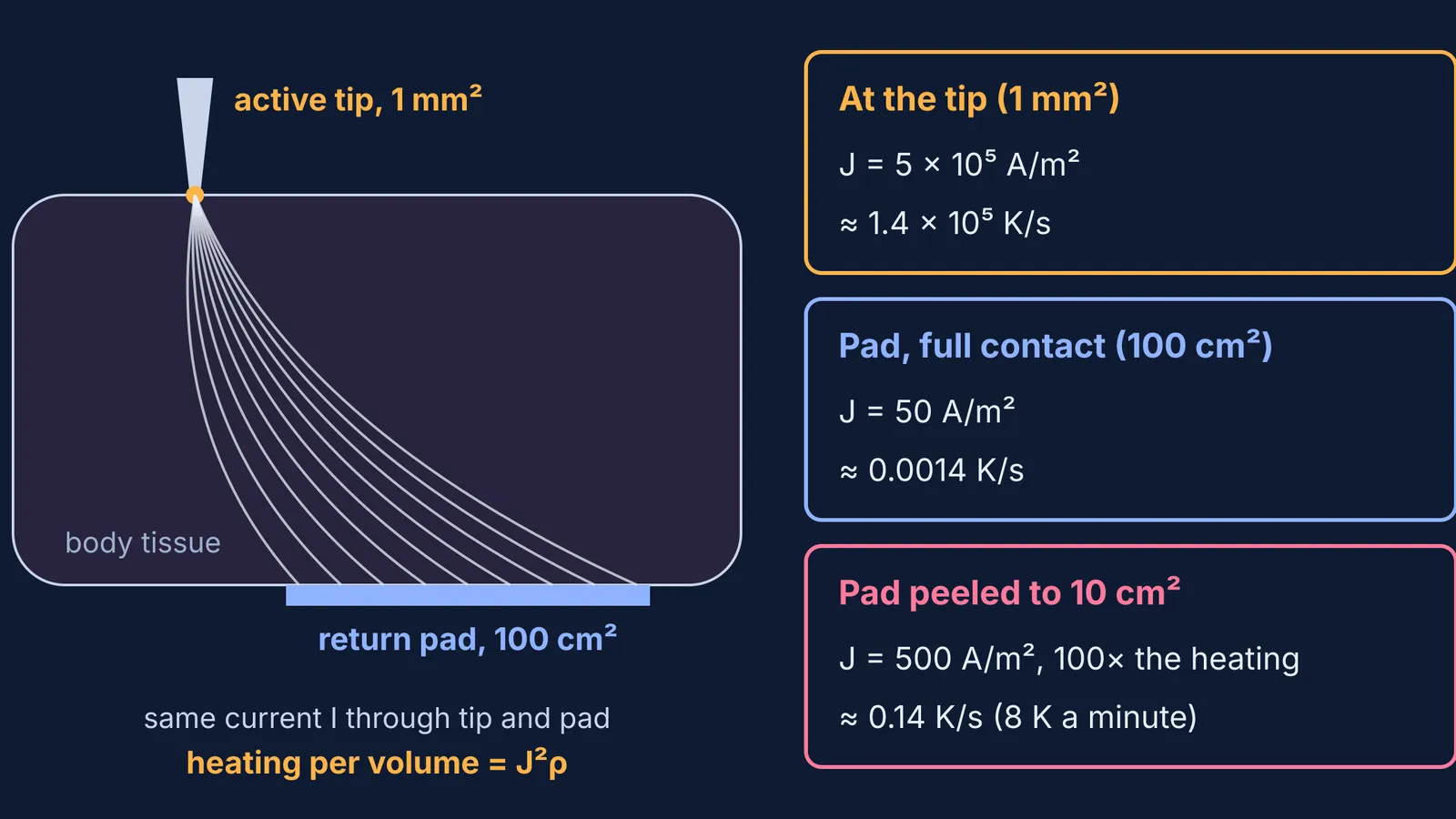
In monopolar electrosurgery, a pen-like instrument with a fine metal tip carries a high-frequency current into the body. The current spreads through the tissue and leaves through a large, sticky return pad, often on the thigh. At the tip, tissue heats so fast that it is cut or sealed. At the pad, the skin barely warms. The same current flows through both, so why the difference? And why can a pad that has partly peeled off cause a burn? The answers are current density and Joule heating per unit volume, plus one fact about frequency.
This is a physics explainer, not medical advice. Electrosurgical equipment is set up and operated only by trained surgical staff, and nothing here is a guide to settings or use.
Why does the same current heat the tip and the pad so differently?
Current density is current per unit area, J = I/A. If you need a refresher on why J is a vector and how it relates to drift speed, see what current density is and why it is a vector.
The key step is to write Joule heating per unit volume instead of for a whole resistor. Take a small cube of tissue of side L with resistivity ρ. Its resistance is R = ρL/L² = ρ/L, the current through it is JL², so the power is
P = I²R = (JL²)² × ρ/L = J²ρ L³.
Divide by the volume L³: power per unit volume = J²ρ. This is the local form of the H = I²Rt rule whose history is told in the story of Joule's law of heating.
Because heating goes as J², area matters twice. Make the area 10 times smaller and the heating per volume goes up 100 times.
How fast does tissue heat at the tip and under the pad?
Use round, illustrative values only; real currents and tissue properties vary widely.
Current I = 0.5 A.
Tissue resistivity ρ = 2 Ω m.
Heat capacity per unit volume of tissue, about 3.6 × 10⁶ J/(m³ K), similar to water.
Tip contact area 1 mm² = 1.0 × 10⁻⁶ m². Pad area 100 cm² = 1.0 × 10⁻² m².
At the tip
J = I/A = 0.5/(1.0 × 10⁻⁶) = 5.0 × 10⁵ A/m².
Power per volume = J²ρ = (5.0 × 10⁵)² × 2 = 5.0 × 10¹¹ W/m³.
Heating rate = 5.0 × 10¹¹/3.6 × 10⁶ ≈ 1.4 × 10⁵ K/s.
To go from 37 °C to 100 °C (63 K) takes about 63/1.4 × 10⁵ ≈ 0.45 ms, ignoring heat flowing away.
Water in the cells boils within a fraction of a millisecond, and the cells burst. That is the cutting effect.
Under the pad
J = 0.5/(1.0 × 10⁻²) = 50 A/m².
Power per volume = 50² × 2 = 5.0 × 10³ W/m³.
Heating rate = 5.0 × 10³/3.6 × 10⁶ ≈ 0.0014 K/s, or about 0.08 K in a minute.
The ratio of heating rates is (10⁻²/10⁻⁶)² = (10⁴)² = 10⁸. Units check: (A/m²)² × Ω m = A²Ω/m³ = W/m³, and W/m³ ÷ J/(m³ K) = K/s.
One more real-world detail: the current does not stay at J = 5 × 10⁵ A/m² as it goes deeper. It spreads out from the tip, the area it crosses grows quickly, and J falls. So only a thin layer of tissue right at the tip is heated fiercely.
Why does a half-stuck return pad cause burns?
Suppose the pad peels so that only 10 cm² still touches the skin. The full current must now squeeze through that patch.
J = 0.5/(1.0 × 10⁻³) = 500 A/m², 10 times higher.
Heating rises by 10² = 100 times, to about 0.14 K/s.
Over a minute that is about 8 K, before allowing for blood flow carrying heat away.
That is why a partly detached pad is a recognised cause of burns. A peer-reviewed review, El-Sayed and Saridogan, Gynecology and Pelvic Medicine (2021), explains that the wide pad keeps current density low and attributes pad burns to partial detachment or high skin impedance. It also describes contact quality monitoring: the pad is split in two, the generator checks the contact between the halves, and it alarms and stops if contact is poor. An earlier review, Alkatout et al., JSLS (2012), makes the same points.
Bipolar instruments are different. Both electrodes sit in the instrument tip, so the current only crosses the tissue held between them and no pad is needed.
Why does a high-frequency current not give the patient a shock?
At mains frequency, 50 Hz, a current of a few milliamperes across the chest can be dangerous, because it fires nerves and muscles, including the heart. Why wet skin makes such shocks more likely is covered in why touching switches with wet hands is dangerous.
Electrosurgical generators work at much higher frequencies. The 2021 review cited above gives an output range of about 500 kHz to 3 MHz and states that currents above 100 kHz do not cause the neuromuscular stimulation (the faradic effect) seen at low frequency. Compare the duration of one half-cycle:
50 Hz: 1/(2 × 50) = 10 ms.
500 kHz: 1/(2 × 500,000) = 1.0 µs.
A nerve membrane needs current in one direction for long enough to charge it to its firing threshold. A push lasting a microsecond is reversed before that happens, so the current heats tissue without triggering nerves and muscles.
A common myth is that high frequency is safe because of the skin effect, with current staying on the surface. That is wrong for tissue. The skin depth is δ = √(2ρ/(ωμ₀)). For ρ = 2 Ω m at 500 kHz it comes to about 1.0 m, longer than the path from tip to pad, so the current really does pass through the tissue. Frequency changes whether it stimulates, not where it flows.
To revise current density and Joule heating side by side with other topics, the Concept Library covers every concept in physics, chemistry, biology, mathematics and computing.
Quick checklist
Same current through tip and pad; current density J = I/A differs.
Heating per volume = J²ρ, so it goes as 1/A².
Illustrative numbers: tip 5 × 10⁵ A/m² and about 1.4 × 10⁵ K/s; pad 50 A/m² and about 0.0014 K/s.
Pad contact area down 10 times means heating up 100 times.
Above about 100 kHz, current heats without stimulating nerves and muscles.
The skin effect does not explain safety; the short half-cycle does.
Bipolar tools need no pad. Equipment is operated only by trained staff.


