

On this page
You have likely heard the warning a hundred times: never touch a light switch or appliance with wet hands. But what exactly makes a wet hand so much more dangerous than a dry one? The answer lies in the physics of electrical circuits and a biological quirk of human skin.
The physics of a shock: Ohm's law
The severity of an electric shock does not depend solely on the voltage, but on the amount of current that actually flows through your vital organs. As we learn in introductory physics, Ohm's law states that current equals voltage divided by resistance (I = V/R).
If the voltage from the wall remains constant—230 volts in a standard Indian household (Wikipedia)—the only thing standing between you and a massive electrical current is the resistance of your body.
Why does water lower resistance so much?
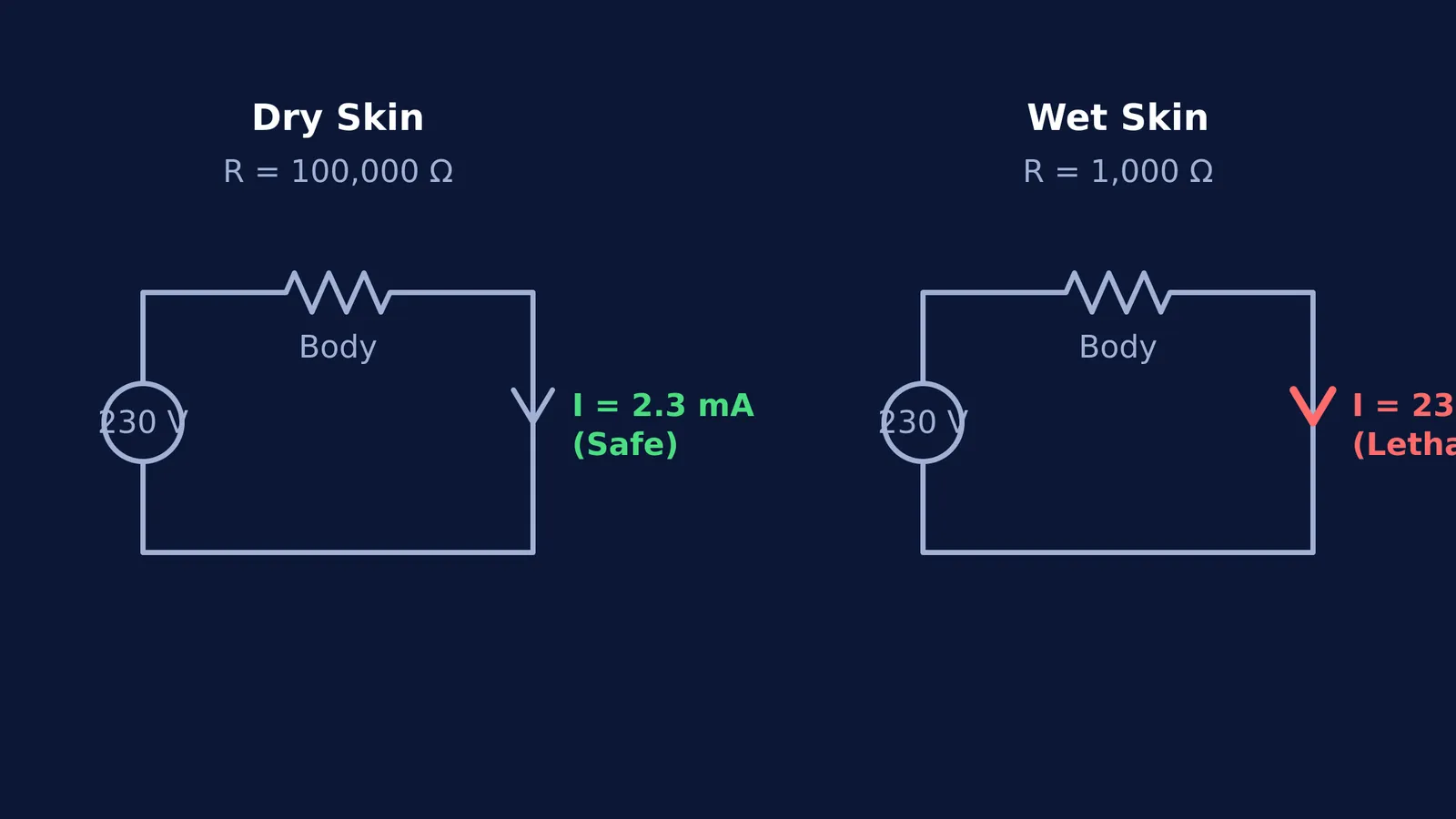
The outer layer of human skin (the stratum corneum) is an excellent insulator. Under dry conditions, the electrical resistance of the human body can be as high as 100,000 ohms (Wikipedia). At 230 volts, a resistance of 100,000 ohms limits the current to just 2.3 milliamps (mA)—a minor shock that you will feel as a slight tingle, but which is generally harmless.
However, water—especially tap water or sweat, which contains dissolved salts and ions—is an excellent conductor. When your skin is wet, it acts like a soaked sponge. The moisture bypasses the dry, insulating dead cells and provides a direct, low-resistance path into the highly conductive, fluid-filled tissues inside your body. According to safety data, wet or broken skin drops your body's resistance to just 1,000 ohms (Wikipedia).
Just as engineering students must understand how resistance changes with length when designing wires, knowing how moisture changes tissue resistance is essential for personal safety.
Why is touching switches with wet hands dangerous?
You might assume that because a switch plate is made of insulating plastic, you are safe even if your hands are wet. But a mechanical switch has tiny gaps around the button. When you press it with wet hands, a drop of water can easily seep into those crevices, creating a continuous conductive liquid bridge between your finger and the live brass contacts inside.
Once that connection is made, your body effectively becomes a new branch in the circuit down to the ground. (Students solving complex grids with the node potential method will recognise this as a parallel path to the ground). Because your wet skin has dropped your resistance to 1,000 ohms, the current spikes dramatically: 230 V / 1,000 Ω = 230 mA (Wikipedia).
This is a lethal amount of electricity. Medical and safety guidelines note that a current of just 10 mA is the "let-go" threshold where muscles contract involuntarily, trapping you against the electrical source (Wikipedia). A current of 30 mA or more across the chest can disrupt the heart's electrical rhythm, causing ventricular fibrillation and cardiac arrest. At 230 mA, a shock is rapidly fatal.
How does the current find a path to the ground?
For an electric shock to occur, current must have a path to flow into your body and a path to exit. Electricity always seeks the easiest route to the ground. When you stand barefoot on a wet bathroom floor, you are perfectly grounded. The moisture on your skin provides the entry point, your body provides the conductive vessel, and the wet floor provides the exit. This complete, low-resistance circuit allows the maximum possible current to flow straight through your core.
What are practical steps to prevent electrical injury?
Electrical safety at home relies on maintaining high resistance in your environment. Here is a practical framework to protect yourself and your family:
Create physical barriers: Always dry your hands thoroughly before touching any plug, switch, or appliance. Water acts as an invisible wire, so removing it removes the danger.
Break the circuit to the ground: Wear rubber-soled footwear when operating appliances in the kitchen or bathroom. Rubber is a highly effective insulator that blocks the current's exit path to the ground.
Install automated protection: Ensure your home's main switchboard is equipped with a Residual Current Device (RCD) or Earth Leakage Circuit Breaker (ELCB). These devices monitor the current going in and coming out. If they detect a difference of even 30 milliamps—meaning electricity is leaking through a person or water—they trip and cut the power in under 40 milliseconds (Wikipedia), well before a lethal shock can occur.
If you want to explore how resistance and voltage determine current flow without taking real-world risks, electricity can sometimes be a hard-to-picture idea. The Fermi Simulation Lab has interactive simulations for the ideas that are easier to see than to read, letting you safely build circuits, adjust resistance, and test Ohm's law on screen.


