

On this page
When you study electricity, one of the first things you learn is that electric current (I) has a direction in a circuit, but it is actually a scalar quantity. It simply tells you the total rate at which charge passes through a wire. But what if you want to know exactly what is happening inside that wire, point by point?
This is where current density comes in.
What is current density (J) and its unit?
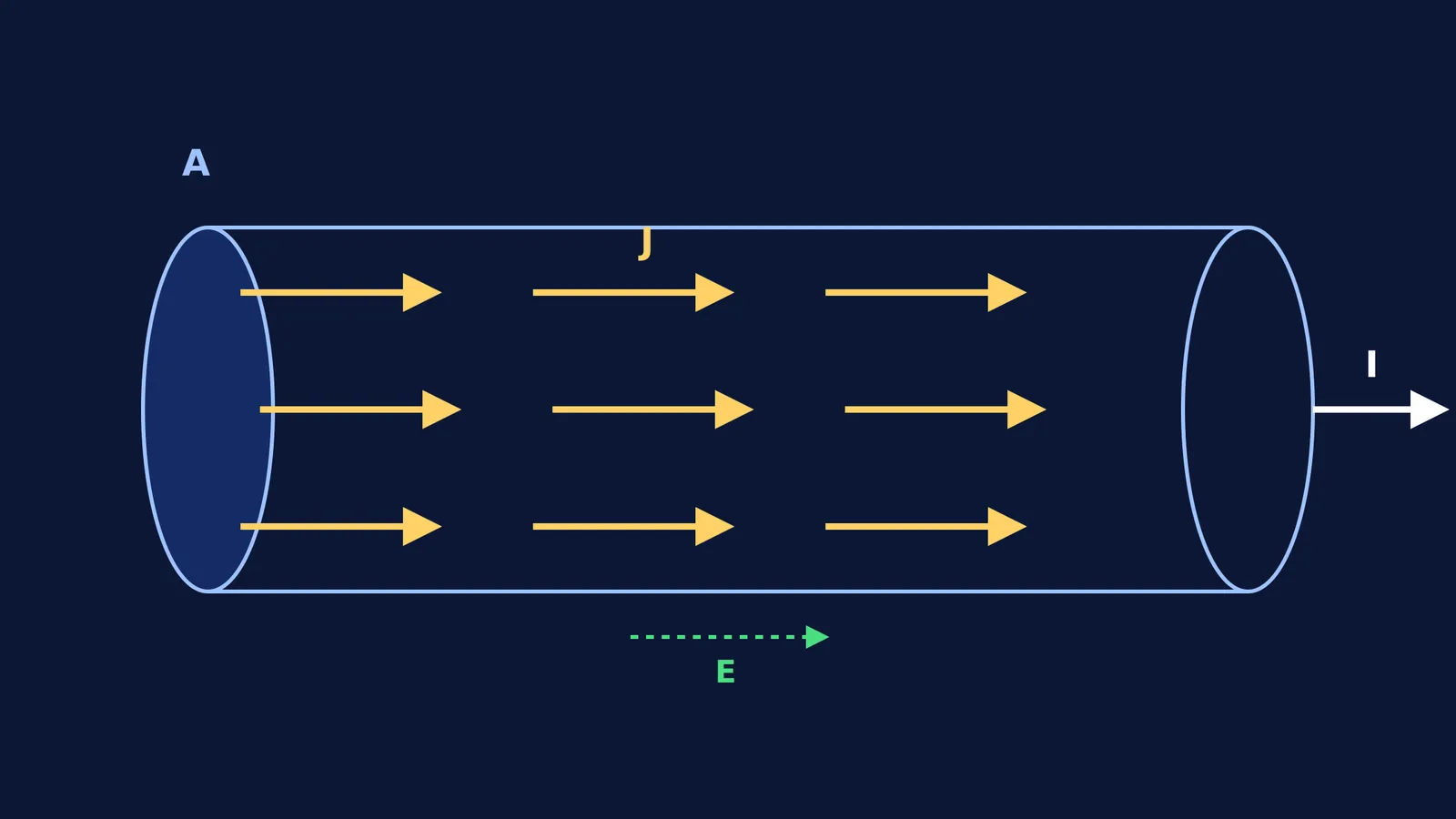
Current density, denoted by the letter J, is defined as the electric current per unit area of cross-section. If a uniform current I flows straight through a wire with a cross-sectional area A, the magnitude of the current density is:
J = I / A
The SI unit of current density is the ampere per square metre (A/m²), as defined in the International System of Units (SI) brochure published by the International Bureau of Weights and Measures (BIPM).
Think of a river. The total current I is like the total amount of water flowing past a bridge every second. The current density J is how fast the water is moving at one specific spot in the river. Near the banks, the water might be slow; in the middle, it might be fast. Current density gives you that detailed, local picture.
How do you use J = I/A in exam problems?
When you solve numericals on current density, use this three-step checklist to avoid common mistakes:
Check the units: Area is often given in mm² or cm². Always convert it to m² before dividing. (Remember, 1 mm² is 10⁻⁶ m²).
Watch the angle: If the cross-section is not perpendicular to the current flow, you must use the projected area perpendicular to the flow.
Use the radius carefully: For a cylindrical wire, the area is πr². If a problem gives you the diameter, halve it first.
Why is current density a vector while current is not?
It seems strange that current has a direction (from positive to negative) but is treated as a scalar. The reason is that current is a macroscopic summary: it is the total flux of charge through a surface. It adds up like water in pipes using simple arithmetic (Kirchhoff's junction rule), without needing vector addition laws.
Current density, however, is a microscopic property defined at every single point inside the conductor. Because charge carriers (like electrons) move in a specific direction at any given point, J must be a vector. The direction of the current density vector is the direction that positive charges would move at that point.
When you look closely at how a bulb glows instantly despite slow drift velocity, it is the electric field establishing itself across the conductor that drives these charges, creating a local current density everywhere at once.
What is the microscopic form of Ohm's law?
In school, you learn Ohm's law as V = IR. This macroscopic version works for a whole wire or a component. But if you zoom in to a single point inside a material, you need the microscopic form of Ohm's law.
Inside a conductor, the current density vector J is directly proportional to the electric field vector E at that point:
J = σE
Here, σ is the electrical conductivity of the material. This equation tells you that the local flow of charge (J) is driven by the local push of the electric field (E), and they point in the same direction for isotropic materials (HyperPhysics).
If you are struggling to picture how fields drive charges point by point, the Fermi Concept Library maps out these microscopic ideas visually, so you can trace the physics rather than just memorising the formula. Understanding how local vectors like J and E build up to macroscopic scalars like I and V is a key step in mastering electrodynamics, whether you are preparing for boards or competitive exams like the JEE. It also changes how you draw diagrams; following the rules for drawing electric field lines helps you visualise where the current density will be strongest.


