

On this page
What is the history of H = I²Rt?
Before 1840, scientists largely believed in the "caloric theory", which argued that heat was a fluid that flowed between objects. James Prescott Joule, a 22-year-old working in his family's brewery, challenged this idea while trying to measure the efficiency of electric motors.
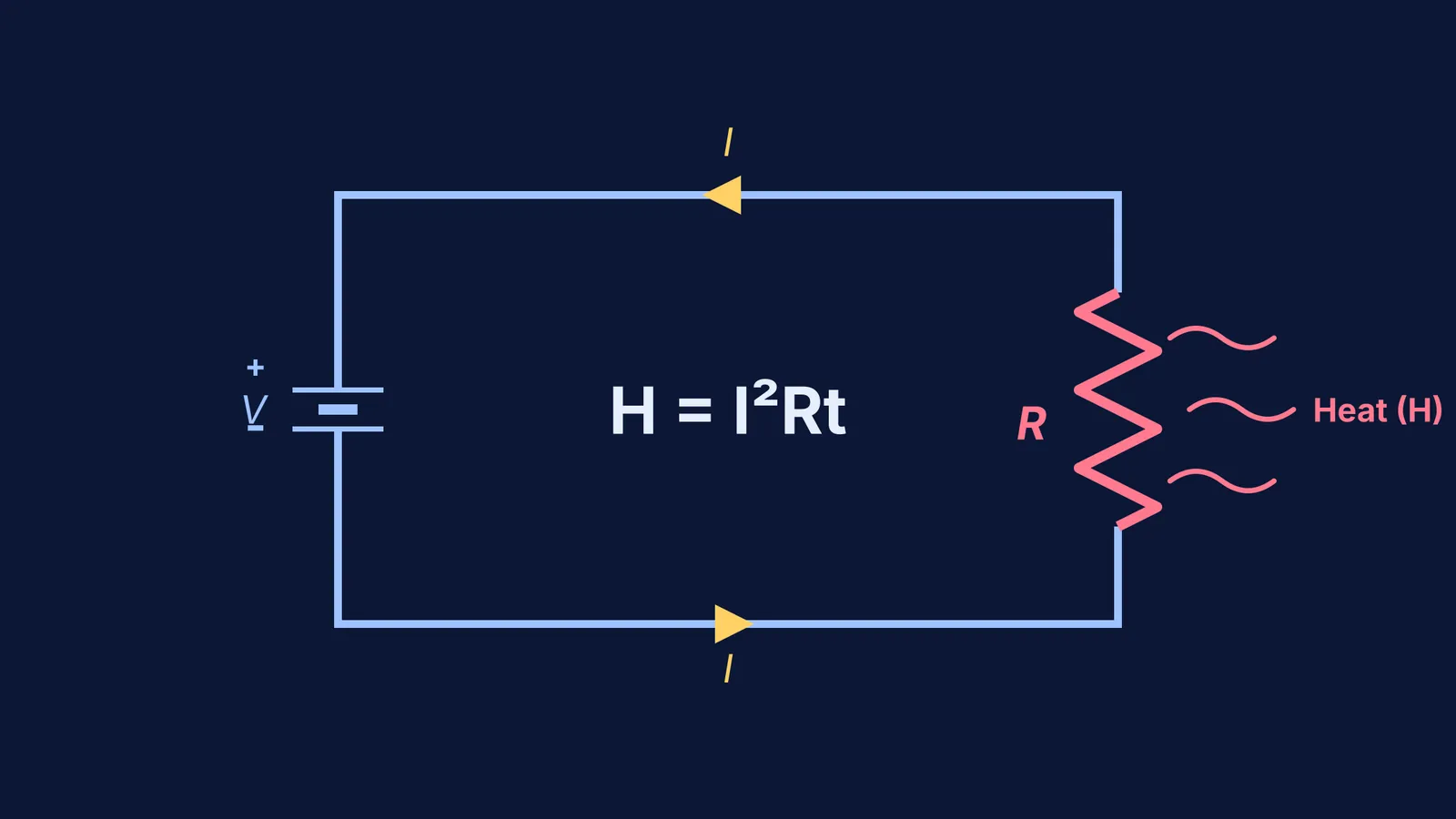
He immersed a wire of known resistance into a fixed mass of water and measured the temperature rise caused by an electric current over 30 minutes. By varying the current and the wire, he deduced that the heat produced was proportional to the square of the current multiplied by the electrical resistance. Though initially overlooked by the Royal Society, he published his full paper, "On the Heat evolved by Metallic Conductors of Electricity", in the *Philosophical Magazine* in 1841. This discovery paved the way for the mechanical theory of heat—the idea that heat is simply a form of energy.
How did this discovery change physics?
Before Joule's experiments, the caloric theory dominated science. It proposed that heat was a weightless, invisible fluid that flowed from hot bodies to cold ones. By proving that electrical work could generate heat in a highly predictable ratio, Joule showed that heat was not a fluid at all.
He followed his electrical experiments with mechanical ones, eventually determining the mechanical equivalent of heat—proving that it takes approximately 4.18 joules of work to raise the temperature of one gram of water by one degree Celsius. This proved that energy is conserved when converting between mechanical work and heat, laying the direct foundation for the First Law of Thermodynamics. The standard unit of energy, the joule (J), was later named in his honour to recognise this fundamental shift in physics.
How does a fuse use Joule heating?
A fuse is a safety device built around Joule's law of heating. The formula H = I²Rt shows that heat rises sharply—as the square of the current—when an electrical surge happens.
Inside a fuse is a thin strip made of metals like zinc, copper, silver, or alloys tailored for a low melting point (Wikipedia)). Placed in series with a circuit, the fuse allows normal current to pass without overheating. But if a fault causes a massive current spike, the I² term forces the wire to heat up instantly. The element reaches its melting point and breaks, stopping the flow of electricity before your appliances catch fire.
Why do heaters not melt like fuses?
Electric heaters, kettles and toasters use the exact same physics to generate heat, but with a different set of materials.
While a fuse is designed to snap under heat, a toaster is designed to survive it. Toasters use heating elements made of Nichrome, a nickel-chromium alloy with a melting point of around 1,400 °C. Nichrome provides a high resistance (R), which produces a large amount of heat (H) as current flows through it. Instead of melting, it glows red-hot and forms a protective chromium oxide layer that prevents the metal from degrading in the air.
If you want to see how current and resistance affect temperature, the Fermi Simulation Lab has interactive simulations for the ideas that are easier to see than to read. (If you change the length of the heating element, the resistance changes too; you can review Stretching a wire: how its resistance changes with length for the mathematics).
A framework for Joule heating numericals
When you solve numericals on heating effects for school exams or JEE, the hardest part is choosing the right formula. Because V = IR, Joule's law can be written in three ways: H = I²Rt, H = VIt, and H = (V²/R)t (Wikipedia).
Use H = I²Rt when components are in series. In a series circuit, the current (I) is constant across all resistors.
Use H = (V²/R)t when components are in parallel. In a parallel circuit, the voltage (V) is the same across all branches.
Always convert time to seconds. If a question says a heater runs for 5 minutes, multiply by 60 before calculating.
If you are struggling to spot series and parallel paths, the Fermi Problem Library has worked problems with a step-by-step solver that explains the reasoning rather than printing an answer.
Let's test the framework: A 44 Ω toaster draws 5 A from a 220 V line for 2 minutes. Since we have I and R, we use H = I²Rt. Convert time: t = 2 × 60 = 120 s. Calculate: H = 5² × 44 × 120 = 25 × 44 × 120 = 132,000 J, or 132 kJ. The toaster produces 132 kJ of heat safely, avoiding the melting point that would blow a fuse.


