

On this page
A common beam balance in a shop looks symmetric, but its two arms are never exactly the same length. If one arm is 25.0 cm and the other is 25.5 cm, the beam can still sit level when it is empty, and yet every reading is off by about 2%. You cannot see a 5 mm difference by eye. You can, however, find the true mass without measuring the arms at all. Weigh the object once on each pan and take the geometric mean of the two readings.
This post works through why that trick is exact, what it tells you about the arms, and how the same physics lets a dishonest seller short every customer.
How does a beam balance use the principle of moments?
A beam balance is a lever with the pivot (fulcrum) in the middle. A mass M hanging at distance a from the pivot pulls down with weight Mg and produces a torque Mga. When the beam is level and at rest, the clockwise and anticlockwise torques about the pivot are equal. This is the principle of moments, explained with the see-saw in how to balance a see-saw with the principle of moments.
For a balance, g cancels on both sides, so the condition is just:
mass on left × left arm = mass on right × right arm
That is why a beam balance compares masses, not weights. It would read the same on the Moon. A spring balance is different, as does a spring balance measure mass or weight shows.
One condition is assumed throughout this post: the empty beam balances. The pans, hooks and beam itself produce no net torque on their own, so only the goods and the weights matter.
Why does a balance with unequal arms give the wrong mass?
Call the left arm a and the right arm b. Put goods of true mass M on the left pan and add standard weights m₁ on the right pan until the beam is level:
M × a = m₁ × b, so m₁ = M × a/b
If a = b, then m₁ = M and all is well. If a is shorter than b, the weights you need are less than M, and you read the goods as lighter than they are. Swap the goods to the right pan and you need weights m₂ on the left:
m₂ × a = M × b, so m₂ = M × b/a
Now the reading is too heavy. The two readings bracket the true mass, one low and one high, by the same factor b/a.
Why is the true mass the geometric mean √(m₁m₂)?
Multiply the two readings:
m₁ × m₂ = (M × a/b) × (M × b/a) = M²
The arm lengths cancel exactly, whatever they are. So:
M = √(m₁ × m₂)
Divide them instead and the mass cancels:
m₂ ÷ m₁ = (b/a)², so b/a = √(m₂ ÷ m₁)
This is called double weighing, or the transposition method. One pair of readings gives you both the true mass and the ratio of the arms.
Worked example: arms of 25.0 cm and 25.5 cm
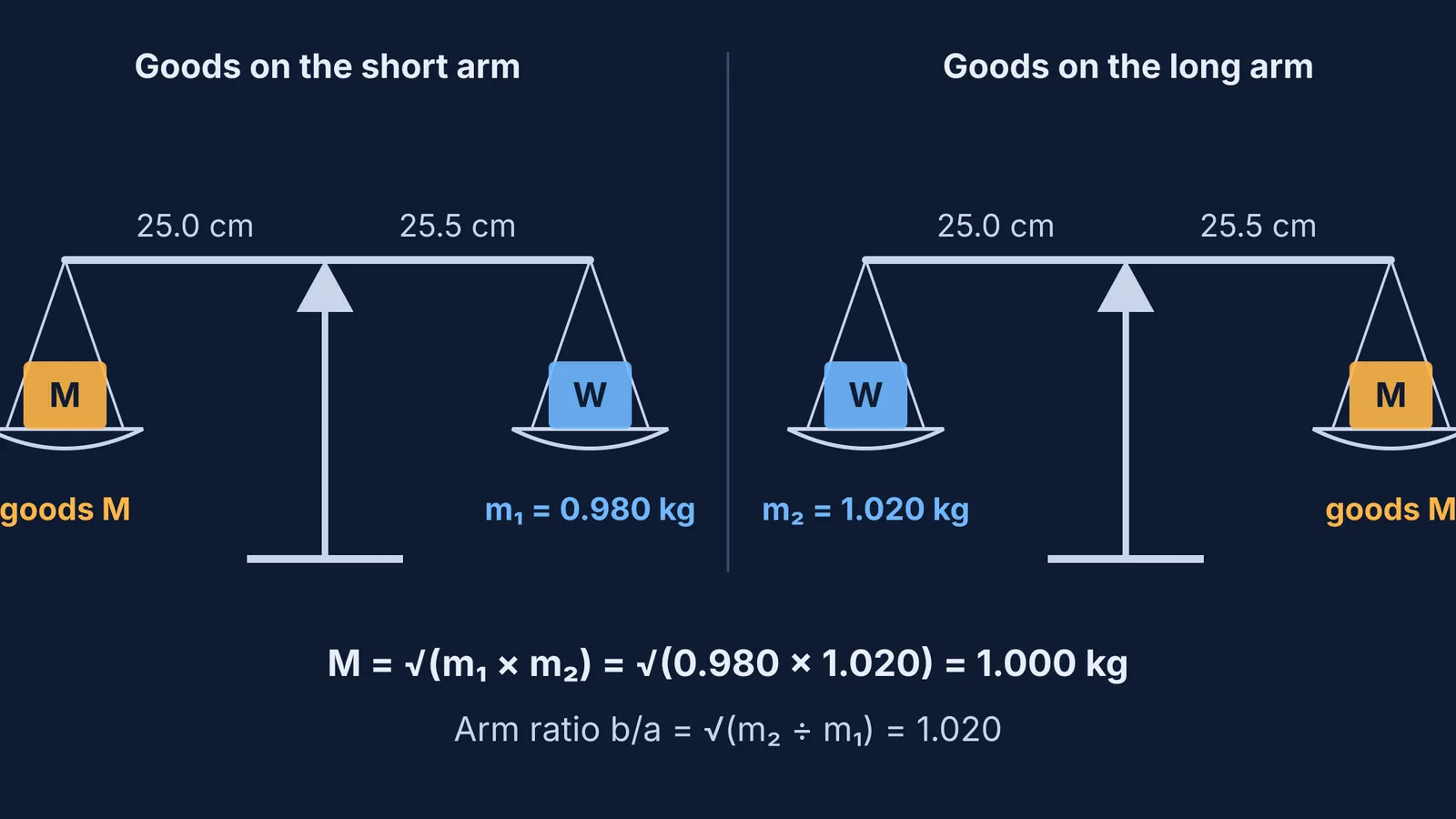
A balance has a = 25.0 cm and b = 25.5 cm. You weigh a packet whose true mass is 1.000 kg. Find each reading, then recover M.
Goods on the short arm. M × a = m₁ × b, so m₁ = 1.000 × 25.0 ÷ 25.5 = 0.9804 kg.
Goods on the long arm. m₂ × a = M × b, so m₂ = 1.000 × 25.5 ÷ 25.0 = 1.0200 kg.
Geometric mean. √(0.9804 × 1.0200) = √1.0000 = 1.0000 kg. Exact.
Arm ratio. √(1.0200 ÷ 0.9804) = √1.0404 = 1.020, which matches 25.5 ÷ 25.0 = 1.020.
Arithmetic mean, for comparison. (0.9804 + 1.0200) ÷ 2 = 1.0002 kg, only 0.02% too high.
Now run it the way an exam does, from readings only. A bag reads 2.45 kg on one pan and 2.55 kg on the other. The true mass is √(2.45 × 2.55) = 2.4995 kg, about 2.50 kg, and the arm ratio is √(2.55 ÷ 2.45) = 1.020.
Why is the arithmetic mean nearly as good?
Write b/a = 1 + ε, where ε is small. Then the arithmetic mean is:
(m₁ + m₂) ÷ 2 = M × [1/(1 + ε) + (1 + ε)] ÷ 2 ≈ M × (1 + ε²/2)
The first-order errors, −ε and +ε, cancel. Only a second-order error ε²/2 is left. With ε = 0.02, that is 0.0002, or 0.02%, exactly what step 5 found. So the arithmetic mean is a good approximation when the readings are close, but the geometric mean is the exact answer. If an exam asks for the true mass, write √(m₁m₂).
How can a shopkeeper cheat with an unequal-arm balance?
Suppose the seller always puts the goods on the long arm (25.5 cm) and a 1 kg standard weight on the short arm (25.0 cm). The beam is level when:
M × 25.5 = 1 × 25.0, so M = 25.0 ÷ 25.5 = 0.980 kg
The customer pays for 1 kg and gets 0.980 kg, about 2% short on every sale. On 50 kg of rice sold in a day, the shortfall is about 0.98 kg. The empty beam balances, so nothing looks wrong.
The cheat depends on the seller choosing the pan. A customer who asks for the goods to be weighed again on the other pan will see the same goods balance only 0.961 kg of weights, about 4% less than the 1 kg they paid for, which exposes the trick at once.
This is one reason trade weights and balances are checked by law. Section 24 of India's Legal Metrology Act, 2009 deals with the verification and stamping of weights and measures held by anyone likely to use them in a transaction.
What if the empty beam does not balance?
Then double weighing fails. An unbalanced empty beam adds a fixed extra torque to both equations, and it no longer cancels when you multiply them. The fix is substitution weighing:
Put the goods on one pan and balance them with any counterweight, such as sand, on the other.
Remove the goods and put standard weights on the same pan until the beam is level again.
The standard weights now equal M exactly, because they sit at the same arm as the goods did.
The arms, the pans and any built-in imbalance all cancel, since nothing on the counterweight side changed. For another one-condition use of moments, see finding the mass of a metre scale with the principle of moments.
To work through more lever and torque problems one step at a time, try the Fermi Problem Library, a step-by-step solver that explains the reasoning.
Quick checklist
Balance condition: mass × arm on one side = mass × arm on the other; g cancels.
Goods on arm a: m₁ = Ma/b. Goods on arm b: m₂ = Mb/a.
True mass: M = √(m₁m₂), exact.
Arm ratio: b/a = √(m₂/m₁).
The arithmetic mean is off only by about ε²/2.
Double weighing needs the empty beam to balance; otherwise use substitution weighing.
Goods on the long arm against a 1 kg weight on a 25.0/25.5 cm balance give 0.980 kg.


