

On this page
When two children climb onto a see-saw, they instinctively learn a fundamental law of physics. A lighter child can suspend a heavier one in mid-air simply by sliding backwards to the end of the board.
This everyday playground trick relies on the principle of moments. In Class 9 ICSE physics, understanding how turning forces balance is the key to solving numerical problems about pivoted rules and uniform metre scales.
What is a moment of force?
Before balancing the see-saw, you need to measure its turning effect. A moment of force, often called torque, is the measure of a force's ability to turn an object around a fixed axis or pivot.
The turning effect depends on two things: how hard you push, and how far you push from the pivot. You calculate it using a simple formula:
Moment of Force = Force × Perpendicular distance from the pivot
In the SI system, force is measured in newtons (N) and distance in metres (m), giving the moment of force a unit of newton-metres (N m).
Forces on a horizontal beam can turn it in two directions. If a force pushes the right side of a see-saw down, it creates a clockwise moment. If a force pushes the left side down, it creates an anticlockwise moment.
What is the principle of moments?
When an object like a see-saw rests perfectly horizontally without tipping, it is in rotational equilibrium. The principle of moments states that for a body in equilibrium, the sum of the clockwise moments about a pivot must equal the sum of the anticlockwise moments about that same pivot.
First formulated by the French mathematician Pierre Varignon in 1687, this rule—also known as Varignon's theorem)—proves that when multiple forces act on a body, their combined turning effect is zero if the body is balanced.
In mathematical terms, for a balanced beam: Sum of Anticlockwise Moments = Sum of Clockwise Moments
How does a see-saw balance?
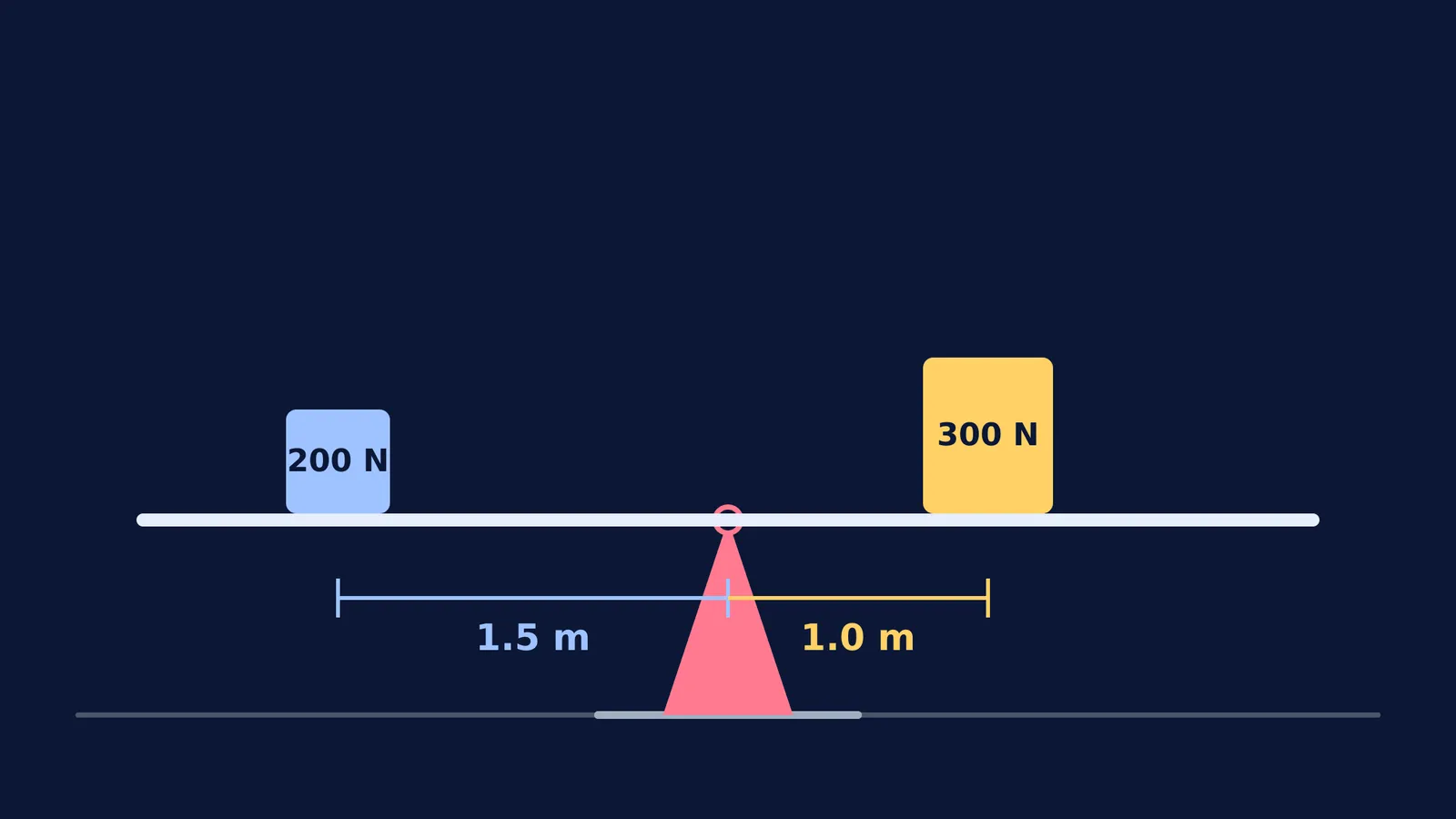
Imagine two children on a see-saw. A 30 kg child sits 2 metres from the pivot on the left. Their anticlockwise moment is 30 kgf × 2 m = 60 kgf m.
For a 40 kg child on the right to balance the see-saw, they cannot sit 2 metres away. If they did, their clockwise moment would be 80 kgf m, and their side would hit the ground. To find their balancing point, we use the principle of moments:
Anticlockwise Moment = Clockwise Moment 60 kgf m = 40 kgf × distance distance = 60 / 40 = 1.5 metres
The heavier child must sit closer to the pivot (at 1.5 metres) to keep the board level. If you struggle to set up these equations correctly when studying alone, Fermi's AI tutor can work out what you already know and build a plan for the session, guiding you through the geometry of forces without just handing over the answer.
How to solve principle of moments numericals?
Examiners love to test the principle of moments using a uniform metre scale suspended by a string or balanced on a knife-edge pivot.
To crack these numericals, follow a strict step-by-step framework:
Locate the pivot: This is your zero point. Every distance must be measured from this exact spot.
Account for the ruler's own weight: If the rule has mass, its weight acts perfectly through its centre of gravity. For a uniform metre scale (100 cm long), this is exactly at the 50 cm mark. If the pivot is not at 50 cm, the ruler's own weight will create a moment. You can see this applied when finding the mass of a metre scale with the principle of moments.
List the anticlockwise forces: Identify every weight on the left side of the pivot. Multiply each by its distance from the pivot to find its turning effect. Add them together.
List the clockwise forces: Identify every weight on the right side. Multiply each by its distance from the pivot and add them together.
Equate and solve: Set the total anticlockwise moment equal to the total clockwise moment and solve for the unknown variable.
If a problem asks for the force in vector terms across three dimensions, you might need to calculate torque as r × F, but for Class 9, straight multiplication on a 2D line is enough. When you make a mistake in a long calculation, the Fermi Problem Library has a step-by-step solver that explains the reasoning rather than just printing an answer, helping you spot exactly where your logic slipped.
A worked Class 9 numerical
Let us apply the framework to a typical exam question.
Question: A uniform metre rule rests horizontally on a knife-edge placed at the 60 cm mark, when a mass of 20 grams is suspended from one end. Where is the 20 g mass suspended, and what is the mass of the rule?
Step 1: Locate the pivot. The pivot is at the 60 cm mark.
Step 2: Account for the ruler's weight. A uniform metre rule's centre of gravity is at the 50 cm mark. Its unknown weight (W) acts downwards at 50 cm. Distance from pivot = 60 cm − 50 cm = 10 cm. Since the 50 cm mark is to the left of the 60 cm pivot, it creates an anticlockwise moment: W × 10.
Step 3: Place the 20 g mass. The ruler is tipping to the left because of its own weight. To balance it, the 20 g mass must be hung on the right side to create a clockwise moment. The question says it is placed at "one end". The only end on the right is the 100 cm mark. Distance from pivot = 100 cm − 60 cm = 40 cm. The clockwise moment is: 20 g × 40 cm = 800 g cm.
Step 4: Equate and solve. Anticlockwise Moment = Clockwise Moment W × 10 = 800 W = 80 grams.
The rule has a mass of 80 g, and the 20 g mass is hung at the 100 cm mark.
By carefully measuring every distance from the pivot, no see-saw or metre rule is too complicated to balance.


