

On this page
When you press your thumb against your phone screen, it opens in a fraction of a second. But how does a fingerprint sensor on a phone work? Depending on your device, the sensor underneath the glass is mapping the unique ridges and valleys of your skin using one of three very different principles: light, electricity, or sound.
How do optical sensors take a photograph of your finger?
Optical fingerprint sensors are essentially specialised digital cameras. When you place your finger on the scanner, the phone screen illuminates your fingertip brightly. A CMOS (complementary metal-oxide-semiconductor) image sensor underneath the display captures the light that reflects off your skin.
Because the raised ridges of your fingerprint touch the screen, they reflect light differently than the recessed valleys, which sit further back. The sensor analyses the light and dark areas of this 2D image to match it against the saved print Wikipedia. While optical sensors are fast and cost-effective, they can struggle if your finger is wet or dirty, and they can sometimes be fooled by a high-quality photograph.
How do capacitive sensors measure distance electrically?
Most physical fingerprint buttons on the side or back of a phone use capacitive technology. Instead of light, these sensors map your finger using an array of tiny electrical circuits.
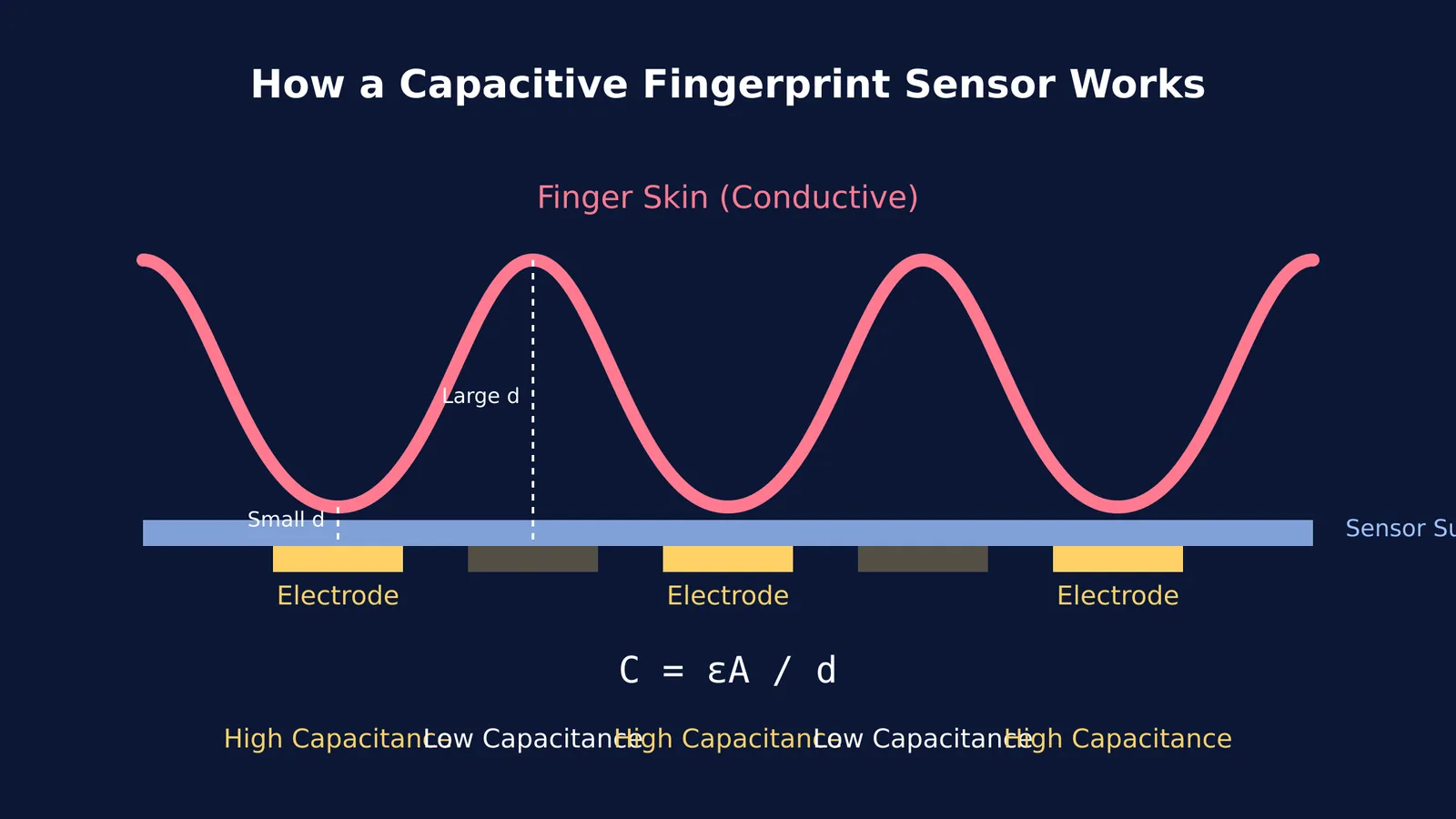
The physics is based on the formula for a parallel-plate capacitor: C = ε A / d, where C is capacitance, ε is the permittivity of the dielectric, A is the area, and d is the distance between the plates Wikipedia. In this setup, the sensor array acts as one plate, and your naturally conductive skin acts as the second plate.
When you touch the sensor, the ridges of your fingerprint are very close to the electrodes (making d small), which results in a high capacitance. The valleys of your fingerprint, however, leave a gap of air. Because the distance d is larger and air has a lower permittivity than skin, the capacitance over a valley is very low Wikipedia. The sensor measures these electrical differences pixel by pixel to create a highly accurate map. Because they rely on the electrical properties of living tissue, capacitive sensors are difficult to fool with a 2D image.
How do ultrasonic sensors map your finger with sound waves?
Premium flagship phones often hide ultrasonic sensors under the glass. Rather than capturing a flat image or an electrical map, they use high-frequency sound waves to create a precise 3D topographic map of your finger Wikipedia.
The sensor contains piezoelectric transducers that send a pulse of ultrasound up through the screen. When the sound wave hits your finger, some of it is absorbed and some bounces back as an echo. The intensity of the reflection depends on the acoustic impedance of the boundary Wikipedia.
Where a ridge touches the glass, the sound wave easily transmits into the skin, resulting in a weak echo. Where there is a valley, the sound wave hits an air gap. Because the density of air is drastically lower than glass, nearly all the sound is reflected back, creating a strong echo. By timing how long the echoes take to return, the sensor calculates the exact depth of the valleys, making it the most secure method available—and one that works well even if your finger is wet or oily.
How does everyday technology connect to your physics syllabus?
When studying for exams like JEE Main or NEET-UG, abstract concepts become easier to remember when you see them working in the real world. Your phone's fingerprint sensor is a perfect revision tool for three major topics:
Electrostatics: Capacitive sensors are a real-world application of parallel-plate capacitors and how a dielectric slab affects charge storage.
Ray Optics: Optical sensors rely on controlled illumination and reflection through a glass slab to form an image.
Waves: Ultrasonic sensors demonstrate displacement and pressure waves in sound, showing how acoustic impedance dictates reflection and transmission at boundaries.
If you find it difficult to visualise how electrical fields change when distances vary, you can experiment with variables in the Fermi Simulation Lab. Playing with a virtual capacitor or setting up wave reflections makes these textbook formulas feel intuitive rather than just another equation to memorise.


