On this page
Check each part on its own before you look at the options.
What do these complex numbers and quadratics questions cover?
Unit 2 of NTA's Syllabus for JEE (Main) - 2027 lists the algebra of complex numbers, modulus and argument, the Argand diagram, quadratic equations and their solutions, relations between roots and coefficients, and nature of roots. Every question stays inside that list and NCERT Class 11 Mathematics Chapter 4, Complex Numbers and Quadratic Equations (Reprint 2026-27). New to the chapter? Start with how to prepare complex numbers and quadratics for JEE Main.
Can you solve these statement questions?
Options for Q1 to Q4: (1) Both correct (2) Both incorrect (3) I correct, II incorrect (4) I incorrect, II correct
Q1 (easy). Statement I: |(2 + i)²| = 5. Statement II: 1/(3 + 4i) = (3 − 4i)/25.
Answer: (1). I correct: |z²| = |z|², and |2 + i|² = 4 + 1 = 5. II correct: multiply top and bottom by the conjugate 3 − 4i; the denominator becomes 9 + 16 = 25.
Trap: (4). Stopping at |2 + i| = √5 makes I look false.
Q2 (medium). Statement I: i + i² + i³ + ... + i¹⁰² = 0. Statement II: i⁻³⁵ = −i.
Answer: (2). I incorrect: every block of 4 consecutive powers sums to 0, so the first 100 terms vanish and i¹⁰¹ + i¹⁰² = i − 1 remains. II incorrect: i³⁶ = 1, so i⁻³⁵ = i³⁶ × i⁻³⁵ = i.
Trap: (1). Assuming long sums always cancel, and ignoring the minus in the exponent (i³⁵ = −i).
Q3 (medium). For x² − 6x + k = 0 with real k. Statement I: If the roots are real and differ by 4, then k = 5. Statement II: Both roots are positive exactly when 0 < k < 9.
Answer: (3). I correct: (α − β)² = (α + β)² − 4αβ = 36 − 4k = 16, so k = 5 (roots 1 and 5). II incorrect: at k = 9 the equation is (x − 3)² = 0, a double root 3, which is positive. The right range is 0 < k ≤ 9.
Trap: (1). Using D > 0 when the question allows equal roots.
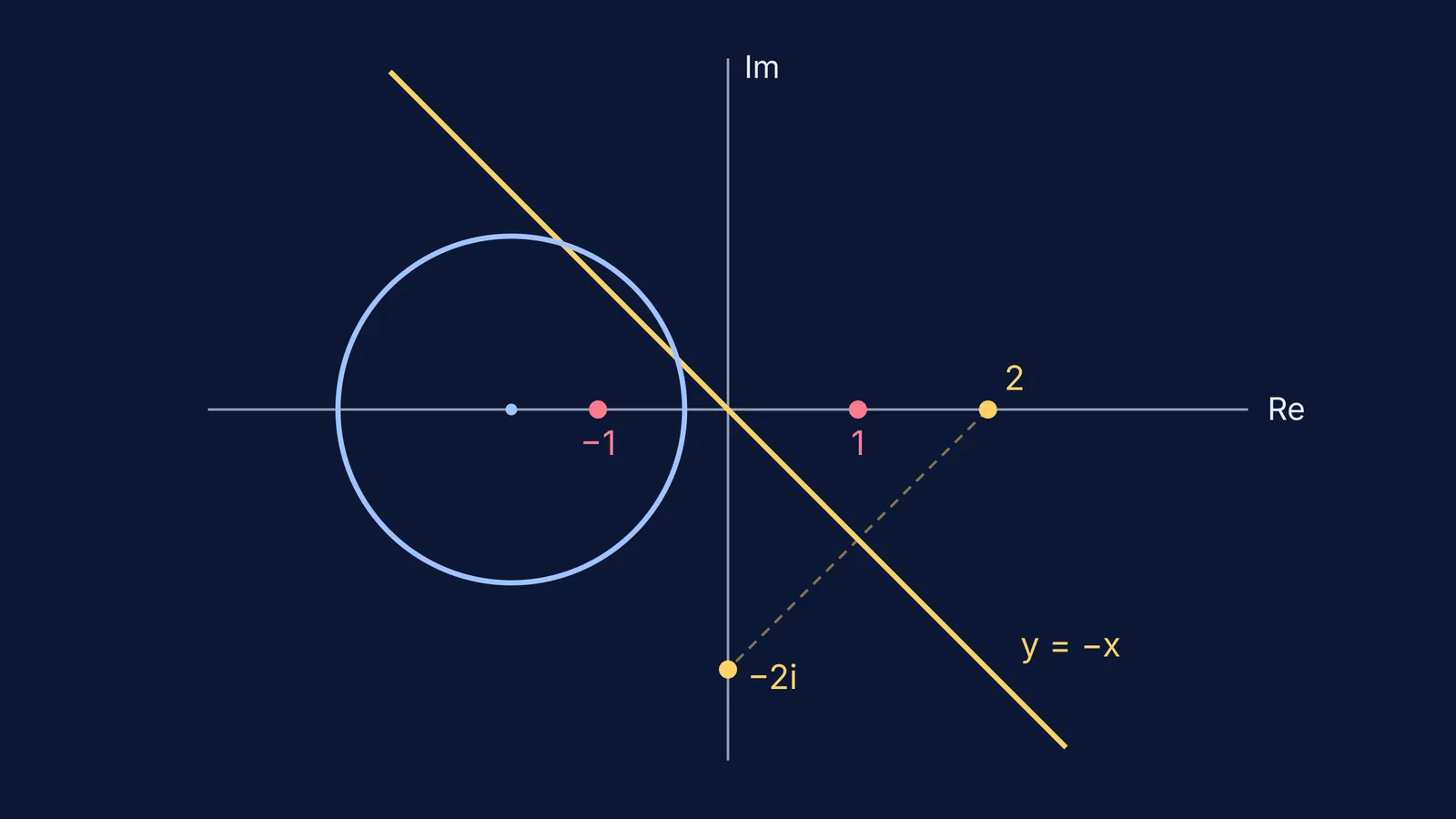
Q4 (hard). Statement I: The locus of |z − 2| = |z + 2i| is the line y = x. Statement II: The locus of |z − 1| = 2|z + 1| is a circle with centre (−5/3, 0) and radius 4/3.
Answer: (4). I incorrect: z + 2i = z − (−2i), so z is equidistant from 2 and −2i. Squaring gives −4x + 4 = 4y + 4, so the locus is y = −x. II correct: squaring gives 3x² + 3y² + 10x + 3 = 0, so the centre is (−5/3, 0) and r² = 25/9 − 1 = 16/9.
Trap: (1). Reading z + 2i as distance from 2i gives the bisector of 2 and 2i, which is y = x.
Can you solve these match-the-list questions?
Q5 (easy). For z = 1 + i√3, match each quantity with its value.
List-I: A. |z| B. z × z̄ C. z³ D. arg z
List-II: I. 2 II. 4 III. −8 IV. π/3
(1) A-II, B-I, C-III, D-IV (2) A-I, B-II, C-III, D-IV (3) A-I, B-II, C-IV, D-III (4) A-II, B-IV, C-III, D-I
Answer: (2). A: √(1 + 3) = 2. B: z × z̄ = |z|² = 4. C: z = 2(cos π/3 + i sin π/3), so z³ = 8(cos π + i sin π) = −8. D: tan θ = √3 in the first quadrant gives π/3.
Trap: (1), swapping |z| and z × z̄. The product with the conjugate is the square of the modulus.
Q6 (medium). α and β are the roots of x² − 5x + 3 = 0. Match each expression.
List-I: A. α² + β² B. 1/α + 1/β C. α³ + β³ D. (α − β)²
List-II: I. 13 II. 19 III. 5/3 IV. 80
(1) A-I, B-III, C-IV, D-II (2) A-II, B-IV, C-III, D-I (3) A-III, B-II, C-IV, D-I (4) A-II, B-III, C-IV, D-I
Answer: (4). With α + β = 5 and αβ = 3: A: 25 − 6 = 19. B: (α + β)/αβ = 5/3. C: 125 − 3 × 3 × 5 = 80. D: 25 − 12 = 13.
Trap: (1), subtracting 4αβ for α² + β² and 2αβ for (α − β)².
Q7 (medium). Match each equation with the nature of its roots.
List-I: A. x² − 4x + 4 = 0 B. x² + x + 1 = 0 C. 2x² − 7x + 3 = 0 D. x² − 2x − 1 = 0
List-II: I. Real, distinct, irrational II. Real and equal III. Non-real, conjugate pair IV. Real, distinct, rational
(1) A-II, B-III, C-IV, D-I (2) A-II, B-III, C-I, D-IV (3) A-III, B-II, C-IV, D-I (4) A-IV, B-III, C-II, D-I
Answer: (1). Discriminants: A: 16 − 16 = 0. B: 1 − 4 = −3. C: 49 − 24 = 25, a perfect square with rational coefficients, so roots 3 and 1/2. D: 4 + 4 = 8, not a perfect square, so roots 1 ± √2.
Trap: (2), swapping C and D; only C has a perfect-square discriminant.
Q8 (hard). For x² − 2kx + k + 6 = 0 with real k, match each condition with the values of k.
List-I: A. Real and equal roots B. Non-real roots C. Both roots positive D. Both roots negative
List-II: I. −6 < k ≤ −2 II. k ≥ 3 III. −2 < k < 3 IV. k = −2 or k = 3
(1) A-IV, B-III, C-I, D-II (2) A-III, B-IV, C-II, D-I (3) A-IV, B-III, C-II, D-I (4) A-IV, B-II, C-III, D-I
Answer: (3). D/4 = k² − k − 6 = (k − 3)(k + 2). A: D = 0 at k = 3 or −2. B: D < 0 for −2 < k < 3. C: D ≥ 0, sum 2k > 0 and product k + 6 > 0 give k ≥ 3. D: D ≥ 0, 2k < 0 and k + 6 > 0 give −6 < k ≤ −2; at k = −6 one root is 0.
Trap: (1). Writing the sum of roots as −2k swaps C and D.
How do you attack these formats quickly?
Judge each statement alone, on paper, before reading the four options.
Settle the easier statement first; if it is false, two options go at once.
Rewrite z + a as z − (−a) before reading any locus.
For roots, write sum, product and D first; most items then take one line.
In a match grid, fix the most distinctive pair and strike every code that disagrees.
If a sign slip keeps costing you marks, the Fermi Problem Library has a step-by-step solver that explains the reasoning. For the rest of your JEE preparation, Fermi Test Prep covers JEE Main and Advanced.
For more timed work, try complex numbers and quadratics numerical value questions and the complex numbers and quadratic equations practice set with solutions.