On this page
Section B of JEE Main maths gives you no options to eliminate: you type a number, and it is right or wrong. Complex numbers and quadratics suit this format, since many questions end in a modulus, a sum of roots or a count. Try each original question below before reading its solution.
How are JEE Main numerical value questions marked?
The JEE (Main) 2027 Information Bulletin from NTA gives each subject 20 multiple-choice questions in Section A and 5 numerical value questions in Section B. A correct numerical answer earns +4, a wrong one −1, a blank 0. You type the answer on an on-screen keypad, rounded off to the nearest integer. So a wrong guess costs a mark.
All eight questions stay inside Unit 2 of the JEE Main 2027 syllabus: modulus, the Argand diagram, roots and coefficients, and nature of roots.
Which easy and medium questions should you get exactly right?
Q1. If z = (3 + 4i)(1 − i)/(1 + i), find |z|.
Modulus is multiplicative, so |z| = |3 + 4i| × |1 − i| / |1 + i| = 5 × √2/√2 = 5.
Answer: 5. Check: (1 − i)/(1 + i) = −i, so z = 4 − 3i, and |4 − 3i| = 5. Common slip: typing 25, which is |z|².
Q2. Find the real number S = i + i² + i³ + ... + i²⁰²⁷.
Powers of i repeat every four terms, and each block sums to 0. Since 2027 = 4 × 506 + 3, only i²⁰²⁵ + i²⁰²⁶ + i²⁰²⁷ = i − 1 − i is left.
Answer: −1. Check: as a geometric series, S = i(1 − i²⁰²⁷)/(1 − i) = i(1 + i)/(1 − i) = i × i = −1. Common slip: losing the minus sign on the keypad, or starting the count at i⁰.
Q3. If α and β are the roots of x² − 5x + 3 = 0, find α³ + β³.
Here α + β = 5 and αβ = 3, so α³ + β³ = (α + β)³ − 3αβ(α + β) = 125 − 45 = 80.
Answer: 80. Check: the roots are about 4.303 and 0.697, and their cubes add to about 79.66 + 0.34 = 80. Common slip: taking α + β = −5 and typing −80.
Q4. How many integers k make x² + kx + 9 = 0 have no real roots?
No real roots needs k² − 36 < 0, so −6 < k < 6, which gives the integers −5 to 5.
Answer: 11. Check: at k = 6 the equation is (x + 3)² = 0, which has a real repeated root, so 6 is rightly left out. Common slip: including ±6 and typing 13.
Q5. α and β are the roots of x² − 3x + 1 = 0, and x² − px + q = 0 has roots α² and β². Find p + q.
p = α² + β² = (α + β)² − 2αβ = 9 − 2 = 7, and q = (αβ)² = 1.
Answer: 8. Check: α² = (7 + 3√5)/2 and β² = (7 − 3√5)/2 add to 7 and multiply to (49 − 45)/4 = 1. Common slip: writing α² + β² = 9 and typing 10.
Which harder questions test the Argand diagram and common roots?
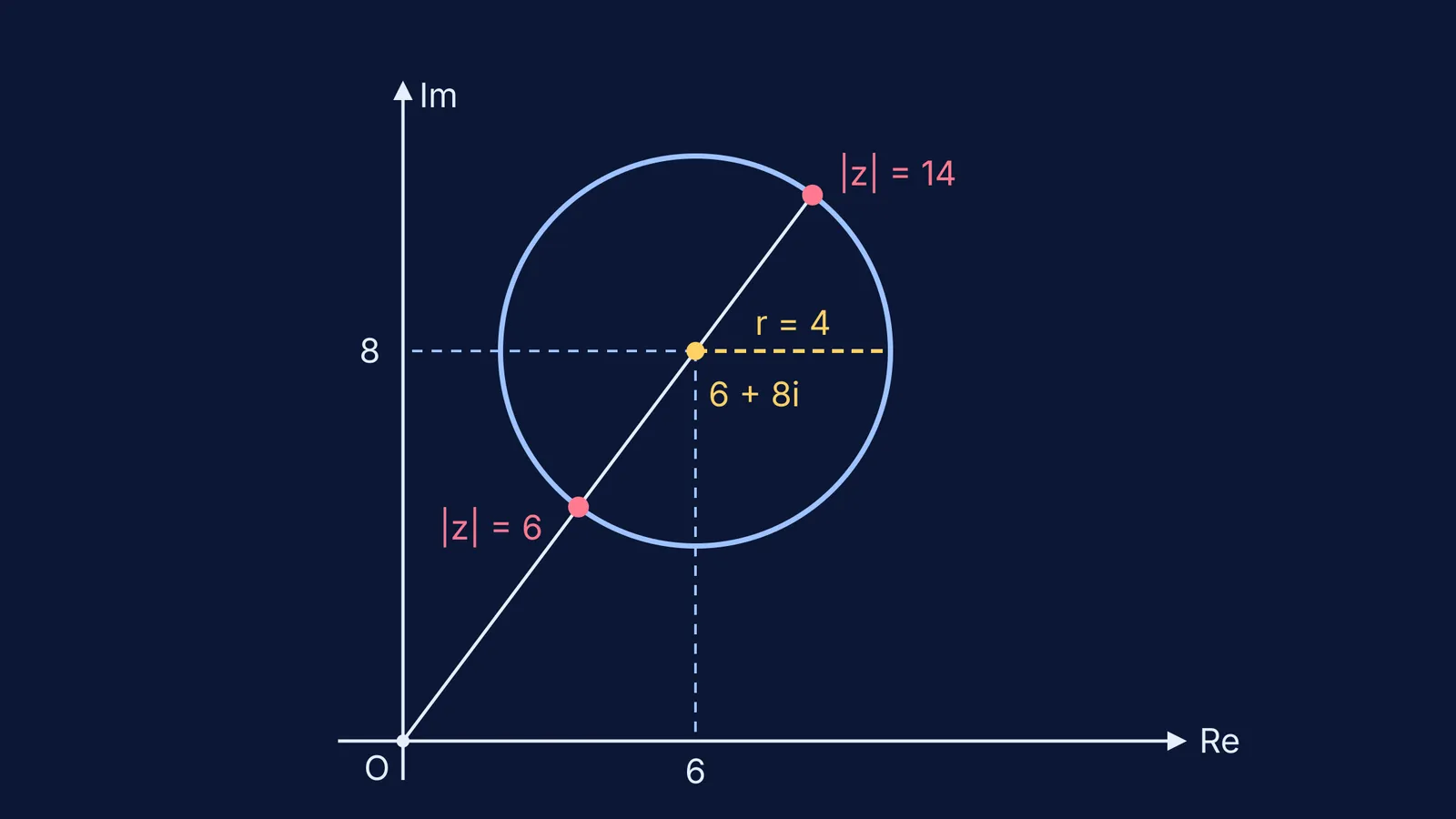
Q6. For z on the circle |z − 6 − 8i| = 4, let m and M be the least and greatest values of |z|. Find mM.
The circle has centre 6 + 8i and radius 4. The centre is √(36 + 64) = 10 from the origin, which lies outside the circle. On the line through the origin and the centre, m = 10 − 4 = 6 and M = 10 + 4 = 14.
Answer: 84. Check: the nearest point is 0.6(6 + 8i) = 3.6 + 4.8i, whose modulus is 6. Common slip: taking the centre's distance as 6 + 8 = 14, which gives 180.
Q7. x² − 7x + 12 = 0 and x² − ax + 24 = 0 have exactly one common root. Find the sum of all possible values of a.
The first equation has roots 3 and 4. If 3 is common, 9 − 3a + 24 = 0, so a = 11 and the other root is 8. If 4 is common, 16 − 4a + 24 = 0, so a = 10 and the other root is 6.
Answer: 21. Check: neither 8 nor 6 solves the first equation, so each case shares exactly one root. Common slip: solving one case only and typing 11 or 10.
Q8. How many complex numbers z satisfy z² + |z| = 0?
Put z = x + iy. The imaginary part gives 2xy = 0. If y = 0, then x² + |x| = 0 forces x = 0. If x = 0, then −y² + |y| = 0 gives y = 0 or ±1. So z = 0, i or −i.
Answer: 3. Check: i² + |i| = −1 + 1 = 0. Common slip: dividing by |z| early, losing z = 0, and typing 2.
How should you practise numerical value questions?
Solve on paper, without options, under a timer.
Run a check before looking at the answer.
Log each wrong number by its slip (sign, missed case, boundary, formula) and redo those a week later.
For multiple-choice practice, try our complex numbers and quadratic equations practice set, or start with how to prepare complex numbers and quadratics for JEE Main. Physics uses the same format, as in these kinematics numerical value questions.
When a wrong number comes from the method, the Fermi Problem Library has a step-by-step solver that explains the reasoning. For JEE Main and Advanced preparation, see Fermi Test Prep.