

On this page
Here are eight original kinematics questions for the JEE Main numerical-value section, easy to hard, each with a worked solution and the wrong number most students type. Take g = 10 m/s² and ignore air resistance.
What does the JEE Main numerical section look like?
The Information Bulletin for JEE (Main) 2027 from NTA says each subject in Paper 1 has Section A (MCQs) and Section B, where answers are filled in as a numerical value. Physics has 5 Section B questions. A correct answer gets +4 and an incorrect one −1, so Section B carries negative marking. You enter an integer on an on-screen keypad, and the answer should be rounded off to the nearest integer.
All eight sit inside Unit 2, Kinematics, of NTA's Syllabus for JEE (Main) 2027, and inside NCERT Class 11 Chapter 2, Motion in a Straight Line and Chapter 3, Motion in a Plane. For theory first, see our guide on how to prepare Kinematics for JEE Main.
Easy: can you get these right first time?
Q1 (easy). A delivery rider rides 6 km to a customer at a steady 30 km/h and returns along the same road at 20 km/h. What is the average speed for the round trip, in km/h?
Answer: 24. Time = 6/30 + 6/20 = 0.2 + 0.3 = 0.5 h. Average speed = 12 km ÷ 0.5 h = 24 km/h.
Trap: 25, the simple mean of 30 and 20. More time is spent at the slower speed.
Q2 (easy). A metro train starts from rest with uniform acceleration and covers 2.5 m during the 3rd second of its motion. How far does it travel in the first 10 s, in metres?
Answer: 50. Distance in the nth second = a(n − ½), so 2.5 = a × 2.5 and a = 1 m/s². In 10 s, s = ½ × 1 × 10² = 50 m.
Trap: 28, from reading "during the 3rd second" as "in the first 3 s".
Q3 (easy). A particle moves along the x-axis with x = t³ − 12t² + 36t + 2 (x in metres, t in seconds). What is its acceleration, in m/s², at the second instant it is momentarily at rest?
Answer: 12. v = 3t² − 24t + 36 = 3(t − 2)(t − 6), so it stops at t = 2 s and t = 6 s. a = 6t − 24, which is 12 m/s² at t = 6 s.
Trap: −12, the acceleration at the first stop, t = 2 s.
Medium: where do the steps pile up?
Q4 (medium). A cyclist rides a circular track of radius 21 m at constant speed, completing one lap in 22 s. Take π = 22/7. What is the magnitude of the change in her velocity over one-third of a lap, in m/s, to the nearest integer?
Answer: 10. Speed v = 2π × 21 / 22 = 6 m/s. A third of a lap turns the velocity through 120°, so |Δv| = 2v sin 60° = 6√3 ≈ 10.39, which rounds to 10.
Trap: 0, because the speed does not change. Velocity's direction does.
Q5 (medium). A ball is projected from level ground. Exactly 2 s after launch, its velocity is (8î + 6ĵ) m/s, with ĵ pointing vertically up. What is its horizontal range, in metres, to the nearest integer?
Answer: 42. The horizontal part stays 8 m/s. The vertical part at launch was 6 + 10 × 2 = 26 m/s. Time of flight = 2 × 26/10 = 5.2 s, so range = 8 × 5.2 = 41.6 m, which rounds to 42.
Trap: 10 (9.6 rounded), from treating (8î + 6ĵ) as the launch velocity.
Q6 (medium). A small plane flies at 200 km/h relative to the air. A wind blows towards the east at 40 km/h. The pilot wants to go due north over the ground. What is the plane's ground speed, in km/h, to the nearest integer?
Answer: 196. Head partly west to cancel the drift: ground speed = √(200² − 40²) = √38,400 ≈ 195.96 km/h, which rounds to 196.
Trap: 204, from adding the two at right angles, √(200² + 40²).
Hard: can you handle two stages?
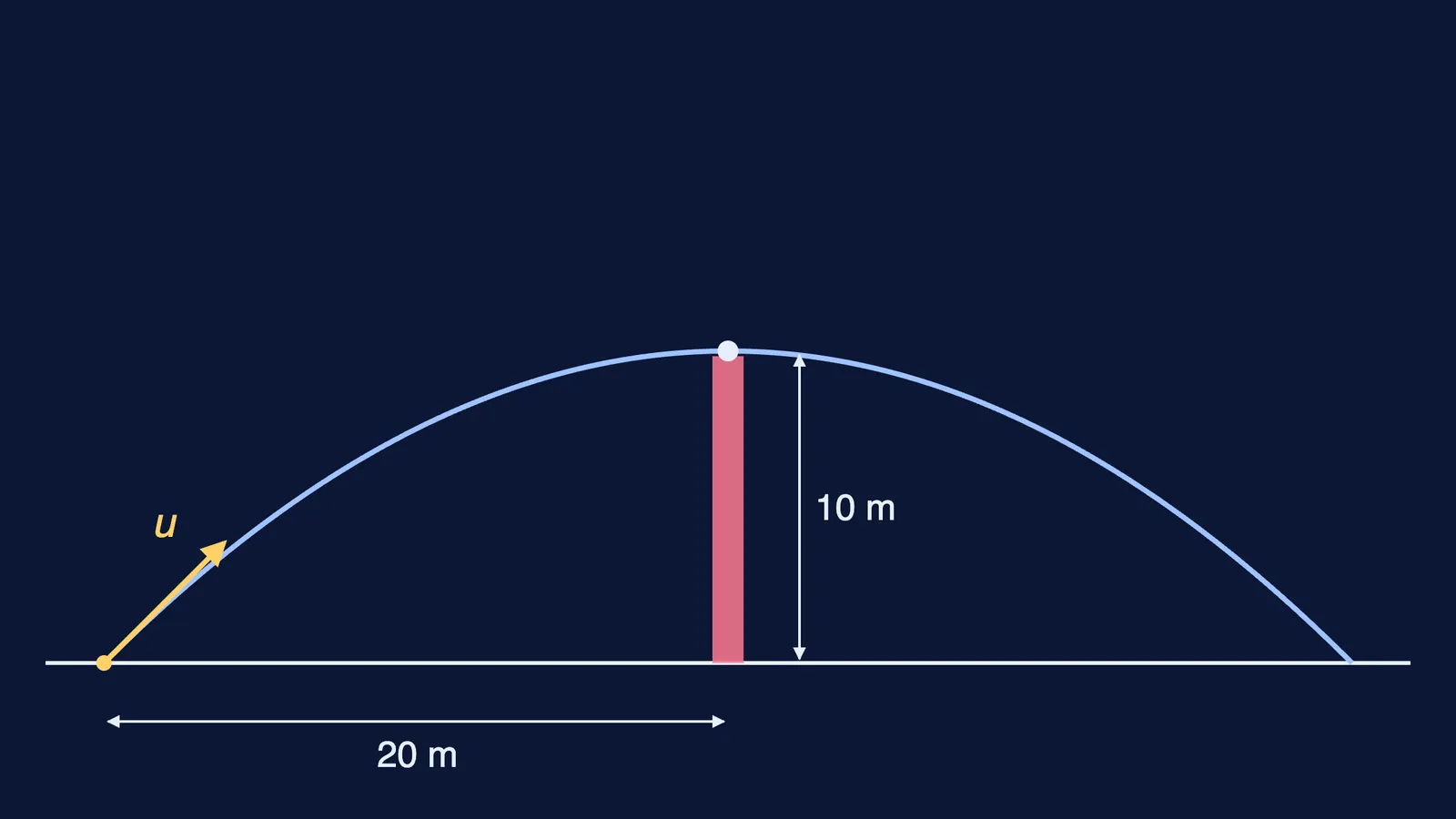
Q7 (hard). A ball is thrown from level ground and passes just over the top of a wall 10 m high and 20 m away at the highest point of its path. What was its launch speed, in m/s, to the nearest integer?
Answer: 20. At the top, vᵧ = 0, so uᵧ² = 2gH = 200 and uᵧ ≈ 14.14 m/s. Time to the top ≈ 1.414 s, so uₓ = 20/1.414 ≈ 14.14 m/s. Launch speed = √(200 + 200) = 20 m/s.
Trap: 14, the vertical component alone.
Q8 (hard). Two cars travel in the same lane at 20 m/s, one behind the other. The front car brakes at 5 m/s². The rear driver reacts 0.8 s later and then brakes at 4 m/s². What is the smallest initial gap, in metres, that avoids a collision?
Answer: 26. The front car stops in 4 s after 20²/(2 × 5) = 40 m. The rear car covers 20 × 0.8 = 16 m before braking, then 20²/(2 × 4) = 50 m, 66 m in all. The rear car stays faster until it stops, so the gap is smallest at the end: 66 − 40 = 26 m.
Trap: 10, from ignoring the reaction time (50 − 40). Another is 20, from checking the gap only when the front car stops.
For more mixed practice, try our Kinematics JEE Main practice questions with full solutions.
How do you get the number right in kinematics?
Convert km/h to m/s (divide by 3.6) before mixing units with seconds or g.
Fix one positive direction and keep it. A negative velocity or acceleration is information, not an error.
Carry unrounded values (√200, not 14) and round only the final answer to the nearest integer.
Check whether the motion changes direction or stops: Q3 and Q8 hinge on it.
Use the constants given in the question, such as g = 10 m/s² or π = 22/7.
Answer won't match? The Fermi Problem Library has worked problems with a step-by-step solver that explains the reasoning rather than printing an answer.


