On this page
Here are eight original JEE Main-style kinematics questions, easy to hard, each with a worked solution and the most tempting wrong option explained.
In the official Syllabus for JEE (Main) - 2027 from NTA, Kinematics is Physics Unit 2. Every question below stays inside that unit.
How should you use this JEE Main kinematics set?
Hide the answers and allow about two minutes a question.
Sketch first and pick a positive direction.
Mark each one right, wrong or guessed; a guess counts as wrong.
Take g = 10 m/s² and ignore air resistance. If a topic feels shaky, read our guide on how to prepare Kinematics for JEE Main first.
Easy: can you handle calculus and the kinematic equations?
Q1 (easy). A particle moves along a line with velocity v = 3t² − 12, in m/s, with t in seconds. What distance does it cover from t = 0 to t = 3 s?
(A) 9 m (B) 23 m (C) 15 m (D) 7 m
Answer: (B). Velocity is zero at t = 2 s, so the particle turns round there. Displacement is t³ − 12t: −16 m over 0 to 2 s, then +7 m over 2 to 3 s. Distance = 16 + 7 = 23 m.
Trap: (A) is the size of the net displacement (−9 m).
Q2 (easy). For a body moving in a straight line, v² = 36 − 4x, with v in m/s and x in metres. What is its acceleration?
(A) −4 m/s² (B) 2 m/s² (C) −2 m/s² (D) −1 m/s²
Answer: (C). Compare with v² = u² + 2ax: 2a = −4, so a = −2 m/s².
Trap: (A) reads the coefficient of x as a and forgets the 2 in 2ax.
Q3 (easy). A marble rolls off a table 1.25 m high at 3 m/s. What is its speed just before it hits the floor?
(A) 8 m/s (B) 5 m/s (C) 3 m/s (D) 5.8 m/s
Answer: (D). The fall takes t = √(2h/g) = 0.5 s, so the vertical velocity is 10 × 0.5 = 5 m/s. Speed = √(3² + 5²) = √34 ≈ 5.8 m/s.
Trap: (A) adds the two components as numbers instead of as vectors.
Medium: can you track two moving bodies at once?
Q4 (medium, numerical). Car A starts from rest with an acceleration of 2 m/s². At that instant, car B is 16 m ahead, moving the same way at a steady 6 m/s. What is the largest gap between them, in metres, before A catches B?
Answer: 25. The gap is 16 + 6t − t². It peaks when the speeds match: 2t = 6, so t = 3 s. Gap = 16 + 18 − 9 = 25 m.
Trap: answering 16 assumes the gap only shrinks. A loses ground for the first 3 s.
Q5 (medium). A ball is thrown from the top of a 25 m tower at 20 m/s, 30° above the horizontal. How far from the foot of the tower does it land?
(A) 59.7 m (B) 34.6 m (C) 25.1 m (D) 69.0 m
Answer: (A). Components: 10 m/s up and 10√3 ≈ 17.3 m/s across. With up as positive, −25 = 10t − 5t², so t² − 2t − 5 = 0 and t = 1 + √6 ≈ 3.45 s. Range = 17.3 × 3.45 ≈ 59.7 m.
Trap: (B) uses R = u² sin 2θ / g, which only works when the ball lands at its launch height.
Q6 (medium). At noon, ship B is 20 km due north of ship A. A sails east at 6 km/h and B sails south at 8 km/h. When are they closest, and how far apart are they then?
(A) 2:00 pm, 0 km (B) 1:36 pm, 12 km (C) 2:30 pm, 15 km (D) 1:36 pm, 16 km
Answer: (B). In A's frame, B moves at 10 km/h (6 west, 8 south), at an angle θ to the line joining them with sin θ = 0.6. Closest distance = 20 sin θ = 12 km, after 20 cos θ = 16 km of relative path: 1.6 h, so 1:36 pm.
Trap: (C) waits until B crosses A's track, when they are still 15 km apart.
Hard: can you handle relative velocity and inclined planes?
Q7 (hard). A scooter rider heading east at 4 m/s finds the rain falling vertically. When she speeds up to 12 m/s, the rain seems to hit her from the front at 45° to the vertical. What is the actual speed of the rain?
(A) 4.0 m/s (B) 8.0 m/s (C) 11.3 m/s (D) 8.9 m/s
Answer: (D). The rain looks vertical at 4 m/s, so its own horizontal velocity is 4 m/s east. At 12 m/s, the rain's velocity relative to her is 8 m/s west, and a 45° angle means its vertical component is also 8 m/s. Actual speed = √(4² + 8²) = √80 ≈ 8.9 m/s.
Trap: (C) is the rain's speed relative to her at 12 m/s.
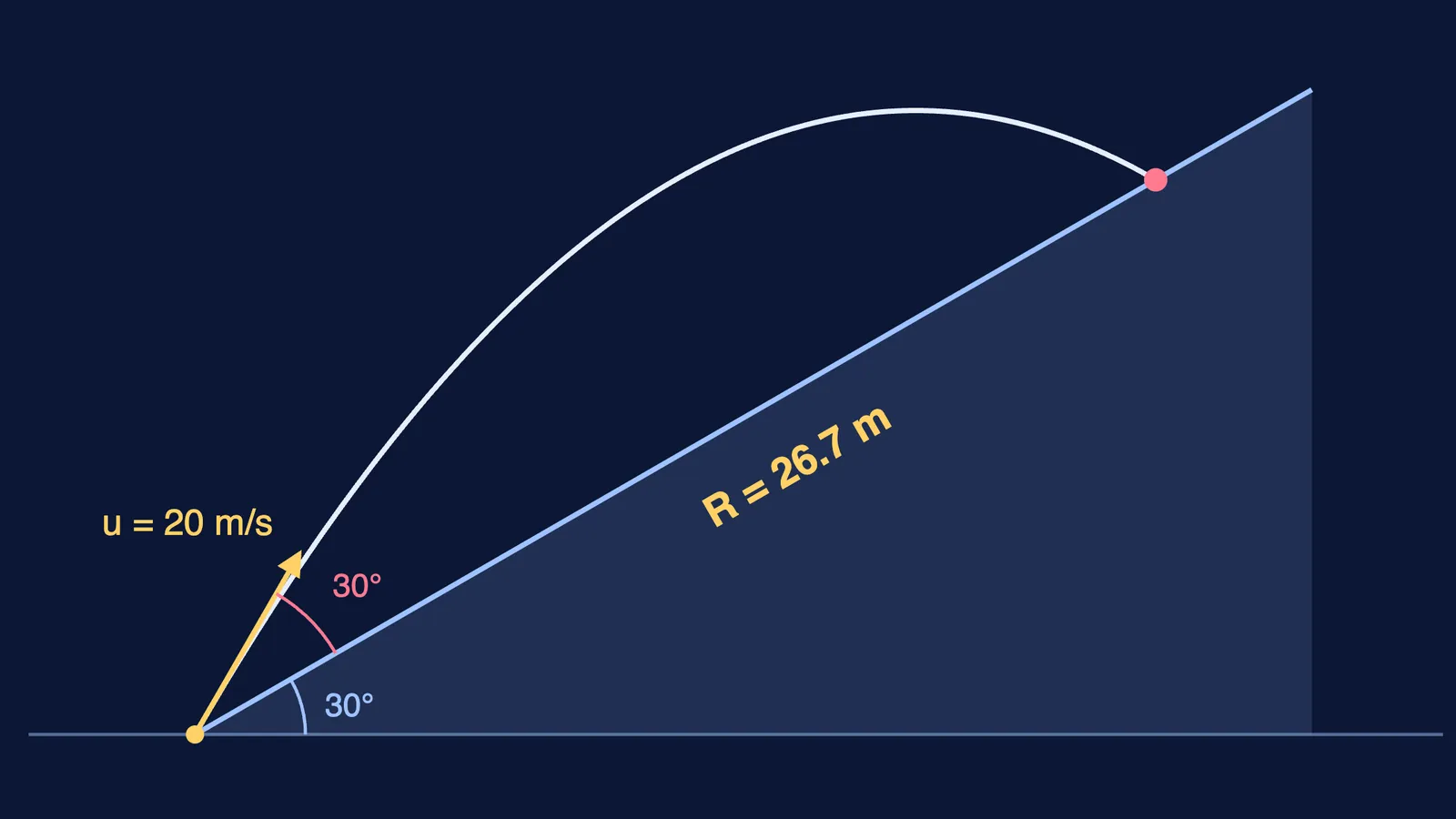
Q8 (hard). A stone is projected from the bottom of a 30° incline at 20 m/s, at 30° to the incline's surface (60° to the horizontal). How far up the incline does it land?
(A) 34.6 m (B) 20.0 m (C) 26.7 m (D) 23.1 m
Answer: (C). Take axes along and perpendicular to the incline. Perpendicular velocity is 20 sin 30° = 10 m/s and acceleration is −g cos 30°, so flight time is 2 × 10 / (10 cos 30°) ≈ 2.31 s. Along the incline: 20 cos 30° × 2.31 − ½(10 sin 30°)(2.31)² ≈ 40 − 13.3 ≈ 26.7 m.
Trap: (B) drops the cos² θ from R = 2u² sin α cos(α + θ) / (g cos² θ).
What should you do after checking your answers?
Sort your misses: misread question, wrong idea, or arithmetic slip. Each needs a different fix. If projectiles caused most of the trouble, our explainer on Motion in a Plane for Class 11 starts from vectors.
For more practice, the Fermi Problem Library has worked problems with a step-by-step solver that explains the reasoning rather than printing an answer, so you can see where your method went off.
Redo the set in a week, timed and without notes.