On this page
The NMC's NEET (UG) 2026 syllabus lists Biodiversity and its conservation under Unit 10, Ecology and Environment, including extinction, endangered organisms and sacred groves. Each organism in this chapter is tied to a cause, a place or a count, and questions test those ties.
Everything below comes from Chapter 13 of NCERT Class 12 Biology (Reprint 2026-27), with NCERT's spelling. The 12 questions are original, not past-paper items or predictions.
Which example organisms does NCERT name in Biodiversity and Conservation?
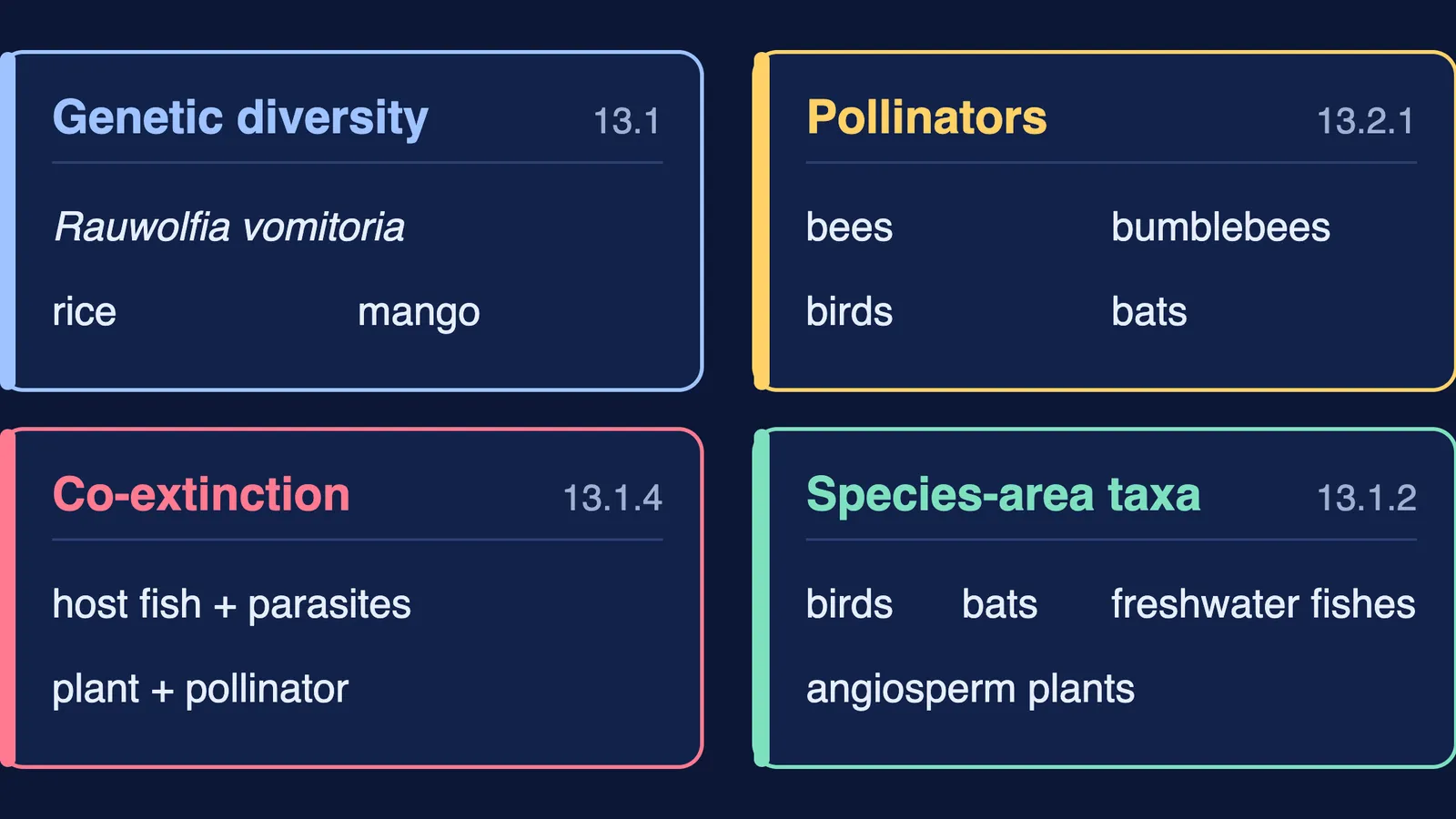
Genetic diversity (13.1): *Rauwolfia vomitoria* across Himalayan ranges (reserpine); rice, over 50,000 strains in India; mango, 1,000 varieties.
Species counts in the chapter opening: ants (more than 20,000 species), beetles (3,00,000), fishes (28,000), orchids (nearly 20,000).
Species diversity and latitude (13.1, 13.1.2): amphibians, richer in the Western Ghats than the Eastern Ghats; bird species by place: Colombia nearly 1,400, New York 105, Greenland 56, India more than 1,200.
Species-area taxa (13.1.2): angiosperm plants, birds, bats, freshwater fishes; plants in Britain, birds in California, molluscs in New York state; frugivorous birds and mammals across continents (slope 1.15).
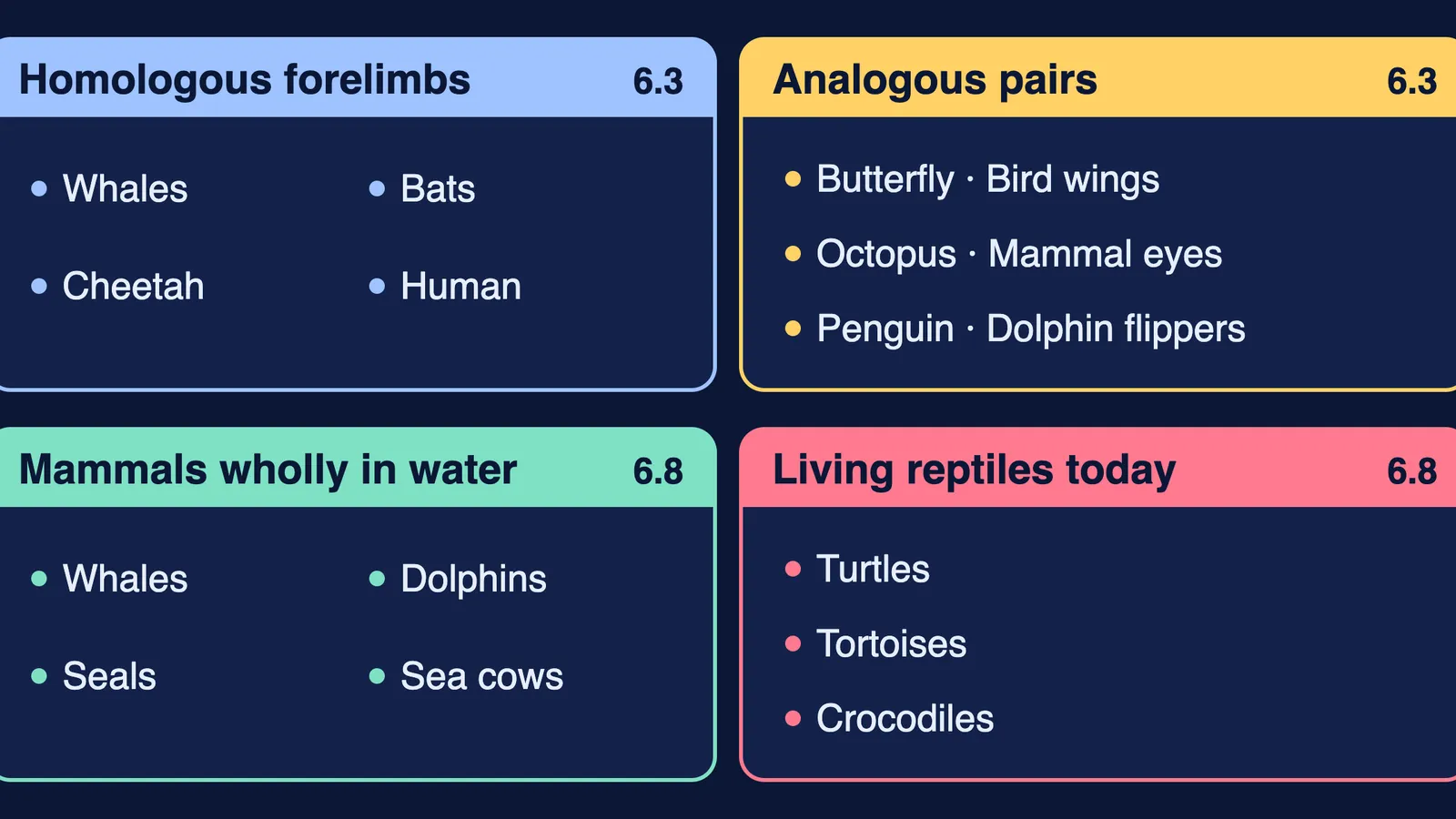
Recent extinctions (13.1.4): dodo, quagga, thylacine, Steller's Sea Cow, and three tiger subspecies: Bali, Javan, Caspian.
Over-exploitation (13.1.4): Steller's sea cow, passenger pigeon; over-harvested marine fish.
Alien species invasions (13.1.4): Nile perch in Lake Victoria, where more than 200 cichlid fish species were lost; carrot grass (*Parthenium*), *Lantana*, water hyacinth (*Eicchornia*, NCERT's spelling); African catfish *Clarias gariepinus*.
Co-extinction (13.1.4): a host fish and its parasites; a coevolved plant and its pollinator.
Services and conservation (13.2.1, 13.2.2): pollinators (bees, bumblebees, birds, bats); a bulbul's song (an intangible benefit); the tiger, saved by saving its whole forest (in situ).
Steller's sea cow sits in groups 5 and 6, so it is never a wrong option below.
How do you answer "which is an example of" questions?
Name each option's role first; wrong options are real NCERT names from another section.
Q1. Which is an invasive weed named by NCERT? (1) *Eicchornia* (2) *Clarias gariepinus* (3) bulbul (4) dodo
Answer: (1). Water hyacinth is listed with carrot grass and *Lantana*; *Clarias* is an invasive fish, not a weed, and the dodo is a recent extinction.
Q2. Which does NCERT give as an example of extinction through over-exploitation? (1) dodo (2) passenger pigeon (3) quagga (4) cichlid fish of Lake Victoria
Answer: (2). NCERT gives no cause for the dodo or quagga; the cichlids fell to an introduced species.
Q3. Which is NOT among NCERT's recent extinctions? (1) thylacine (2) Caspian tiger (3) quagga (4) Nile perch
Answer: (4). The Nile perch is the invader, not an extinct species.
Q4. Which organism is NOT named in NCERT's "Evil Quartet" examples? (1) passenger pigeon (2) *Lantana* (3) Nile perch (4) thylacine
Answer: (4). The thylacine appears only in the recent-extinctions list.
How do you crack match-the-organism questions?
Settle the pair you are surest of, cross out every option that contradicts it, then confirm one more pair.
Q5. List-I: A. *Parthenium* B. *Eicchornia* C. *Clarias gariepinus* D. Cichlid fish. List-II: I. Water hyacinth II. African catfish III. Carrot grass IV. Over 200 species lost in Lake Victoria. (1) A-III, B-I, C-II, D-IV (2) A-I, B-III, C-II, D-IV (3) A-III, B-II, C-I, D-IV (4) A-III, B-I, C-IV, D-II
Answer: (1). These are NCERT's own common names and outcome.
Q6. List-I: A. Passenger pigeon B. Water hyacinth C. Western Ghats amphibians D. Tiger. List-II: I. Species diversity II. In situ conservation III. Over-exploitation IV. Alien species invasion. (1) A-IV, B-III, C-I, D-II (2) A-III, B-IV, C-I, D-II (3) A-III, B-IV, C-II, D-I (4) A-III, B-I, C-IV, D-II
Answer: (2). Protecting the whole forest for the tiger is NCERT's in situ example.
Q7. Bird species by place. List-I: A. Colombia B. New York C. Greenland D. India. List-II: I. 105 II. 56 III. More than 1,200 IV. Nearly 1,400. (1) A-IV, B-II, C-I, D-III (2) A-III, B-I, C-II, D-IV (3) A-IV, B-I, C-II, D-III (4) A-IV, B-I, C-III, D-II
Answer: (3). Counts fall with latitude, 41° N for New York and 71° N for Greenland.
Q8. Species count. List-I: A. Ants B. Beetles C. Fishes D. Orchids. List-II: I. 3,00,000 II. More than 20,000 III. 28,000 IV. Nearly 20,000. (1) A-IV, B-I, C-III, D-II (2) A-II, B-III, C-I, D-IV (3) A-II, B-I, C-IV, D-III (4) A-II, B-I, C-III, D-IV
Answer: (4). Ants are "more than", orchids "nearly", 20,000.
How do you handle two-statement and correct-pair questions?
Judge each statement alone. In pair questions, one wrong word sinks the pair.
Options for Q9 to Q11: (1) Both correct (2) Both incorrect (3) I correct, II incorrect (4) I incorrect, II correct.
Q9. Statement I: NCERT names the Bali, Javan and Caspian tigers among recent extinctions. Statement II: Steller's sea cow appears both as a recent extinction and as a loss through over-exploitation.
Answer: (1). Both match section 13.1.4.
Q10. Statement I: NCERT's species-diversity example compares amphibians of the Western and Eastern Ghats. Statement II: NCERT calls the arrival of *Clarias gariepinus* a legal introduction for aquaculture.
Answer: (3). NCERT calls it illegal; the catfish threatens indigenous catfishes.
Q11. Statement I: NCERT says Meghalaya's sacred groves are the last refuges for many rare and threatened animals. Statement II: NCERT says many marine fish populations are over harvested.
Answer: (4). The refuges are for rare and threatened plants.
Q12. Which pair is correctly matched? (1) *Lantana*, water hyacinth (2) Nile perch, Lake Victoria (3) *Clarias gariepinus*, native catfish (4) Passenger pigeon, alien invasion
Answer: (2). *Lantana* has no common name in NCERT, the catfish is African, and the pigeon was over-exploited.
More formats on this chapter: the biodiversity statement and match-the-list set, the diagram-based biodiversity questions and the biodiversity assertion-reason questions.
Which group keeps slipping? Fermi's AI tutor works out what you already know and builds a plan for the session.