

On this page
These 14 original questions follow the Biodiversity and Conservation chapter of NCERT Class 12 Biology, 2026-27 reprint. The topic sits in Unit 10, Ecology and Environment, of the NMC's NEET (UG)-2026 syllabus. The NEET (UG)-2026 bulletin gives Biology 90 of 180 questions, marked +4 and −1. For a refresher, read our NEET guide to biodiversity and conservation.
How do you solve Statement I and II questions on biodiversity?
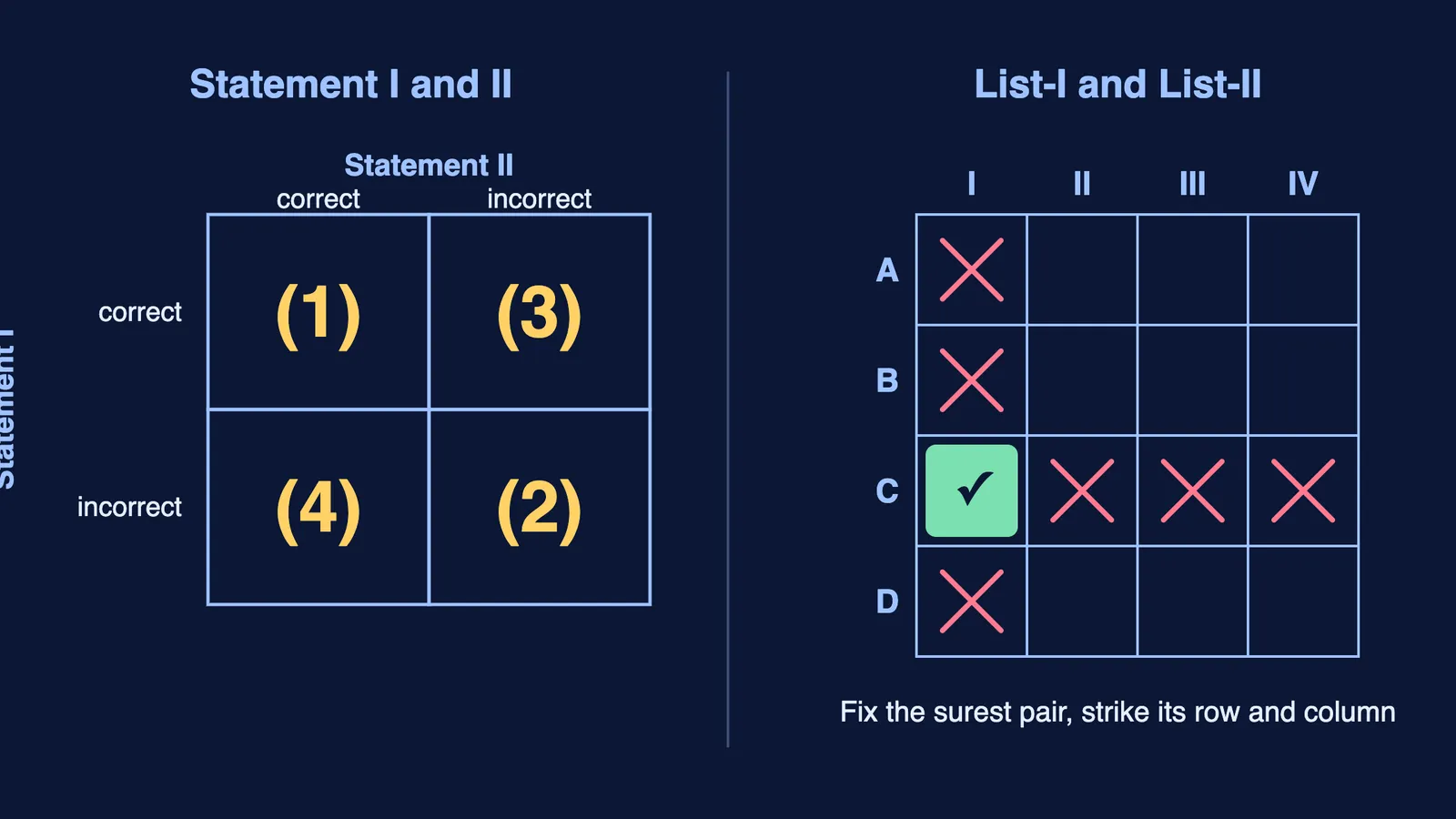
Options for Q1 to Q4: (1) Both correct. (2) Both incorrect. (3) I correct, II incorrect. (4) I incorrect, II correct.
Q1. Statement I: Edward Wilson, a sociobiologist, popularised the term biodiversity. Statement II: India's 1,000 mango varieties show species diversity.
Answer: (3). Varieties within one species show genetic diversity.
Q2. Statement I: Species inventories are more complete for tropical countries than for temperate ones. Statement II: Robert May's estimate puts global species diversity at about 7 million.
Answer: (4). Temperate inventories are the more complete ones.
Q3. Statement I: In Tilman's plots, species-rich plots varied more in total biomass from year to year. Statement II: In Ehrlich's rivet popper analogy, wing rivets stand for key species.
Answer: (4). Species-rich plots varied less, and were more productive.
Q4. Statement I: Nearly half of all species might be wiped out within 100 years if present trends continue. Statement II: Earth's five earlier mass extinctions all happened after humans appeared.
Answer: (3). The five earlier episodes predate humans; today's differs in rate.
How do you handle "which statements are correct" questions?
Mark each line T or F; one sure F often removes two options.
Q5. Which are correct about tropical diversity? A. The tropics span 23.5° N to 23.5° S. B. An Ecuador forest can hold up to 10 times the vascular plant species of an equal-area US Midwest forest. C. The Amazon rain forest holds about 1,300 species of fishes. D. The Amazon rain forest holds more than 40,000 plant species. E. The Amazon rain forest has as many amphibian species as mammal species.
(1) A, B and D only (2) A, B, D and E only (3) B, C and E only (4) A, B, C, D and E
Answer: (2). C swaps two counts: 3,000 fishes, 1,300 birds. Mammals and amphibians are 427 each.
Q6. Which are correct about India's biodiversity? A. India covers 2.4 per cent of Earth's land. B. India's share of global species diversity is 8.1 per cent. C. India is one of 12 mega diversity countries. D. India has recorded nearly 45,000 animal species and twice as many plant species. E. Using May's estimate, more than 1,00,000 plant species in India may still be undescribed.
(1) A, B and C only (2) A, B, C and E only (3) B, C, D and E only (4) A, B, D and E only
Answer: (2). D is reversed: nearly 45,000 plants, and twice as many animals.
How do you crack match-the-list questions on this chapter?
The full method is in our match-the-list guide for NEET.
Q7. List-I: A. Dodo B. Quagga C. Thylacine D. Steller's sea cow. List-II: I. Australia II. Russia III. Mauritius IV. Africa.
(1) A-III, B-IV, C-I, D-II (2) A-IV, B-III, C-I, D-II (3) A-III, B-I, C-IV, D-II (4) A-II, B-IV, C-I, D-III
Answer: (1). NCERT's recent extinctions, each with its place.
Q8. List-I: A. Habitat loss B. Over-exploitation C. Alien species invasion D. Co-extinction. List-II: I. Over-harvested marine fish populations II. African catfish *Clarias gariepinus* in Indian rivers III. Obligate partners dying with an extinct species IV. Amazon cleared for soya beans and beef cattle.
(1) A-IV, B-II, C-I, D-III (2) A-I, B-IV, C-II, D-III (3) A-IV, B-I, C-II, D-III (4) A-IV, B-I, C-III, D-II
Answer: (3). Anchor on D-III; the catfish separates (3) from (1).
Q9. Share of species threatened with extinction. List-I: A. Birds B. Mammals C. Amphibians D. Gymnosperms. List-II: I. 32% II. 12% III. 31% IV. 23%.
(1) A-II, B-IV, C-III, D-I (2) A-IV, B-II, C-I, D-III (3) A-I, B-IV, C-II, D-III (4) A-II, B-IV, C-I, D-III
Answer: (4). Amphibians (32%) edge gymnosperms (31%), the trap in option (1).
Q10. List-I: A. Bioprospecting B. Sixth Extinction C. Lungs of the planet D. Evil Quartet. List-II: I. The Amazon rain forest II. Four major causes of biodiversity loss III. Searching biodiversity for economically useful products IV. Today's extinction episode, faster than earlier ones.
(1) A-I, B-IV, C-III, D-II (2) A-III, B-IV, C-I, D-II (3) A-III, B-II, C-I, D-IV (4) A-IV, B-III, C-I, D-II
Answer: (2). NCERT calls the Amazon the lungs of the planet.
Q11. Sacred groves, as NCERT places them. List-I: A. Khasi and Jaintia Hills B. Aravalli Hills C. Sarguja, Chanda and Bastar D. Western Ghat regions. List-II: I. Madhya Pradesh II. Karnataka and Maharashtra III. Meghalaya IV. Rajasthan.
(1) A-IV, B-III, C-I, D-II (2) A-III, B-I, C-IV, D-II (3) A-III, B-IV, C-I, D-II (4) A-III, B-IV, C-II, D-I
Answer: (3). NCERT's own list.
Which single-answer questions test the same chapter?
Check the stem for "incorrect" before reading options.
Q12. Within a region, Z = 0.2. If the explored area grows 32 times, species richness becomes about: (1) 1.2 times (2) 2 times (3) 6.4 times (4) 32 times
Answer: (2). From log S = log C + Z log A, S rises by 32^0.2 = 2, because 2^5 = 32.
Q13. At the 2002 Johannesburg summit, 190 countries pledged a significant cut in biodiversity loss by: (1) 2000 (2) 2005 (3) 2010 (4) 2020
Answer: (3). NCERT gives 2010 as the target year.
Q14. Which is incorrect according to NCERT? (1) Extinctions are random across taxa, with no group more vulnerable. (2) The Amazon is estimated to produce 20% of atmospheric oxygen. (3) Over 25% of drugs sold worldwide come from plants. (4) Species estimates give no figures for prokaryotes.
Answer: (1). NCERT says extinctions are not random; amphibians look more vulnerable.
How should you use this set?
Sort each miss: a fact never learnt, or one pinned to the wrong label. Redo misses after two days, then try our biodiversity assertion-reason set. This is a study summary, not medical advice.
Not sure which part of ecology to revise first? Fermi's AI tutor works out what you already know and builds a plan for the session.


