

On this page
Biodiversity and Conservation is a chapter of facts, so its assertion-reason traps come from linking two true facts by mistake. Every statement below was checked against the NCERT Class 12 Biology chapter on Biodiversity and Conservation (2026-27 reprint), a named topic in the NMC syllabus for NEET (UG)-2026. For the full chapter, read our biodiversity and conservation guide for NEET.
How do you answer assertion-reason questions?
Judge each statement on its own first. Only if both are true, ask: is R the direct reason NCERT gives for A?
Keys for every question:
Assertion-reason: (A) Both A and R are true and R is the correct explanation of A. (B) Both A and R are true but R is NOT the correct explanation of A. (C) A is true but R is false. (D) A is false but R is true.
Statement pairs: (A) Both statements are correct. (B) Both statements are incorrect. (C) Statement I is correct, Statement II is incorrect. (D) Statement I is incorrect, Statement II is correct.
Biodiversity assertion-reason questions with answers
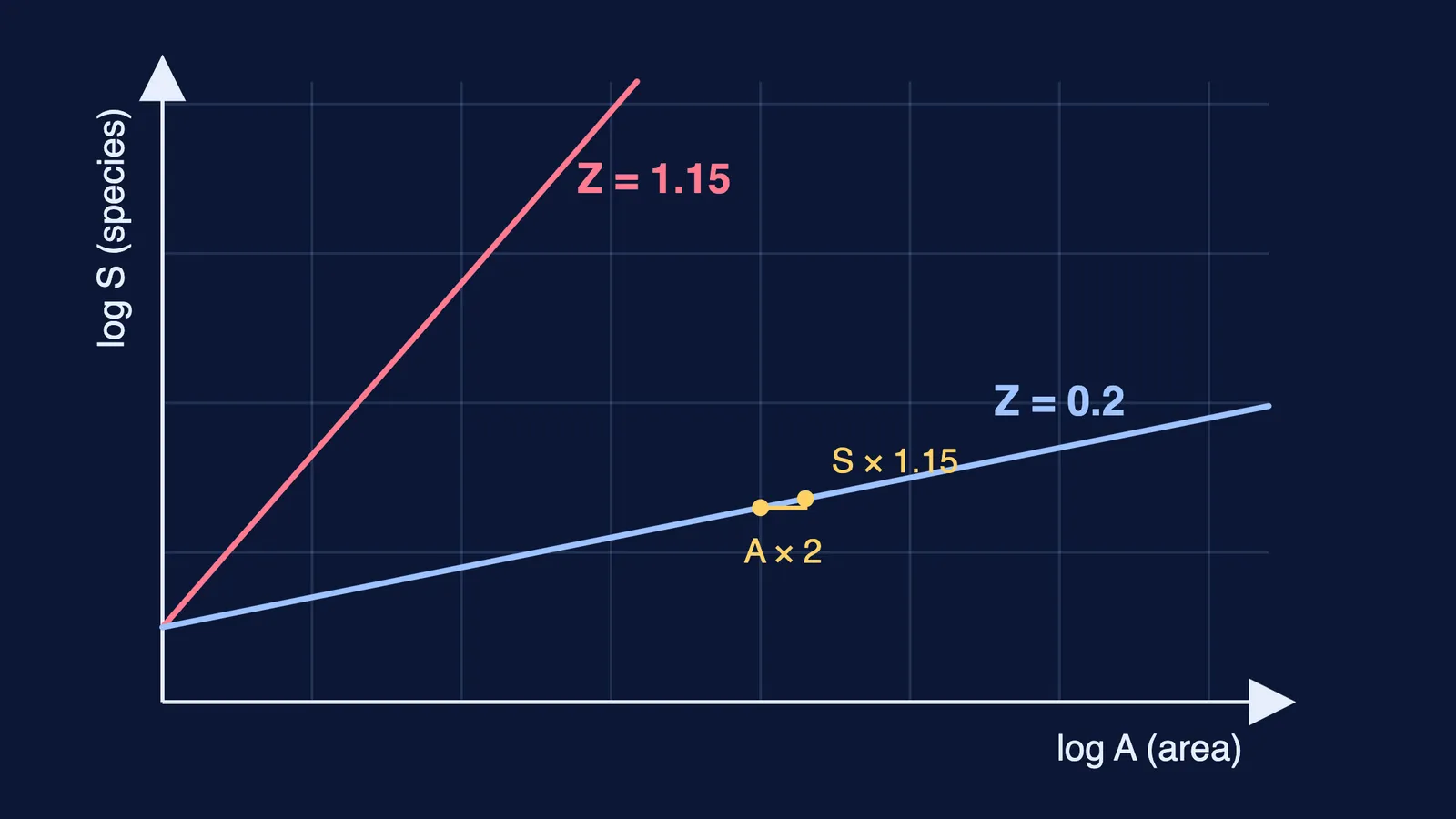
All facts below are from the NCERT Biodiversity and Conservation chapter. Within a region, the species-area relationship is log S = log C + Z log A, so S = C × A^Z.
Q1 (easy). Assertion (A): Plants of Rauwolfia vomitoria from different Himalayan ranges can differ in the potency and concentration of reserpine they make, an example of genetic diversity. Reason (R): Genetic diversity is variation within one species across the range where it grows.
Answer: (A). Both are true, and R is why this counts as genetic diversity: one species, varying across its range. Trap: calling it species diversity because a medicinal plant is involved.
Q2 (easy). Assertion (A): Tropical latitudes have had a long, undisturbed stretch of evolutionary time for species to diversify. Reason (R): Temperate regions went through frequent glaciations in the past, while tropical latitudes stayed relatively undisturbed.
Answer: (A). Both are true, and NCERT gives the lack of glaciations as the reason the tropics had more time. Trap: choosing (B) because R talks about temperate regions.
Q3 (medium). Assertion (A): The world has more species of fungi than of fishes, amphibians, reptiles and mammals put together. Reason (R): Insects make up more than 70 per cent of all recorded animal species.
Answer: (B). Both are true, but insect numbers say nothing about fungi, which are not animals. Trap: linking two "biggest group" facts from one paragraph.
Q4 (medium). Assertion (A): Ex situ conservation protects a threatened species together with its whole natural ecosystem. Reason (R): Gametes of threatened species can be kept viable and fertile for long periods by cryopreservation.
Answer: (D). R is true and is an ex situ method. A is false: protecting the whole ecosystem is in situ conservation; ex situ takes the organism out of its habitat. Trap: swapping in situ and ex situ.
Q5 (medium). Assertion (A): Breaking a large habitat into small fragments badly affects mammals and birds that need large territories. Reason (R): Every alien species introduced into a new region becomes invasive.
Answer: (C). A is true. R is false: NCERT says only some introduced alien species turn invasive. Trap: accepting "every" because Parthenium and Lantana are so familiar.
Q6 (hard). Assertion (A): Within a region where Z = 0.2, doubling the explored area roughly doubles the number of species. Reason (R): Within a region, Z usually lies between 0.1 and 0.2, whatever the taxonomic group.
Answer: (D). R is true. A is false: doubling A multiplies S by 2^0.2, which is about 1.15, so species rise by about 15 per cent, not 100 per cent. Trap: reading the straight log-log line as "species proportional to area".
Statement I and Statement II questions on biodiversity
Same source: the NCERT chapter.
Q7 (easy). Statement I: Biodiversity hotspots are chosen for very high species richness together with a high degree of endemism. Statement II: Three hotspots, Western Ghats and Sri Lanka, Indo-Burma and Himalaya, cover India's regions of exceptionally high biodiversity.
Answer: (A). Both match NCERT; endemism means species found nowhere else. Trap: thinking species richness alone qualifies a region.
Q8 (medium). Statement I: The narrowly utilitarian argument for conservation rests on ecosystem services such as pollination and oxygen production. Statement II: The ethical argument says a species deserves protection only if it has some economic value.
Answer: (B). Statement I describes the broadly utilitarian argument; the narrowly utilitarian one is about direct products such as food, fibre and medicines. In Statement II, the ethical argument actually gives every species intrinsic value, even with no economic use. Trap: mixing up "narrowly" and "broadly".
Q9 (medium). Statement I: Of the four causes in the "Evil Quartet", habitat loss and fragmentation is the most important driver of extinction. Statement II: The loss of over 200 cichlid fish species in Lake Victoria is an example of co-extinction.
Answer: (C). Statement I is NCERT's ranking. Statement II is wrong: the cichlids were lost after the Nile perch was introduced, which makes it an alien species invasion. Co-extinction is when an obligately linked species, such as a parasite, dies with its host. Trap: calling any chain of extinctions "co-extinction".
Q10 (hard). Statement I: Plants make up most of the 784 extinctions recorded by the IUCN Red List (2004) over the last 500 years. Statement II: All biodiversity hotspots together cover about 30 per cent of Earth's land area.
Answer: (B). Plants were only 87 of the 784; most were invertebrates (359) and vertebrates (338). The hotspots cover less than 2 per cent of land; 30 per cent is how much their strict protection could cut ongoing mass extinctions. Trap: attaching a remembered number to the wrong fact.
How should you use this set?
Do all ten in one sitting, without notes.
For every miss, note the failed step: a false statement believed, or a wrong "because" link.
Re-read the NCERT paragraph behind each miss and list the pairs you swapped: in situ and ex situ, narrowly and broadly utilitarian, invasion and co-extinction.
Retry the set three days later in a new order.
If the species-area equation keeps tripping you, the Fermi Concept Library gives every concept in biology its own lesson. For more practice on paired statements, read how to judge statement-based questions in NEET, and for the method across subjects, see how to crack assertion-reason questions.


