On this page
Eight original items, easy to hard, each with the key and the tempting wrong option. Judge each part before reading the options.
What do these probability and statistics questions cover?
Unit 13 of NTA's Syllabus for JEE (Main) - 2027 lists mean, median, mode, variance, standard deviation and mean deviation, the addition and multiplication theorems, Bayes' theorem and the probability distribution of a random variable. Every item fits that list and NCERT's Class 11 Chapter 13, Statistics and Class 12 Chapter 13, Probability. Variance divides by n. New to the chapter? Start with what to study in statistics for JEE Main.
Can you solve these statement questions?
Options for Q1 to Q4: (1) Both correct (2) Both incorrect (3) I correct, II incorrect (4) I incorrect, II correct
Q1 (easy). Data: 2, 4, 6, 8, 10. Statement I: The mean is 6 and the variance is 8. Statement II: Tripling each value and then adding 5 gives variance 72.
Answer: (1). I: squared deviations 16, 4, 0, 4, 16 sum to 40; 40/5 = 8. II: adding 5 changes nothing; tripling multiplies variance by 9. Trap: (3), from adding 5 to the variance.
Q2 (medium). P(A) = 0.5, P(B) = 0.4, P(A ∪ B) = 0.7. Statement I: A and B are mutually exclusive. Statement II: A and B are independent.
Answer: (4). P(A ∩ B) = 0.5 + 0.4 − 0.7 = 0.2, not 0, so I fails; 0.5 × 0.4 = 0.2, so II holds. Trap: (1). Two events with nonzero probability can never be both.
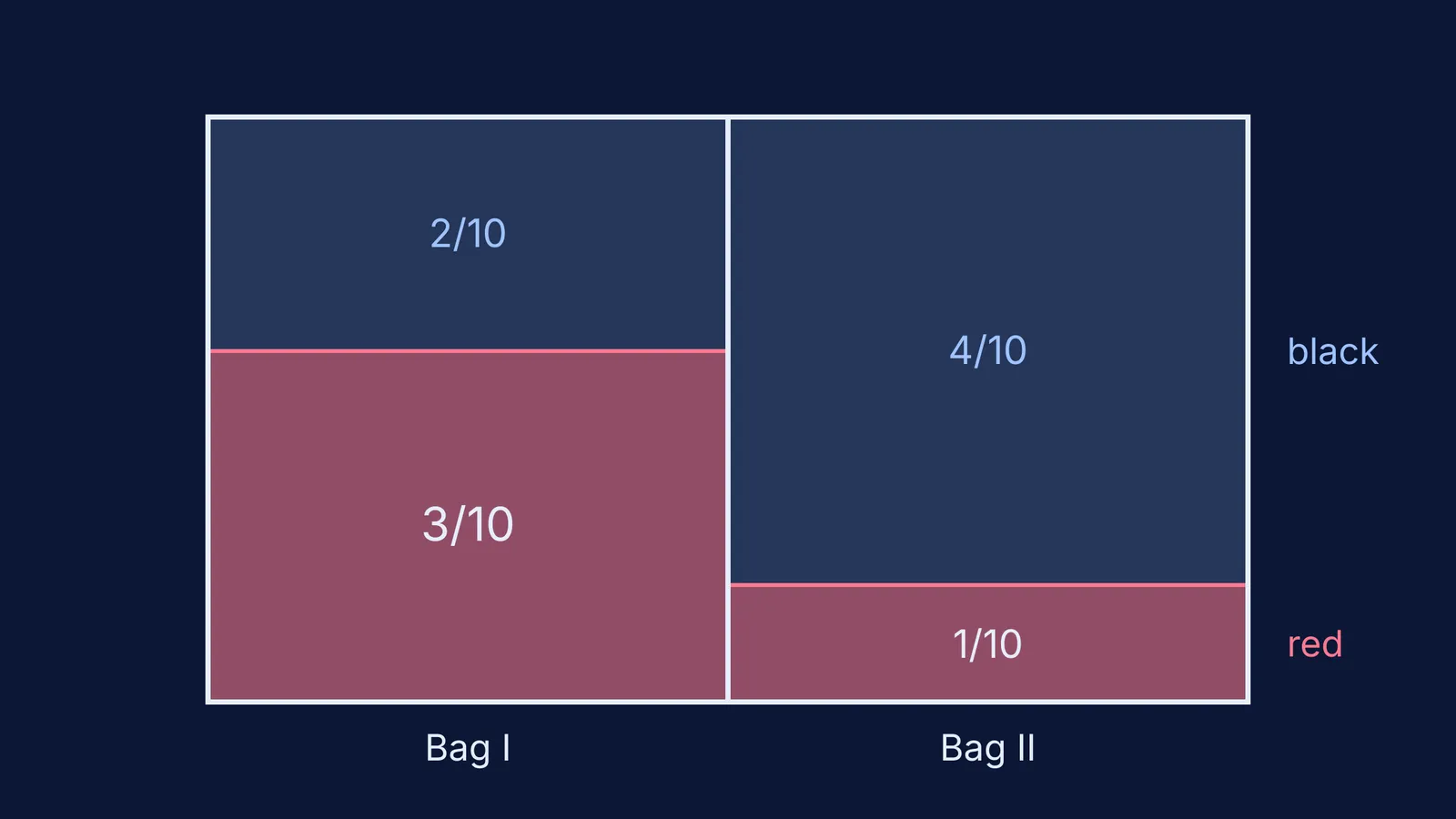
Q3 (medium). Bag I: 3 red, 2 black balls. Bag II: 1 red, 4 black. A fair coin picks the bag; one ball is drawn. Statement I: P(red) = 2/5. Statement II: Given the ball is red, the probability it came from Bag I is 3/5.
Answer: (3). I: (1/2)(3/5) + (1/2)(1/5) = 2/5. II: by Bayes' theorem it is (3/10) ÷ (4/10) = 3/4. Trap: (1). 3/5 is P(red | Bag I), the condition reversed.
Q4 (hard). X takes the values 1, 2, 3, 4 with P(X = k) = ck. Statement I: E(X) = 2.5. Statement II: Var(X) = 1.25.
Answer: (2). 10c = 1, so c = 1/10. E(X) = 30/10 = 3. E(X²) = 100/10 = 10, so Var(X) = 1. Trap: (1). 2.5 and 1.25 belong to four equally likely values.
Can you solve these match-the-list questions?
Q5 (easy). Data: 1, 3, 3, 6, 7, 10.
List-I: A. Mean B. Median C. Mode D. Range
List-II: I. 3 II. 4.5 III. 5 IV. 9
(1) A-II, B-III, C-I, D-IV (2) A-III, B-II, C-I, D-IV (3) A-III, B-I, C-II, D-IV (4) A-IV, B-II, C-I, D-III
Answer: (2). Mean 30/6 = 5; median (3 + 6)/2 = 4.5; mode 3; range 9. Trap: (1), swapping mean and median.
Q6 (medium). Two fair dice are thrown.
List-I: A. Sum is 8 B. A double C. At least one 6 D. A double, given sum 8
List-II: I. 1/5 II. 1/6 III. 5/36 IV. 11/36
(1) A-III, B-I, C-IV, D-II (2) A-IV, B-II, C-III, D-I (3) A-III, B-II, C-IV, D-I (4) A-II, B-III, C-IV, D-I
Answer: (3). Five outcomes sum to 8: 5/36. Doubles: 6/36 = 1/6. 1 − 25/36 = 11/36. Only (4,4) of those five: 1/5. Trap: (1). Reversing D's condition gives 1/6.
Q7 (medium). Ten observations have mean 20 and standard deviation 4.
List-I: A. SD after adding 5 to each B. SD after doubling each C. Variance after doubling each D. Mean after x becomes 2x − 5
List-II: I. 4 II. 8 III. 35 IV. 64
(1) A-I, B-IV, C-II, D-III (2) A-II, B-I, C-IV, D-III (3) A-I, B-II, C-III, D-IV (4) A-I, B-II, C-IV, D-III
Answer: (4). A shift leaves SD at 4; doubling gives 8 and variance 64; 2 × 20 − 5 = 35. Trap: (1), mixing up variance and SD. Scaling by k multiplies SD by |k|, variance by k².
Q8 (hard). A fair coin is tossed three times; X is the number of heads.
List-I: A. P(at least one head) B. E(X) C. Var(X) D. P(two heads | at least one head)
List-II: I. 3/7 II. 3/4 III. 7/8 IV. 3/2
(1) A-III, B-IV, C-II, D-I (2) A-III, B-II, C-IV, D-I (3) A-II, B-IV, C-III, D-I (4) A-I, B-IV, C-II, D-III
Answer: (1). X = 0, 1, 2, 3 with probabilities 1/8, 3/8, 3/8, 1/8. A: 1 − 1/8 = 7/8. B: 12/8 = 3/2. C: E(X²) = 3, so Var(X) = 3 − 9/4 = 3/4. D: (3/8) ÷ (7/8) = 3/7. Trap: (2), swapping mean and variance (np = 3/2, npq = 3/4).
How do you attack these formats quickly?
Judge each statement alone; if one is false, two options go.
In conditional probability, name the given event first.
In a match grid, fix the most distinctive pair and strike codes that disagree.
Same slip keeps coming back? The Fermi Problem Library has worked problems with a step-by-step solver that explains the reasoning. For wider preparation, Fermi Test Prep covers JEE Main and Advanced.
For timed practice, try probability numerical value questions and statistics numerical value questions with answers.