On this page
How are JEE Main numerical value questions marked?
NTA's Information Bulletin for JEE (Main) 2027 says each Paper 1 subject has 20 Section A questions (MCQs) and 5 Section B questions whose answer is a numerical value. A correct Section B answer earns +4, a wrong one −1, and a blank 0. You enter an integer on an on-screen keypad, and the answer should be rounded off to the nearest integer.
Statistics sits in Unit 13 of the mathematics Syllabus for JEE (Main) 2027: mean, median and mode of grouped and ungrouped data, and standard deviation, variance and mean deviation. Variances are often fractions, so each question says what to type.
Easy: can you get the basic measures right?
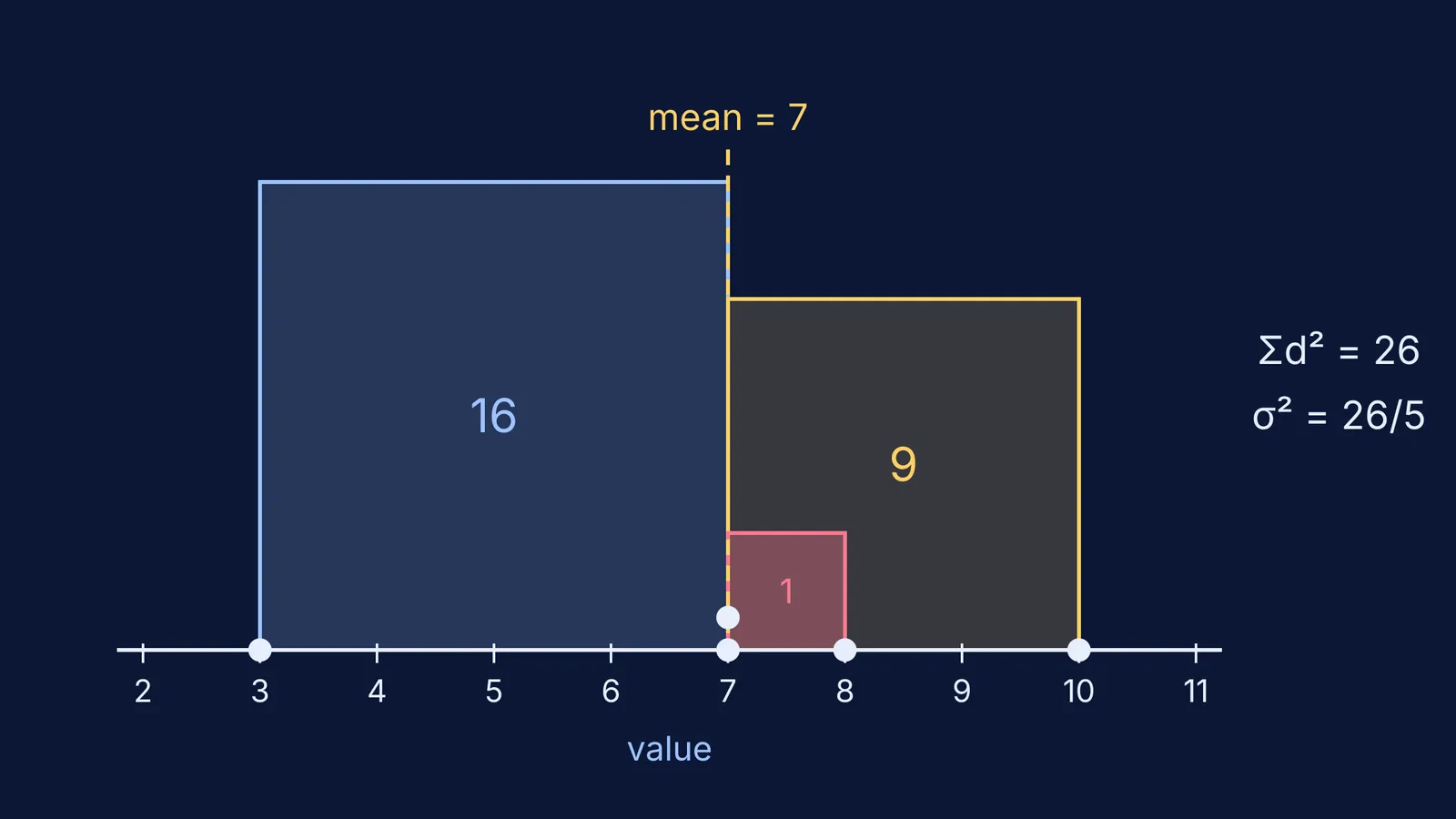
Q1 (easy). The mean of 3, 7, 8, 10 and x is 7. If σ² is their variance, find 5σ².
Answer: 26. The sum is 35, so x = 7. Deviations from 7 are −4, 0, 1, 3, 0; their squares add to 16 + 0 + 1 + 9 + 0 = 26, so σ² = 26/5.
Check: Σx² = 9 + 49 + 64 + 100 + 49 = 271, and 271/5 − 49 = 26/5. Slip: dividing by n − 1 = 4 gives 32.5, a non-integer that should send you back. For a full data set, variance divides by n.
Q2 (easy). Find 7 times the mean deviation about the median of 2, 4, 7, 8, 9, 12, 15.
Answer: 23. The median is 8. The absolute deviations are 6, 4, 1, 0, 1, 4, 7, totalling 23, so the mean deviation is 23/7.
Check: values below the median sit 6 + 4 + 1 = 11 away and values above sit 1 + 4 + 7 = 12 away; 11 + 12 = 23. Slip: 3, from typing the mean deviation 23/7 rounded, not 7 times it.
Q3 (easy). Ten observations have mean 12 and variance 9. Each is multiplied by 3 and then 4 is subtracted. Find the new mean plus the new variance.
Answer: 113. New mean = 3 × 12 − 4 = 32. New variance = 3² × 9 = 81, because subtracting 4 shifts every value equally.
Check: the new standard deviation is 3 × 3 = 9, and 9² = 81. Slip: 59, from 3 × 9 = 27 instead of 9 × 9.
Medium: can you work from sums instead of data?
Q4 (medium). Twenty observations have mean 10 and variance 4. Later, one value recorded as 12 is found to be 8. Find 100 times the correct variance.
Answer: 396. Σx = 200 and Σx² = 20(4 + 100) = 2080. Correcting: Σx = 196, Σx² = 2080 − 144 + 64 = 2000. New mean 9.8, so σ² = 100 − 96.04 = 3.96.
Check: 12 and 8 sit equally far from the old mean 10, so Σ(x − 10)² stays at 80; with the mean now 9.8, σ² = 80/20 − 0.2² = 3.96. Slip: 796, from correcting Σx but not Σx².
Q5 (medium). Classes 0–10, 10–20, 20–30, 30–40 and 40–50 have frequencies 5, 8, f, 12 and 5. The mean is 26. Find f.
Answer: 10. With mid-points 5, 15, 25, 35, 45, Σfx = 790 + 25f and N = 30 + f. Setting 26(30 + f) = 790 + 25f gives f = 10.
Check: N = 40 and Σfx = 1040, and 1040/40 = 26. Slip: using class limits instead of mid-points.
Q6 (medium). Group A has 10 values with mean 20 and variance 9; group B has 15 values with mean 25 and variance 16. If σ² is the combined variance, find 5σ².
Answer: 96. The combined mean is 575/25 = 23. Each group adds n(σ² + d²), with d its distance from 23: 10(9 + 9) + 15(16 + 4) = 480, so σ² = 480/25 = 19.2.
Check: σ² must exceed the weighted average of the variances, 13.2, because the means differ. Slip: 66, from that weighted average.
Hard: can you reason back from mean and variance?
Q7 (hard). The numbers 4, 5, 8, a and b have mean 6 and variance 2. Find ab.
Answer: 42. a + b = 30 − 17 = 13. Σx² = 5(2 + 36) = 190, so a² + b² = 190 − 105 = 85. Then 2ab = 169 − 85 = 84.
Check: a and b are 6 and 7; the deviations −2, −1, 2, 0, 1 give squares totalling 10, and 10/5 = 2. Slip: 84, forgetting to halve 2ab.
Q8 (hard). The variance of the first n odd natural numbers is 133. Find n.
Answer: 20. The numbers 1, 3, …, 2n − 1 form an AP with mean n. Since Σ(2k − 1)² = n(4n² − 1)/3, the variance is (4n² − 1)/3 − n² = (n² − 1)/3. So n² = 400.
Check: an AP with common difference d has variance d²(n² − 1)/12, here (n² − 1)/3. Slip: dropping d² gives n² = 1597, not a perfect square. Why square at all? See why variance squares deviations instead of absolute values.
How do you avoid the wrong number in Statistics?
Divide by n, not n − 1 (Q1).
Scaling by k multiplies the variance by k²; shifts change only the mean (Q3).
Correct both Σx and Σx² (Q4); use mid-points for classes (Q5).
Round only at the end. A blank costs nothing; a wrong number costs a mark.
If your answer won't match, the Fermi Problem Library has a step-by-step solver that explains the reasoning rather than printing an answer. For JEE Main and Advanced preparation, start at Fermi Test Prep.
Next, try Statistics JEE Main practice questions with solutions or read Statistics for JEE Main: syllabus, worked examples and a plan.