On this page
Heat a persulphate solution and it slowly turns into acid. Acid speeds the reaction up, so it should run faster and faster. In 1910 Leila Green and Orme Masson, at the University of Melbourne, found that it does not: sodium and potassium persulphates at 80 °C fell apart by a clean first-order law, with k ≈ 0.0055 min⁻¹. Their explanation still works as a lesson in what "first order" hides. The paper is "The Dynamics of the Decomposition of Persulphuric Acid and its Salts in Aqueous Solution", J. Chem. Soc. Trans. 97, 2083–2099. We read it in the scanned 1910 volume and checked the numbers below against the page images. The paper gives only Leila Green's name and the university; we have not been able to check other details of her life. Masson's earlier work is in Masson and Steele, 1899: Fehling's blue copper is an anion.
How did Green and Masson follow the reaction?
Each solution was split into 5 c.c. samples, sealed in tubes and heated in a thermostat at 80.0 °C. At set times a tube was taken out and its acid titrated with standard sodium hydroxide, using methyl orange. Concentrations are in mol L⁻¹ and times in minutes.
The reaction, as they wrote it:
S₂O₈²⁻ + H₂O → 2HSO₄⁻ + ½O₂
Check: S 2 and 2, O 9 and 9, H 2 and 2, charge −2 and −2. Sulphur stays +6. The change is in the O–O bridge (structure of H₂S₂O₈): its two oxygens are −1, and one goes to 0 in O₂ while the other goes to −2.
Their Table I gives k₁ = 0.00541, 0.00577 and 0.00533 for three sodium persulphate solutions (0.125 to 0.226 M) and 0.00545 for potassium persulphate. The value hardly depends on concentration or on the metal, which is what first order means.
Why didn't the acid speed it up?
Levi and Migliorini (1906) had already shown that persulphates decompose first order and that acids speed them up. Green and Masson confirmed both and saw the clash: the product is acid, so the curve "should exhibit the features of an auto-accelerated" reaction. It did not.
Their answer: the product stays as HSO₄⁻ and gives "practically no H⁺ ions". In other words, "sulphuric acid be regarded as a monobasic acid under the conditions of the experiments." Free H⁺ never builds up, so nothing speeds up. They called this a working assumption that "may be objected to". It fits the modern picture: HSO₄⁻ is a much weaker acid than H₂SO₄ (its Ka is about 1 × 10⁻² at 25 °C), so in these solutions most of it stays as HSO₄⁻.
Magnesium persulphate was the exception that proves the rule. Mg²⁺ + HSO₄⁻ ⇌ MgSO₄ + H⁺ releases some H⁺, and its k crept up from about 0.0055 at the start to 0.0066 half-way and 0.0092 near the end.
What happened with persulphuric acid and barium persulphate?
Persulphuric acid starts with H⁺ already present, and that H⁺ stays constant during a run. Each run was first order, but K depended on the starting concentration A: K = 0.010 + 0.163A. That is a pseudo-first-order constant with the catalyst folded in, just as water is folded into k for ester hydrolysis. For A = 0.2566 M, the formula gives 0.0518 against 0.0527 found. They admitted that 0.010 being nearly twice the salt's 0.0055 was "difficult to explain on any hypothesis".
Barium persulphate is different. The HSO₄⁻ formed meets Ba²⁺, and insoluble BaSO₄ precipitates, leaving free H⁺:
2BaS₂O₈ + H₂O → H₂S₂O₈ + 2BaSO₄ + ½O₂
(Check: Ba 2 and 2, S 4 and 4, O 17 and 17, H 2 and 2.) Now acid accumulates, and the curve showed "strong auto-acceleration" until half the persulphate was gone and all the barium had precipitated. After that it ran as plain first-order persulphuric acid. The initial constant for the barium salt was only 0.0040.
How did added sulphates test the idea?
If H₂SO₄ is monobasic here, adding it should help only half as much as the same amount of a fully ionised dibasic acid. Sodium hydrogen sulphate should do nothing, and sodium sulphate should slow persulphuric acid down by mopping up H⁺ as HSO₄⁻. Their Table VI showed all three: with NaHSO₄, K = 0.0060 (salt alone 0.0055); with Na₂SO₄, persulphuric acid dropped from 0.0293 to 0.0151.
Worked example: half-life, acid catalysis and activation energy
Half-life of the salt at 80 °C. t½ = 0.693 ÷ k = 0.693 ÷ 0.0055 = 126 min, about 2.1 h. Time for 90% decomposition = 2.303 ÷ 0.0055 = 419 min, about 7 h.
Persulphuric acid, A = 0.2566 M. K = 0.010 + 0.163 × 0.2566 = 0.0518 min⁻¹ (found 0.0527). t½ = 0.693 ÷ 0.0527 = 13.2 min, nearly ten times faster than the salt.
Added sulphuric acid. For 0.1304 M Na₂S₂O₈ + 0.1332 M H₂SO₄, [Na⁺] = 0.2608 M and, if H₂SO₄ gives one H⁺, [H⁺] = 0.1332 M. Their rule weights 0.0055 and 0.010 by Na⁺ and H⁺, then adds 0.163 times half the H⁺ (their k is per mole of dibasic acid): K = 0.0055 × 0.2608/0.3940 + 0.010 × 0.1332/0.3940 + 0.163 × 0.0666 = 0.0036 + 0.0034 + 0.0109 = 0.0179. They printed 0.0179 calculated and 0.0161 found. Counting H₂SO₄ as fully dibasic gives 0.0295, far too high.
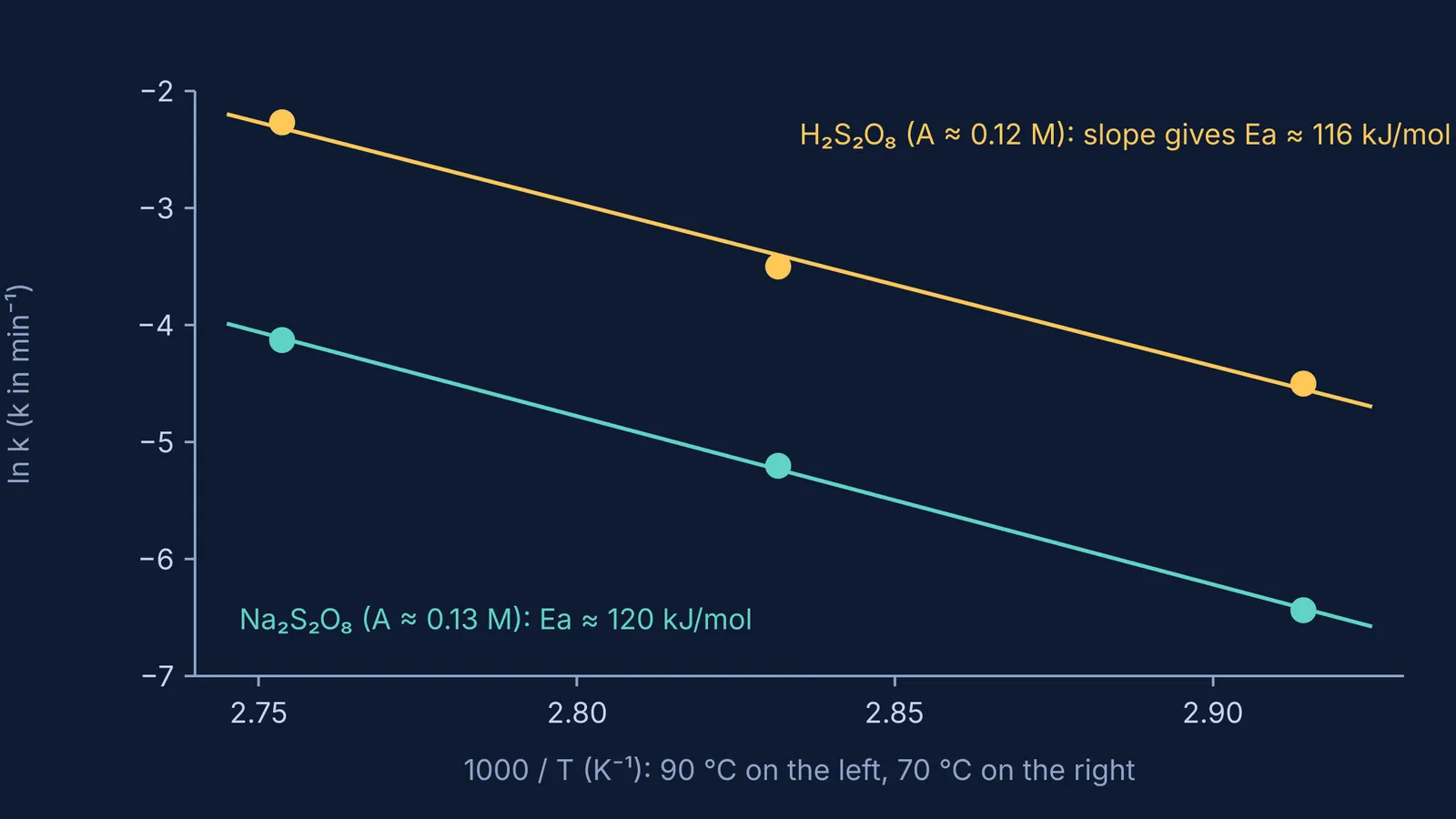
Activation energy. Their Table VIII gives k = 0.0016 min⁻¹ at 70 °C and 0.0161 min⁻¹ at 90 °C. With T₁ = 343.15 K and T₂ = 363.15 K: ln(0.0161 ÷ 0.0016) = ln 10.06 = 2.309, and 1/T₁ − 1/T₂ = 1.605 × 10⁻⁴ K⁻¹. Ea = 8.314 × 2.309 ÷ 1.605 × 10⁻⁴ = 119.6 kJ mol⁻¹. The two 10-degree steps give 124 and 115 kJ mol⁻¹; three-figure rate constants cannot do better. The persulphuric acid series gives about 116 kJ mol⁻¹.
The 10-degree rule. The paper says k rose "about tenfold" from 70 to 90 °C, which is √10.06 ≈ 3.2 per 10 °C, not the "doubles every 10 °C" rule of thumb. That rule fits an Ea of about 53 kJ mol⁻¹ near room temperature.
Where does this show up in JEE and NEET?
Class 12 Chemical Kinetics: integrated first-order law, t½ = 0.693/k, pseudo-first-order reactions, and Ea from two temperatures.
Autocatalysis: the barium salt behaves like the slow start of the KMnO₄–oxalic acid titration, where a product speeds the reaction.
Class 12 p-block: the O–O bridge in peroxodisulphuric acid.
For timed practice on half-life and Arrhenius numericals, Fermi Test Prep offers JEE Main and Advanced preparation with an AI tutor.
Quick checklist
S₂O₈²⁻ + H₂O → 2HSO₄⁻ + ½O₂ is first order, k ≈ 0.0055 min⁻¹ at 80 °C, t½ ≈ 126 min.
No self-acceleration, because HSO₄⁻ releases little H⁺.
Persulphuric acid: K = 0.010 + 0.163A, pseudo-first order.
Barium salt: BaSO₄ precipitates, H⁺ builds up, autocatalysis.
Ea ≈ 120 kJ mol⁻¹ from 70 and 90 °C; about 3.2 times faster per 10 °C.