On this page
These two usually turn up in the p-block chapter as one-line questions: "Find the oxidation state of sulphur in H2S2O8" or "How many peroxide bonds are there in Caro's acid?" Both catch students who count oxygens without drawing the molecule. Here is how to draw each one and get the oxidation state right.
What is the structure of H2SO5 (Caro's acid)?
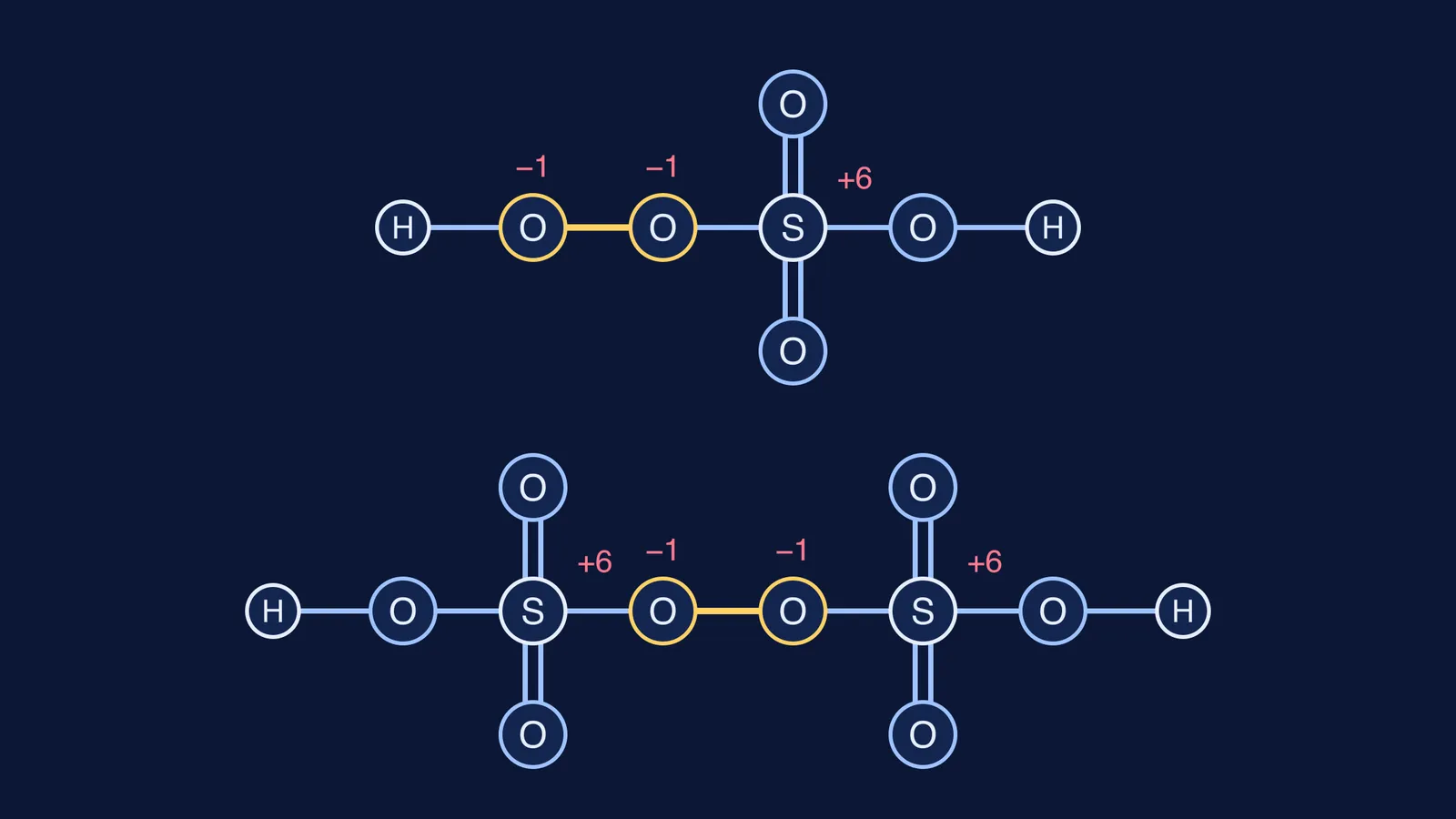
Start from sulphuric acid, HO–S(O)2–OH. Caro's acid swaps one OH for an OOH group, so its connectivity is HO–O–S(O)2–OH (Wikipedia: Peroxymonosulfuric acid). PubChem records the same skeleton, written as OOS(=O)(=O)O, and a molar mass of 114.08 g/mol (PubChem CID 2754594).
Sulphur sits at the centre of a tetrahedron: two S=O, one S–OH and one S–O–OH.
There is exactly one O–O (peroxide) bond. It joins the oxygen on sulphur to the oxygen of the end OH.
Both hydrogens sit on oxygen, but they are not equal. The OH on sulphur is strongly acidic (pKa about 1); the H on the peroxy end is weak (pKa 9.3), according to the same Wikipedia page.
The acid is named after the German chemist Heinrich Caro, who first reported investigations of mixtures of hydrogen peroxide and sulphuric acid in an 1898 paper (Wikipedia). The same mixture is one route to it: H2O2 + H2SO4 ⇌ H2SO5 + H2O.
What is the structure of H2S2O8 (Marshall's acid)?
Marshall's acid is two SO3H groups joined through a peroxide bridge: HO–S(O)2–O–O–S(O)2–OH (Wikipedia: Peroxydisulfuric acid). PubChem writes it as OS(=O)(=O)OOS(=O)(=O)O, with a molar mass of 194.15 g/mol (PubChem CID 24413).
Each sulphur is tetrahedral, with two S=O, one S–OH and one S–O bond into the bridge.
There is one O–O bond, in the middle, and the molecule is symmetric about it.
That gives four S=O bonds and two OH groups in total, one OH on each sulphur.
It is named after Hugh Marshall, who discovered it in 1891 and reported the persulphates from the University of Edinburgh's chemical laboratory (Marshall, J. Chem. Soc. Trans. 59, 771). It can be made by electrolysing moderately concentrated (60–70%) sulphuric acid at platinum electrodes at high current density (Wikipedia). Our post on what forms at the anode when sulphuric acid is electrolysed works through the electrode chemistry.
What is the oxidation state of sulphur in H2SO5 and H2S2O8?
The blind method takes H as +1 and every O as −2, then solves:
H2SO5: 2 + x − 10 = 0, so x = +8.
H2S2O8: 2 + 2x − 16 = 0, so x = +7.
Both answers are impossible. Sulphur is in group 16 and has six valence electrons, so it cannot go above +6. The mistake is treating every oxygen as −2. In an O–O bond the two oxygens share their electron pair equally, so each peroxide oxygen is −1, just as in H2O2. Our post on the oxidation number of oxygen in OF2, H2O2 and KO2 explains why.
The right way, in three steps:
Draw the structure and mark the O–O bond.
Sort the oxygens. H2SO5 has three ordinary oxygens (−2) and two peroxide oxygens (−1). H2S2O8 has six ordinary and two peroxide.
Solve. H2SO5: 2 + x − 6 − 2 = 0, so x = +6. H2S2O8: 2 + 2x − 12 − 2 = 0, so x = +6.
That matches the +6 given for sulphur in peroxymonosulfuric acid and peroxydisulfuric acid.
How do you tell H2S2O8 from H2S2O7?
The formulas differ by one oxygen. In disulphuric (pyrosulphuric) acid, H2S2O7, two SO2(OH) groups are joined by a single oxygen, an S–O–S bridge (Wikipedia: Disulfuric acid). In H2S2O8 the bridge is S–O–O–S. Sulphur is +6 in both; H2S2O7 has no peroxide oxygen, so 2 + 2x − 14 = 0 gives +6 directly.
A quick way to sort any sulphur oxoacid on a test:
Name has "peroxo" or "per-" (persulphate): there is an O–O bond.
One more oxygen than H2SO4 or H2S2O7 (H2SO5, H2S2O8): the extra oxygen makes an O–O bond. (Not H2SO4 against H2SO3: no O–O there.)
Blind count gives sulphur above +6: there is an O–O bond.
For the rest of the family, from sulphurous to thiosulphuric acid, see structures and basicity of the oxoacids of phosphorus and sulphur.
Five questions to test yourself
How many O–O bonds does H2S2O8 have? (One.)
What is the oxidation state of sulphur in H2SO5? (+6.)
Which hydrogen in Caro's acid is only weakly acidic? (The one on the peroxy end.)
How many S=O bonds does Marshall's acid have? (Four.)
Why is +7 wrong for sulphur in H2S2O8? (It treats the two peroxide oxygens as −2.)
If question 5 tripped you, the gap is the peroxide idea, not the arithmetic. The Fermi Concept Library covers every concept in chemistry, so you can revisit oxidation states. When you want to check a whole working, the Fermi Problem Library has a step-by-step solver that explains the reasoning rather than printing an answer.
Next time an oxidation state comes out too high, draw the molecule first and look for the O–O link.