On this page
Part 1 sorts the example plants named in Chapter 5 of NCERT Class 11 Biology (Reprint 2026-27) into ten groups, with sections. Part 2 has 12 original NEET-format questions with answers and NCERT reasons. The chapter sits in Unit 2, Structural Organisation in Animals and Plants, of the NMC syllabus for NEET (UG) 2026. This reprint has no root, stem or leaf modification sections.
Which example plants does NCERT name in morphology of flowering plants?
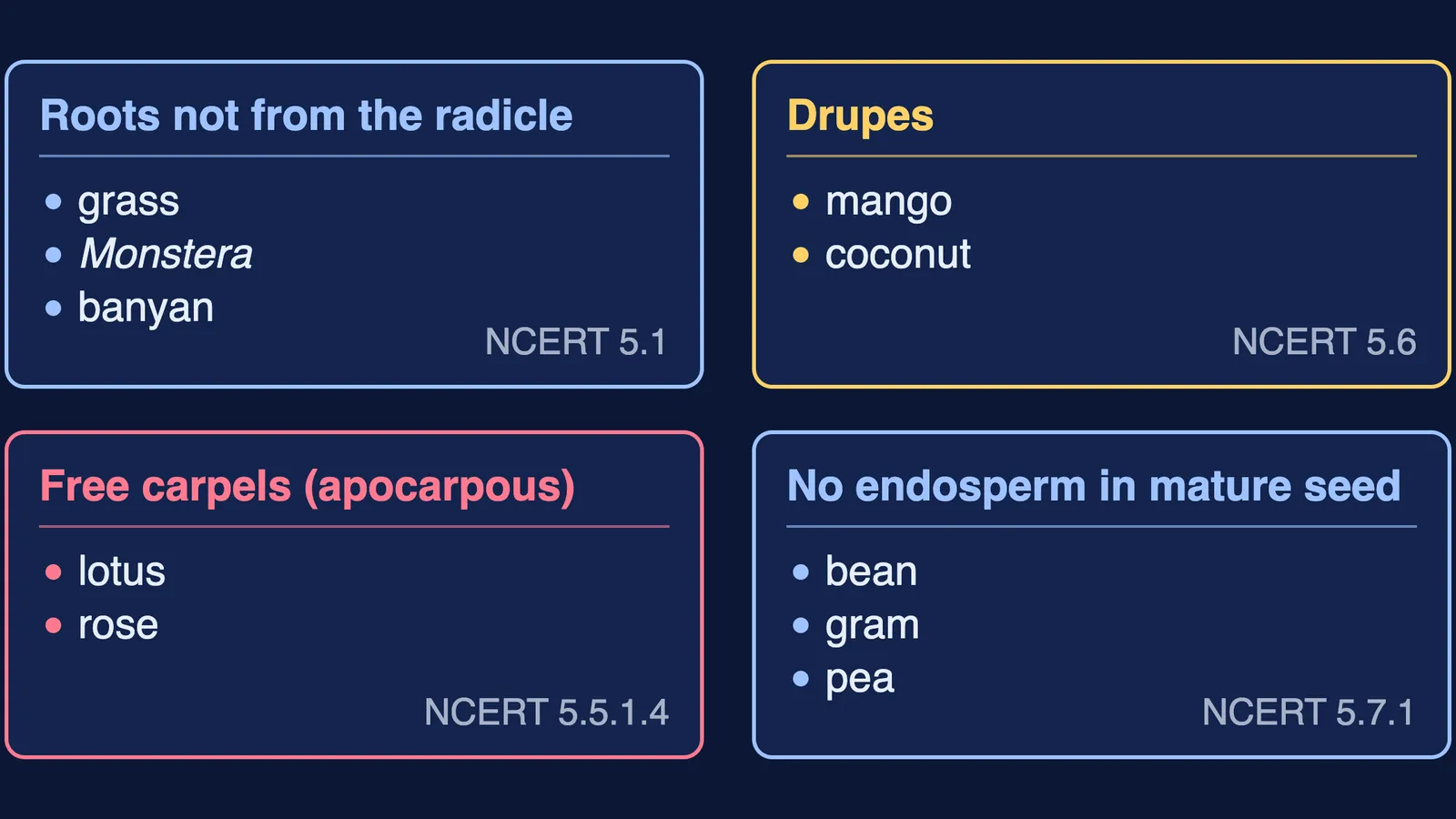
Root systems (5.1): tap root, mustard; fibrous, wheat; adventitious, grass, *Monstera*, banyan.
Compound leaves (5.3.2): pinnate, neem; palmate, silk cotton.
Phyllotaxy (5.3.3): alternate, china rose, mustard, sun flower; opposite, *Calotropis*, guava; whorled, *Alstonia*.
Symmetry (5.5): actinomorphic, mustard, datura, chilli; zygomorphic, pea, gulmohur, bean, *Cassia*; asymmetric, canna.
Ovary position (5.5): hypogynous, mustard, china rose, brinjal; perigynous, plum, rose, peach; epigynous, guava, cucumber, ray florets of sunflower.
Aestivation (5.5.1.2): valvate, *Calotropis*; twisted, china rose, lady's finger, cotton; imbricate, *Cassia*, gulmohur; vexillary, pea, bean.
Stamens and perianth (5.5, 5.5.1.3): perianth, lily; epipetalous, brinjal; epiphyllous, lily; monoadelphous, china rose; diadelphous, pea; polyadelphous, citrus; unequal filaments, *Salvia*, mustard.
Carpels and placentation (5.5.1.4): apocarpous, lotus, rose; syncarpous, mustard, tomato; marginal, pea; axile, china rose, tomato, lemon; parietal, mustard, *Argemone*; free central, *Dianthus*, Primrose; basal, sunflower, marigold.
Fruits and seeds (5.6, 5.7): drupe, mango, coconut; one cotyledon, wheat, maize; two, gram, pea; endospermic, castor; non-endospermous, bean, gram, pea; non-endospermic monocot, orchids.
Solanaceae (5.9): drawn as *Solanum nigrum* (makoi); food, tomato, brinjal, potato (*Solanum tuberosum*); spice, chilli; medicine, belladonna, ashwagandha; fumigatory, tobacco; ornamental, petunia. This is a study summary, not medical advice. Mustard's floral formula belongs to Brassicaceae (5.8).
How do you remember morphology examples?
Walk a flower from the outside in: ovary position, symmetry, petals in the bud, stamens, carpels, placentation, then fruit and seed. At each stop, name one plant that is in and one NCERT puts somewhere else, such as "twisted: cotton; not twisted: *Cassia*". Then check gaps against the list above.
Which is, or is NOT, an NCERT example?
How to attack: name the feature or features asked, then check each option against NCERT's list for each.
Q1. Which plant does NCERT cite for both alternate phyllotaxy and parietal placentation? (1) sun flower (2) tomato (3) mustard (4) guava Answer: (3). Sunflower is basal, tomato axile, and guava opposite (5.3.3, 5.5.1.4).
Q2. Which plant does NCERT cite for both opposite phyllotaxy and an epigynous flower? (1) *Calotropis* (2) guava (3) cucumber (4) china rose Answer: (2). NCERT gives no ovary position for *Calotropis* or phyllotaxy for cucumber; china rose is alternate (5.3.3, 5.5).
Q3. Which is NOT an NCERT example of a hypogynous flower? (1) mustard (2) china rose (3) brinjal (4) peach Answer: (4). Peach is perigynous, with a half-inferior ovary (5.5).
Q4. Which is NCERT's example of polyadelphous stamens? (1) citrus (2) pea (3) china rose (4) lily Answer: (1). Pea is diadelphous, china rose monoadelphous, and lily is NCERT's epiphyllous example (5.5.1.3).
Can you match plants and judge example statements?
How to attack: lock the row you are surest of, strike every code that disagrees, then test one remaining row.
Q5. Match each plant with the pair of features NCERT illustrates with it. List-I: (A) china rose (B) pea (C) sunflower (D) *Calotropis*. List-II: (I) opposite leaves; valvate aestivation (II) alternate leaves; axile placentation (III) vexillary aestivation; two cotyledons (IV) inferior ovary in ray florets; basal placentation. (1) A-II, B-III, C-IV, D-I (2) A-II, B-IV, C-III, D-I (3) A-I, B-III, C-IV, D-II (4) A-IV, B-III, C-II, D-I Answer: (1). See 5.3.3 to 5.7.
Q6. Match each pair of plants with the group NCERT puts both in. List-I: (A) china rose and lemon (B) *Dianthus* and Primrose (C) *Cassia* and gulmohur (D) lady's finger and cotton. List-II: (I) imbricate aestivation (II) axile placentation (III) twisted aestivation (IV) free central placentation. (1) A-II, B-IV, C-III, D-I (2) A-II, B-IV, C-I, D-III (3) A-IV, B-II, C-I, D-III (4) A-II, B-I, C-IV, D-III Answer: (2). Sections 5.5.1.2 and 5.5.1.4; NCERT gives no aestivation for lemon.
Codes for Q7 to Q10: (1) I and II both correct (2) Neither correct (3) Only I correct (4) Only II correct
Q7. Statement I: Tomato is NCERT's example of both a syncarpous gynoecium and axile placentation. Statement II: NCERT names gram and pea as seeds with one cotyledon. Answer: (3). Gram and pea have two cotyledons; wheat and maize have one (5.7).
Q8. Statement I: Pea and bean are NCERT's examples of both zygomorphic flowers and vexillary aestivation. Statement II: Datura and chilli are NCERT's examples of actinomorphic flowers. Answer: (1). See 5.5 and 5.5.1.2.
Q9. Statement I: Wheat is NCERT's example of both a tap root system and a seed with one cotyledon. Statement II: Neem is NCERT's example of a palmately compound leaf. Answer: (2). Wheat has fibrous roots (5.1), and neem's leaf is pinnately compound (5.3.2).
Q10. Statement I: Plum and peach are NCERT's examples of an inferior ovary. Statement II: Tomato, brinjal and potato are the Solanaceae food plants NCERT lists. Answer: (4). Plum and peach have a half-inferior ovary (5.5); food plants, 5.9.
Which pair is correctly matched?
How to attack: read each pair as a true-or-false line; a real term beside the wrong plant is the usual trap.
Q11. (1) *Alstonia*, opposite phyllotaxy (2) canna, zygomorphic flower (3) lemon, basal placentation (4) sun flower, alternate phyllotaxy Answer: (4). *Alstonia* is whorled, canna asymmetric and lemon axile (5.3.3, 5.5, 5.5.1.4).
Q12. (1) cucumber, hypogynous flower (2) *Solanum nigrum* (makoi), NCERT's figure for Solanaceae (3) petunia, fumigatory use (4) gulmohur, actinomorphic flower Answer: (2). Cucumber is epigynous, petunia ornamental and gulmohur zygomorphic (5.5, 5.9, Figure 5.17).
Retry misses after three days. Then try the NCERT exceptions and odd-one-out set for this chapter, our solved morphology practice questions for NEET and the morphology assertion-reason set.
Which example group keeps slipping? Fermi's AI tutor works out what you already know and builds a plan for the session.