On this page
If you have studied relative lowering of vapour pressure, you have used it to find molar mass. In 1905 that was not obvious. Edgar Philip Perman, of University College, Cardiff, opened his paper with: "it is usually stated in text-books on physical chemistry that the method is of no practical value. The object of this paper is to rescue the method from the neglect to which it has been consigned." His paper is "The Determination of Molecular Weight by Lowering of Vapour Pressure", J. Chem. Soc. Trans. 87 (1905) 194–198. We read it in the scanned 1905 volume and checked every number below against the page images. The machine-read text of the scan gets several of them wrong. His apparatus used boiling ether, chloroform and mercury, so this post covers the idea and the maths only.
Why was vapour-pressure lowering hard to use?
The lowering is small. In Perman's first urea run the solution's vapour pressure was 20.5 mm of mercury below the pure solvent's 772.0 mm: a relative lowering of 0.0266. To use it you need both pressures at exactly the same temperature, and you need to read a small difference between two large numbers.
What was the boiling-point trick?
The idea was Ostwald's, from his Grundriss der allgemeinen Chemie (1889, p. 134). Heat the solution in the vapour of the pure solvent, boiling under atmospheric pressure. Then:
The solution sits at the solvent's boiling point for that day's pressure.
At its boiling point, a liquid's vapour pressure equals the outside pressure. So p° is simply the barometer reading.
The solution, at the same temperature, has a lower vapour pressure and does not boil. A mercury U-gauge between the solution's vapour and the air reads the depression d directly.
Two readings, barometer p and gauge d, give the relative lowering d/p. It is the same gap you see on vapour pressure curves for boiling point elevation, read vertically at fixed temperature instead of sideways at fixed pressure.
Perman called it "very simple theoretically", but "practically there are many difficulties to be overcome". His main one: "I obtained a normal depression of vapour pressure, which slowly decreased until it became zero." He first blamed leaks and superheating, then "discovered the true cause to be a trace of air left in the solution, which is gradually evolved on continued heating." Long boiling cured it, and he took readings 5 to 10 minutes after heating began.
What formula did Perman use?
He wrote m = w·M·p/(W·d), where m is the solute's molar mass, w its mass, W the solvent's mass, M the solvent's molar mass, p the barometer and d the depression.
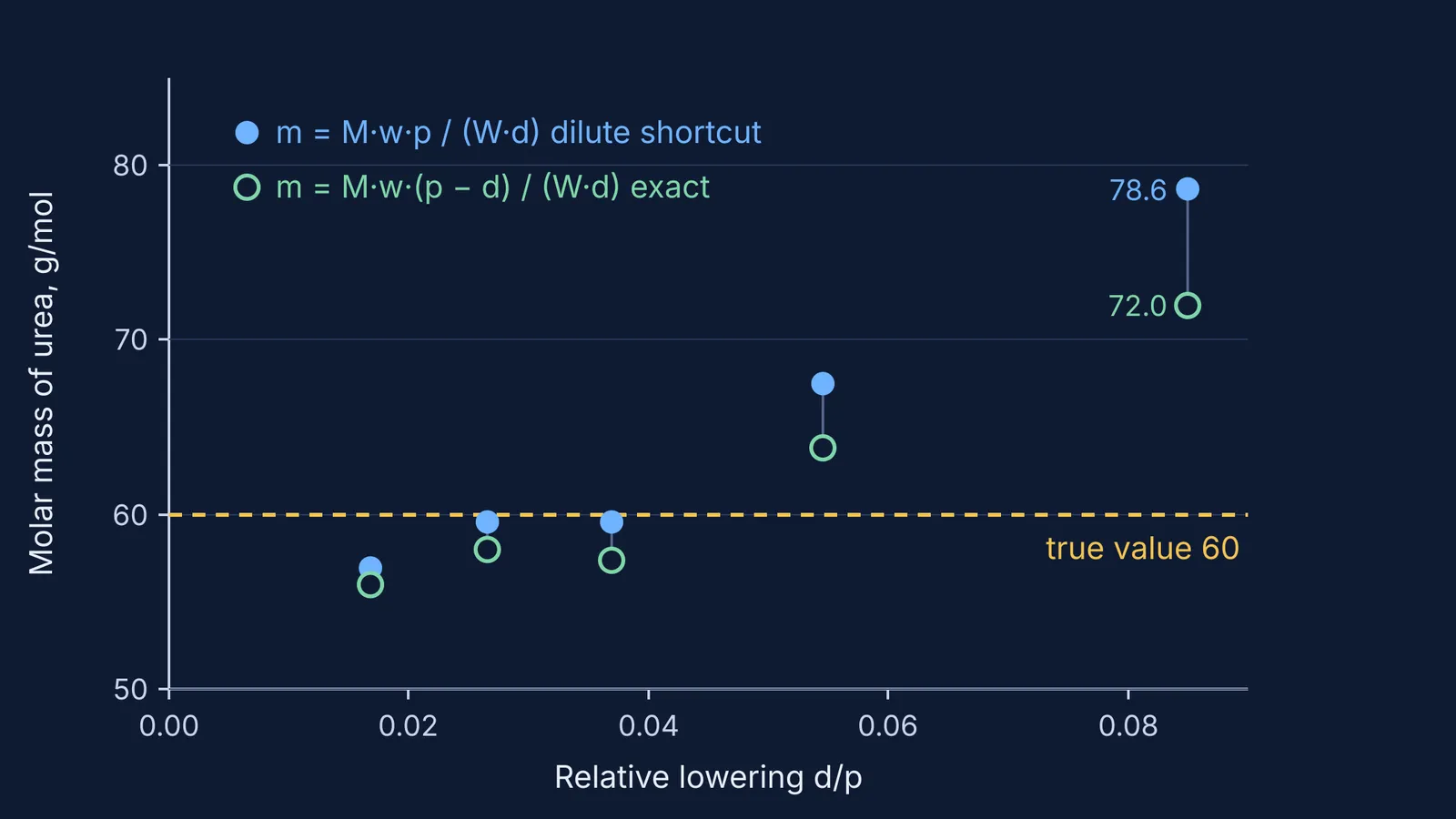
That is NCERT's dilute form. Relative lowering ≈ n₂/n₁, so d/p = (w/m)/(W/M), which rearranges to his formula. The exact form is d/p = x₂ = n₂/(n₁ + n₂). It gives n₂/n₁ = d/(p − d), so m = w·M·(p − d)/(W·d). Our post on relative lowering of vapour pressure and molar mass explains when each form is safe. Perman's table lets you test that rule on real data.
Worked example: urea in water at its boiling point
Perman's first row (he called urea "carbamide"): w = 0.4772 g, W = 5.43 g of water, p = 772.0 mm, d = 20.5 mm. He used M = 18 for water, and every value below reproduces his printed results.
Relative lowering: 20.5/772.0 = 0.0266.
Moles of water: n₁ = 5.43/18 = 0.3017 mol.
Dilute shortcut: n₂ = 0.0266 × 0.3017 = 0.00801 mol, so m = 0.4772/0.00801 = 59.6 g/mol. His table says 59.6.
Exact form: n₂ = 0.3017 × 20.5/(772.0 − 20.5) = 0.00823 mol, so m = 58.0 g/mol.
Compare with 60: the shortcut lands closer, by luck. The two formulas differ by p/(p − d), here 2.7%. Misreading d by 0.5 mm changes m by 2.4%. At this dilution the data cannot tell the two formulas apart.
Cane sugar shows the same thing. With 0.9582 g in 2.64 g of water, p = 754.8 mm and d = 14.5 mm, the shortcut gives 340 (his 340.0) and the exact form 333.6, against a true 342.
What happened in concentrated urea?
His last row: 1.459 g of urea in 3.93 g of water, p = 765.0 mm, d = 65.0 mm. The relative lowering is 0.085, well past the 0.05 at which you should switch to the exact form.
Shortcut: n₂ = 0.085 × 0.2183 = 0.01855 mol, m = 78.6 g/mol, as he printed.
Exact form: n₂ = 0.2183 × 65.0/700.0 = 0.02027 mol, m = 72.0 g/mol.
What Raoult's law expects for true urea (60.06 g/mol): n₂ = 0.02429 mol, x₂ = 0.100, so d should be 76.7 mm. He measured 65.0 mm, only 85% of that.
So of the 18.6 g/mol excess, the shortcut causes 6.6. The rest comes from the solution itself: at about 6.2 mol of urea per kg of water, it lowers the vapour pressure less than an ideal solution would. Perman simply wrote that these "are from very concentrated solutions, so that the normal molecular weight could not be expected."
How well did the method work for other solutes?
From his 20-row table:
naphthalene in ether: 127 and 129, against 128;
p-nitrotoluene in chloroform: 138 and 144.5, against 137;
diphenylamine in ether: four runs from 158 to 179, mean 170.5, against 169.
He judged the results "as good as, and often even better than, those usually obtained by the boiling point method". It is a different route from George Barger's 1904 capillary drops. Barger balanced two solutions until their vapour pressures were equal. Perman measured the lowering itself, in millimetres of mercury.
For more colligative-property numericals of this kind, Fermi Test Prep is built for JEE Main and Advanced preparation, with an AI tutor.
Quick checklist
At the solvent's boiling point, p° = barometric pressure.
Perman's formula, m = w·M·p/(W·d), is the dilute shortcut.
Exact: m = w·M·(p − d)/(W·d); the two differ by p/(p − d).
Dilute urea: 59.6 (shortcut), 58.0 (exact), true 60.
Concentrated urea: 78.6 (shortcut), 72.0 (exact). The rest is non-ideality.
Below a lowering of about 0.02, measurement error outweighs the formula choice.