On this page
Put a drop of salt solution in a closed box next to pure water, and the drop grows. In 1904 George Barger turned that into a way to find molar mass with a capillary tube, a microscope and about 30 milligrams of substance. His paper, "A Microscopical Method of Determining Molecular Weights", is in the Journal of the Chemical Society, Transactions, volume 85, pages 286 to 324 (scan on the Internet Archive). The paper names him as "Scholar of King's College, Cambridge" and is signed from the Wellcome Physiological Research Laboratories, Herne Hill. His tables cover three NCERT ideas: molar mass from vapour pressure, the van 't Hoff factor, and association.
Why did drops of salt solution keep growing?
The work began in Professor Errera's laboratory in Brussels. Fungi were being grown in hanging drops of strong salt solution, in a small chamber "moistened from time to time with distilled water". Over a few weeks "the drops of the salt solutions invariably increased in size".
Errera's explanation was vapour pressure. A salt solution has a lower vapour pressure than pure water at the same temperature. In a closed space, water evaporates from the side with the higher vapour pressure and condenses on the side with the lower one. So water distils into the salt drop. Errera then asked Barger "to study the effect quantitatively".
How did the capillary method work?
Barger filled a capillary tube about 6 to 8 cm long, with a bore of about 1.5 mm, with drops taken alternately from two solutions in the same solvent: the unknown, and a standard of known molar mass. He sealed the tube and measured each drop's thickness under a microscope, then measured again minutes to a day later.
If the two solutions have equal vapour pressure, nothing changes.
If not, the drops with the lower vapour pressure (more solute particles) grow, and the others shrink.
He changed the standard's strength until the drops stopped changing. Then the two solutions have equal vapour pressure, which he called "isotonic". In the same solvent, that means the same concentration of solute particles. In his words, the method "only depends on knowing the direction of change in the drops", not the amount.
Two details make it work. Drops mix a little as they slide past each other, but mixing can only shrink the difference between them: it "cannot, however, obliterate this difference, still less produce a difference in the opposite direction". And because only a comparison is made, the solvent "need have neither a constant melting point nor a constant boiling point", so it need not be pure.
How do you get molar mass from equal vapour pressures?
Raoult's law says the relative lowering of vapour pressure equals the mole fraction of solute. Two dilute solutions in the same solvent with equal vapour pressure therefore hold equal moles of particles per litre. For a solute that neither splits nor pairs up:
M (unknown) = (grams per litre of unknown) ÷ (moles per litre of standard)
How small are the effects? Barger's glucose solution, about 0.139 mol/L in water, lowers the vapour pressure by roughly 0.139 ÷ 55.5 = 0.25%. At 25 °C, where water's vapour pressure is about 3.17 kPa, that is only about 8 Pa. The gap between his 0.13 and 0.14 M standards is under 1 Pa. The drops sense it without any pressure gauge. For the formula itself, see relative lowering of vapour pressure and molar mass.
Worked example: glucose, KNO₃ and NaCl
Glucose. 25.02 g/L of glucose. Drops against 0.13 M cane sugar still changed one way, and against 0.14 M the other way, so the glucose solution lies between them.
M ≤ 25.02 ÷ 0.13 = 192.5 g/mol.
M ≥ 25.02 ÷ 0.14 = 178.7 g/mol.
Barger printed "M between 179—192. Mean 186". The true value for C₆H₁₂O₆ is 180.16.
A second glucose run, against boric acid, gave 165 to 170, so his results are good to roughly 5 to 10%. Urea at 12.00 g/L matched 0.195 to 0.20 M boric acid, giving 60.0 to 61.5 against the true 60.06.
KNO₃, an electrolyte. 10.1 g/L is 10.1 ÷ 101.10 = 0.0999 mol/L of formula units. It matched boric acid at 0.19 to 0.195 M.
van 't Hoff factor i = particle concentration ÷ formula concentration = 0.19 ÷ 0.0999 to 0.195 ÷ 0.0999 = 1.90 to 1.95. Barger gives 1.92.
KNO₃ → K⁺ + NO₃⁻ gives n = 2 ions, so degree of dissociation α = (i − 1) ÷ (n − 1) = about 0.9.
NaCl. 5.85 g/L is 0.100 mol/L, isotonic with 0.175 M boric acid. So i = 0.175 ÷ 0.100 = 1.75, and α = 0.75.
Both i values are below 2 and approximate: Barger notes that boric acid ionises slightly and he ignored that.
Why did benzoic acid weigh 233 in carbon disulphide?
In CS₂, 24.4 g/L of benzoic acid fell between standards of 0.10 and 0.11 M triphenylmethane.
M = 24.4 ÷ 0.11 = 222 to 24.4 ÷ 0.10 = 244. Mean 233. Benzoic acid, C₇H₆O₂, is 122.12.
i = normal M ÷ observed M = 122.12 ÷ 233 = 0.524.
For dimerisation, 2A ⇌ A₂, i = 1 − β/2, where β is the fraction of molecules that pair up. So β = 2(1 − i) = 0.95. About 95% of the acid is dimerised.
The same mean, 233, came out in benzene. Phenol in CS₂ gave 167 to 184 against 94. Ethyl benzoate and phenetole, which have no O–H, gave normal values. Barger's conclusion: "When the hydrogen of the hydroxyl is replaced by ethyl, the association disappears." That points to hydrogen bonding between O–H groups, the effect behind acetic acid's molar mass of 120 in benzene.
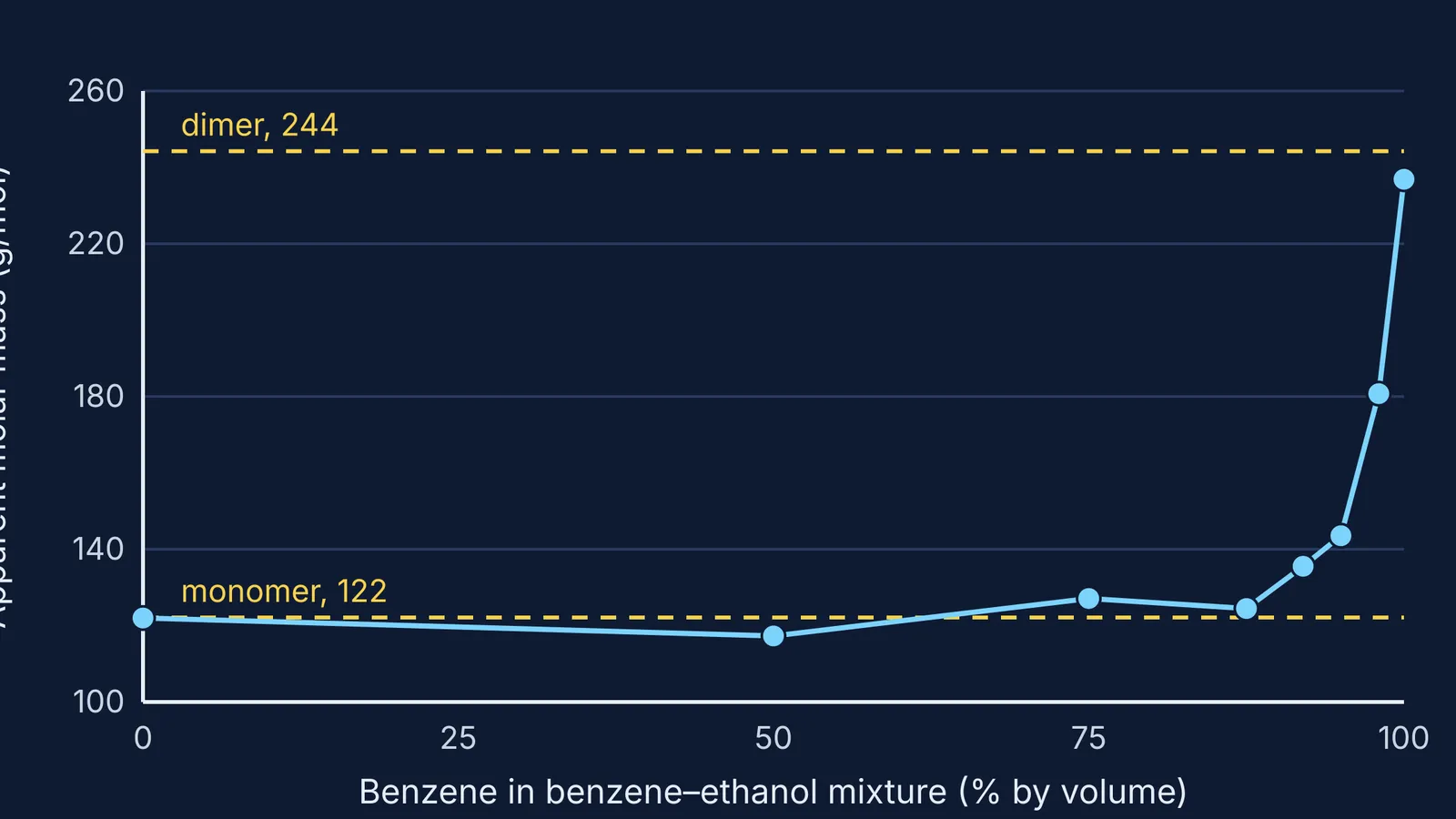
He then ran benzoic acid in benzene–ethanol mixtures. In 100% benzene M was 237. At 98% benzene it fell to 181, at 95% to 144, and at 75% it was 127, close to the monomer. A few per cent of alcohol breaks most of the dimers, because ethanol hydrogen-bonds to the acid itself.
How good was the method?
Barger wanted "a short and easy method of wide application, not necessarily a very accurate one". The weak spots are in his own tables. Mannitol came out at 196, 166 to 171 and 190 to 204 in different runs, against 182. Tryptophan, a sample from F. G. Hopkins, gave 0.0368 ÷ (0.002 × 0.08) = 230 against 204.2, about 13% high.
It is the same idea as Hugo de Vries finding raffinose's molar mass with leaf cells. De Vries used living cells to find equal solute concentration. Barger used vapour pressure, and needed no cell. Note that Barger never measured osmotic pressure; "isotonic" was his word for equal vapour pressure.
If colligative numericals are costing you marks, Fermi Test Prep is JEE Main and Advanced preparation with an AI tutor. For more worked problems on i and association, the Fermi Problem Library has a step-by-step solver that explains the reasoning.
Quick checklist
Equal vapour pressure in the same solvent means equal particle concentration.
M = g/L of unknown ÷ mol/L of an isotonic non-electrolyte standard.
i = C(standard) ÷ C(unknown): KNO₃ about 1.9, NaCl 1.75.
Dimerisation: i = 1 − β/2, so β = 2(1 − i). Benzoic acid in CS₂: β ≈ 0.95.
Hydrogen-bonded dimers form in non-polar solvents and break up when alcohol is added.