On this page
If a question gives you the vapour pressure of a pure solvent, the vapour pressure of a solution and a few masses, it wants one thing: the molar mass of a non-volatile solute. The only real decision is whether the dilute shortcut is good enough or you need the full mole-fraction expression. In a concentrated solution, that choice can change your answer by a quarter.
What does relative lowering of vapour pressure mean?
When you dissolve a non-volatile solute, the solvent's vapour pressure drops from p° to p. In section 1.6.1 of the NCERT Class 12 Chemistry textbook, chapter 1 (Solutions), the ratio (p° − p)/p° is called the relative lowering of vapour pressure. The same section says it is equal to the mole fraction of the solute.
In symbols, with 1 for the solvent and 2 for the solute, NCERT gives three forms:
(p° − p)/p° = x₂ = n₂/(n₁ + n₂), the full expression
(p° − p)/p° ≈ n₂/n₁, used when n₂ is much smaller than n₁
(p° − p)/p° ≈ (w₂ × M₁)/(M₂ × w₁), the same shortcut written with masses
This is a colligative property. It depends on how many solute particles there are, not on what they are. That is why it gives you molar mass: you weigh the solute, the vapour pressure counts its moles, and grams divided by moles is grams per mole. The same idea is behind finding molar mass from depression in freezing point. If Raoult's law itself feels shaky, watch vapour pressure fall in a Raoult's law simulation first.
How do you calculate molar mass from relative lowering of vapour pressure?
Rearrange the mass form: M₂ = (w₂ × M₁ × p°)/(w₁ × (p° − p)). Here is Example 1.6 from the NCERT Solutions chapter. Pure benzene has a vapour pressure of 0.850 bar. Adding 0.5 g of a non-volatile non-electrolyte to 39.0 g of benzene (78 g/mol) lowers it to 0.845 bar.
Relative lowering = (0.850 − 0.845)/0.850 = 0.00588.
Moles of solvent: n₁ = 39.0/78 = 0.500 mol.
Dilute shortcut: n₂ ≈ 0.00588 × 0.500 = 0.00294 mol.
M₂ = 0.5/0.00294 = 170 g/mol, which is NCERT's answer.
Now do it exactly. Rearranging x₂ = n₂/(n₁ + n₂) gives n₂ = n₁ × x₂/(1 − x₂) = 0.500 × 0.00588/0.99412 = 0.00296 mol, so M₂ = 169 g/mol. The two answers differ by about 0.6%, which is smaller than the rounding in the data.
When is the n₂/n₁ approximation not good enough?
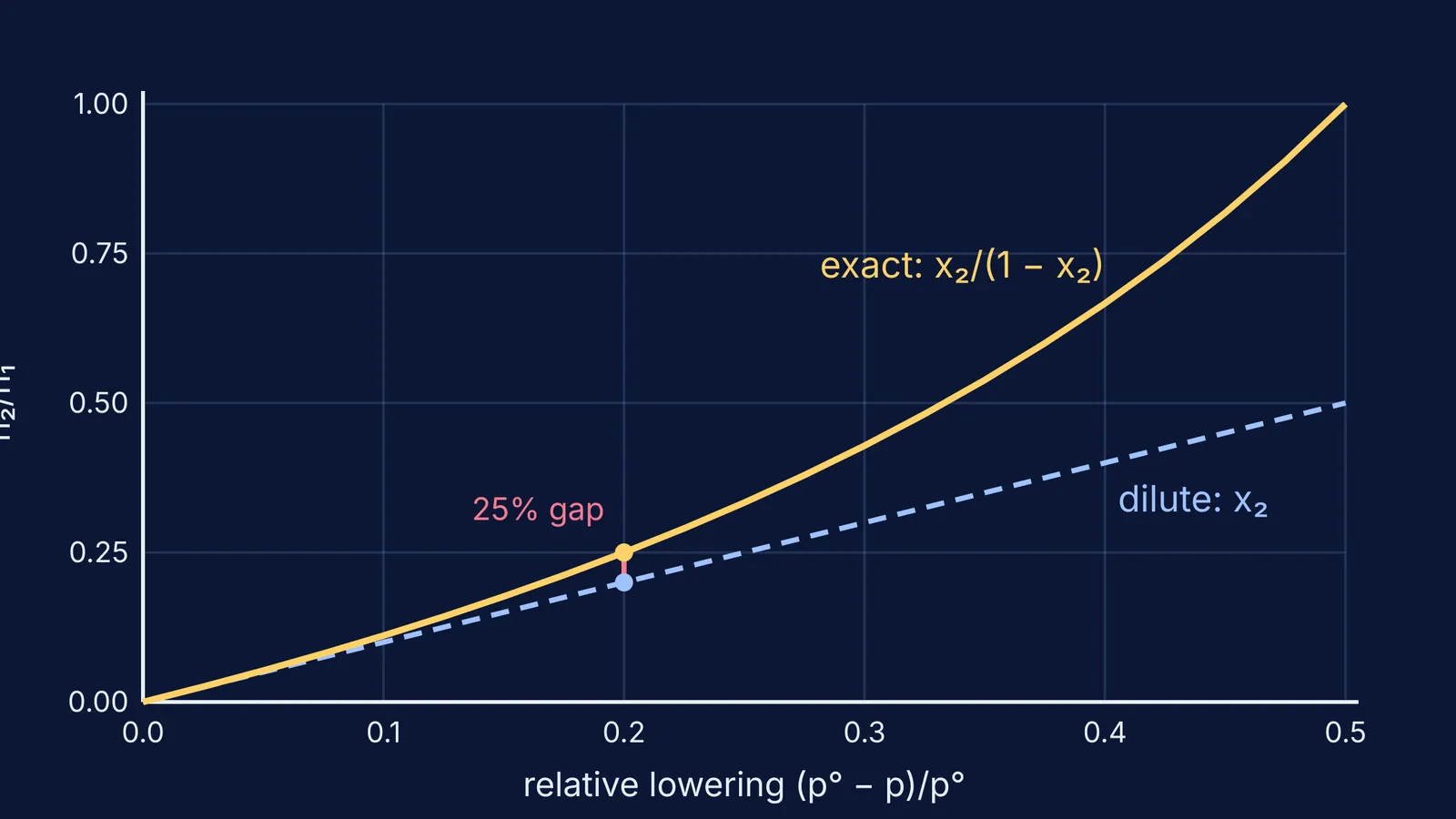
Compare the two versions from the NCERT derivation. The exact form is n₂ = n₁x₂/(1 − x₂); the shortcut is n₂ = n₁x₂. The shortcut undercounts the solute's moles, so it overstates M₂ by a factor of 1/(1 − x₂). As a rule of thumb, the relative error is about the same size as the relative lowering itself.
That gives you a quick decision rule:
Relative lowering below about 0.02: the shortcut is off by about 2% or less, usually within the precision of the data.
Between about 0.02 and 0.05: use the exact form if the answer choices are close together.
Above about 0.05, or if the question calls the solution concentrated: always use the exact form.
Here is a practice case we made up to show the gap. You dissolve 10 g of a non-volatile solute in 36 g of water (18 g/mol, so n₁ = 2.00 mol), and the vapour pressure falls by a fifth, so the relative lowering is 0.200. The shortcut gives n₂ = 0.400 mol and M₂ = 25 g/mol. The exact form gives n₂ = 2.00 × 0.200/0.800 = 0.500 mol and M₂ = 20 g/mol. The shortcut is a quarter too high: the red gap in the diagram above.
Two more limits apply. The formula assumes an ideal solution and a solute that does not evaporate. If the solute dissociates, like NaCl, the vapour pressure counts ions, not formula units. In that case, bring in the van 't Hoff factor, as explained in colligative properties and common slips with i.
What should you check before writing the answer?
Is the solute non-volatile and a non-electrolyte? If it dissociates, include i.
Label the pressures: p° for the pure solvent, p for the solution.
Work out the relative lowering as a number first. Above about 0.02, consider the exact form; above 0.05, always use it.
Use the solvent's molar mass for M₁ (78 for benzene, 18 for water), not the solute's.
Any pressure unit works, because the ratio cancels it.
Sanity check: a smaller lowering means fewer moles, so a larger molar mass.
If you keep mixing up which mass goes on top, the Fermi Problem Library has worked problems with a step-by-step solver that explains the reasoning rather than printing an answer. For the theory behind it, the Fermi Concept Library covers every concept in chemistry, each with its own lesson.
Work out the relative lowering first: that one number tells you which formula to use.