On this page
The first step when HI cleaves an ether is a proton landing on the oxygen. Early evidence that oxygen can do this came from a crystal misread for eight years. In 1899 J. N. Collie and Thomas Tickle showed that dimethylpyrone (2,6-dimethyl-4-pyrone, C₇H₈O₂) forms crystalline salts with HCl, HBr, HI, nitric acid, oxalic acid and picric acid. Their paper, "The Salts of Dimethylpyrone, and the Quadrivalence of Oxygen", is in the Journal of the Chemical Society, Transactions, volume 75, pages 710 to 717 (scan on the Internet Archive). The paper lists Collie as Ph.D., F.R.S., and Tickle as Salters' Company's Research Fellow in the research laboratory of the Pharmaceutical Society of Great Britain.
What was odd about the "chloro" compound?
In 1891 Collie boiled dehydracetic acid with fuming hydrochloric acid and got chlorine-containing crystals, which he and then Feist (1892) took for a diacetylacetone derivative with chlorine bonded to carbon. Three facts did not fit:
It gave no red colour with ferric chloride, which diacetylacetone gives.
In water it behaved, in their words, "exactly as if it were a mixture of dimethylpyrone and hydrogen chloride".
Shaking the solution with chloroform pulled plain dimethylpyrone back out.
A C–Cl bond does not fall apart that easily in water; a salt does. Collie and Tickle concluded that the crystal "behaves much as an easily dissociated salt of a strong acid and a feeble base", and that the base was dimethylpyrone.
Which salts did dimethylpyrone form?
For volatile acids such as HBr and HNO₃ they let dimethylpyrone evaporate with excess acid in a vacuum over solid caustic soda, and salts such as the hydrochloride were "practically unchanged" by drying that way. Their analyses, with their "requires" values in brackets:
Hydrochloride dihydrate, C₇H₈O₂·HCl·2H₂O: HCl 18.4% (18.5), water 18.3% (18.3).
Hydrobromide, C₇H₈O₂·HBr: HBr 39.4% (39.5).
Nitrate, C₇H₈O₂·HNO₃: HNO₃ 33.9% (33.7).
Oxalate, (C₇H₈O₂)₂·H₂C₂O₄: oxalic acid 26.4% (26.6), melting at 121 to 122 °C.
Picrate, C₇H₈O₂·C₆H₃N₃O₇: N 11.9% (11.9), melting at 101 to 102 °C.
They also made a platinochloride, whose formation and appearance "forcibly recall the action of platinic chloride on the hydrochlorides of bases such as those of the pyridine series". With modern atomic masses every value above still comes out as printed, to within 0.1.
How do you check a salt's formula from its % HCl?
The worked example uses the same logic as the chloroplatinate method for a base's molar mass, run with HCl instead of platinum.
Molar masses. C₇H₈O₂ = 124.14 g/mol, HCl = 36.46, H₂O = 18.02 (C 12.011, H 1.008, O 15.999, Cl 35.45).
Mass of salt per mole of HCl. Found HCl = 18.4%, so 36.46 ÷ 0.184 = 198.1 g of salt carries one mole of HCl.
Water in that mass. 18.3% of 198.1 g = 36.3 g, which is 36.3 ÷ 18.02 = 2.01 mol of water.
What is left is the base. 198.1 − 36.5 − 36.3 = 125.4 g, close to 124.1 for one C₇H₈O₂. So the formula is C₇H₈O₂·HCl·2H₂O, M = 196.63 g/mol.
Check forwards. 36.46 ÷ 196.63 = 18.54% HCl and 36.03 ÷ 196.63 = 18.32% water.
The dried salt is the trap. After a month in a desiccator it had 20.8% HCl, and the paper prints "C₇H₈O₂,HCl requires HCl = 22·1 per cent". Recompute it: 36.46 ÷ (124.14 + 36.46) = 36.46 ÷ 160.60 = 22.7%. With the 1899 masses (C 12, H 1, O 16) the answer is still 22.7, so 22.1 is a slip, not an old atomic mass. The found 20.8 is 92% of 22.7, from a sample that had lost "a little more than the theoretical amount of water".
Why did they say oxygen was quadrivalent?
Their formula put H and Cl on the ring oxygen of dimethylpyrone, drawn beside dimethylpyridone hydrochloride with H and Cl on nitrogen. "This, however, involves an assumption that oxygen is quadrivalent", they wrote.
They also suggested that alcohol reacts with hydriodic acid by first adding HI at the oxygen and then losing water: C₂H₅OH + HI → C₂H₅I + H₂O. That is the protonation step you now draw in ether cleavage with HI. They even proposed a parent "hypothetical base, oxonium hydroxide, OH₃OH", alongside NH₄OH, PH₄OH and SH₃OH. So "oxonium" is already in the 1899 paper.
What went wrong with "twelve-valent" oxygen in 1904?
E. H. Archibald and D. McIntosh at McGill University pushed the idea in 1904 (Transactions volume 85, pages 919 to 930, scan). They mixed ether, acetone and alcohols with liquid HCl, HBr and HI at about −80 °C and got sharp-melting crystals, such as ether·HBr (m.p. −40 °C).
For ether and HCl, 3.24 g of ether took 6.8 mL of liquid HCl of density 1.22, which is 8.30 g. Moles: 8.30 ÷ 36.46 = 0.228 mol HCl and 3.24 ÷ 74.12 = 0.0437 mol ether, a ratio of 5.21 (they printed 5.19). They then drew one oxygen bonded to two ethyl groups, five H and five Cl, and their summary table gives oxygen a valency of 12. Of the propyl alcohol compound with 5HCl they wrote, "the oxygen appears to have a valency of twelve".
A stoichiometry is not a bonding diagram. Today we read these solids as one proton on oxygen plus a counter-ion, with any extra HCl held loosely in the crystal:
Et₂O + HCl → Et₂OH⁺ + Cl⁻ (atoms and charge balance).
In Et₂OH⁺, oxygen has three bonds and one lone pair. Formal charge = 6 − 2 − 3 = +1.
Three bond pairs and one lone pair make it pyramidal, like H₃O⁺.
The ether is acting as a Lewis base: a lone pair on oxygen is donated to H⁺.
Archibald and McIntosh came close: the solutions conducted, so "they must be ionised", and they preferred a formula with the ether in the cation.
Why is dimethylpyrone a better base than an ordinary ether?
Archibald and McIntosh's ether and acetone compounds needed liquid acids and all melted at −9 °C or lower. Dimethylpyrone forms salts from aqueous acid at room temperature, because of what the protonated ion becomes.
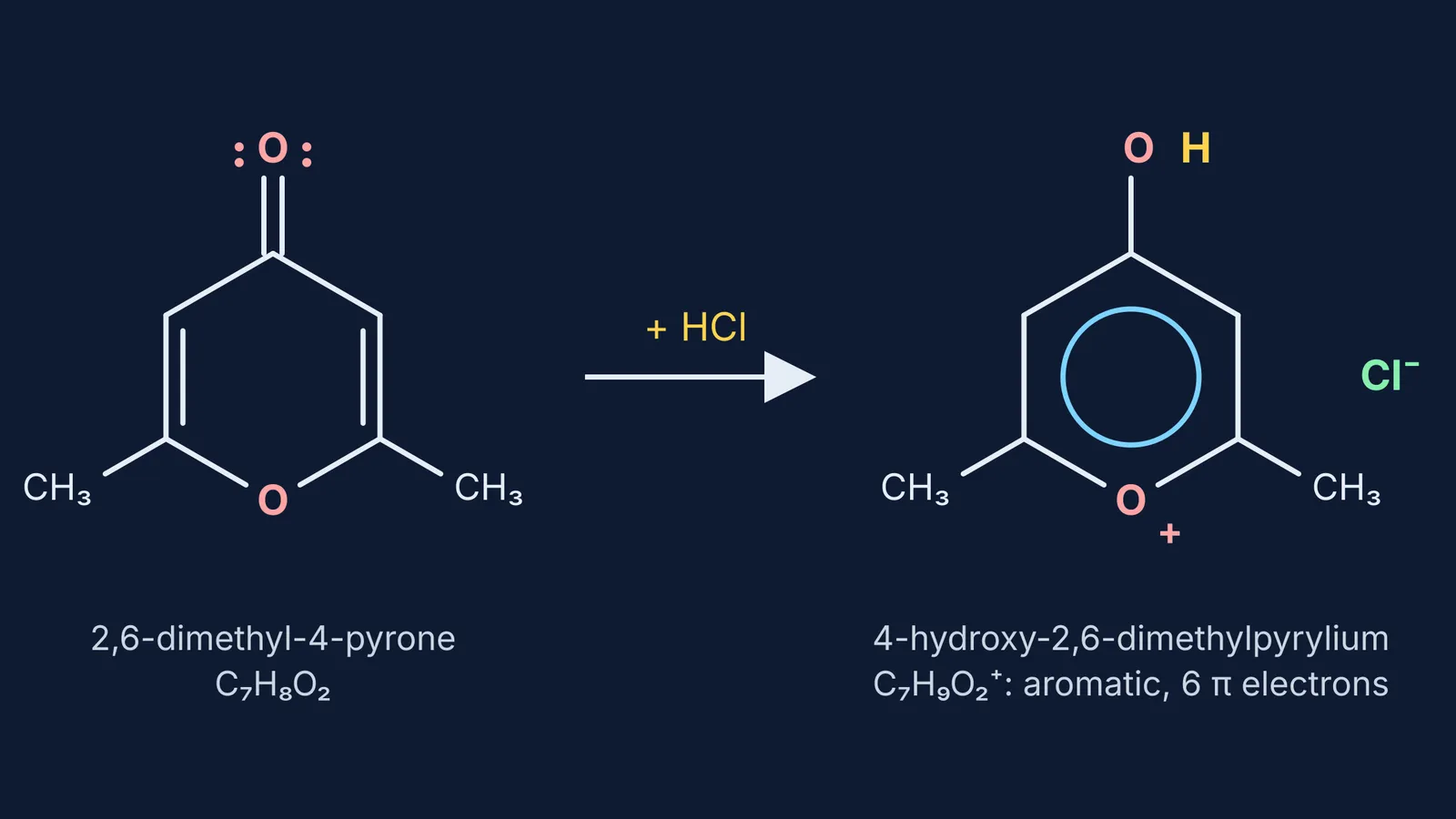
The proton adds to the carbonyl oxygen. That gives the 4-hydroxy-2,6-dimethylpyrylium ion, C₇H₉O₂⁺. Its six-membered ring has six π electrons. Count them in the form with the positive charge on C4: two from each C=C and a lone pair on the ring oxygen. It is aromatic, like the cations in cyclopentadienyl and tropylium aromatic ions. Another resonance form puts the positive charge on the ring oxygen, which then has three bonds (O⁺=C). So Collie and Tickle's ring oxygen with extra bonds was not far off. Even their own text points at the ring: "The combination of one oxygen and five carbon atoms in a ring seems to be one of these" favoured cases.
In your syllabus this touches Class 12 Alcohols, Phenols and Ethers, Class 11 Chemical Bonding (formal charge, VSEPR) and formulas from percentage composition. To see Lewis bases, formal charge and aromaticity as connected ideas, the Concept Library covers every concept in chemistry. For JEE practice, Fermi Test Prep is JEE Main and Advanced preparation with an AI tutor.
Quick checklist
Dimethylpyrone·HCl·2H₂O: 18.5% HCl, 18.3% water.
Anhydrous C₇H₈O₂·HCl: 22.7% HCl, not the printed 22.1.
Ether + acid → R₂OH⁺: three bonds, one lone pair, formal charge +1, pyramidal.
Pyrone salts are stable because the protonated ion is an aromatic pyrylium ring.