On this page
Every genus below is named in NCERT Class 11 Biology, Chapter 3, Plant Kingdom (Reprint 2026-27), with its section. The NEET (UG) syllabus puts plant groups in Biology Unit 1, Diversity in Living World, and asks for at least two examples of each category. All 12 questions are original practice, not forecasts.
Which example organisms does NCERT name in Plant Kingdom?
Algal body forms (3.1, 3.1.2): colonial *Volvox*; filamentous *Ulothrix* and *Spirogyra*; simple branched filamentous *Ectocarpus*; unicellular *Chlorella*; kelps for massive marine bodies.
Types of gamete fusion (3.1): isogamous *Ulothrix* (flagellated gametes) and *Spirogyra* (non-flagellated); anisogamous *Eudorina*; oogamous *Volvox* and *Fucus*.
Green, brown and red algae (3.1.1 to 3.1.3): green *Chlamydomonas*, *Volvox*, *Ulothrix*, *Spirogyra*, *Chara*; brown *Ectocarpus*, *Dictyota*, *Laminaria*, *Sargassum*, *Fucus*; red *Polysiphonia*, *Porphyra*, *Gracilaria*, *Gelidium*.
Algae people use (3.1): food from the sea *Porphyra*, *Laminaria*, *Sargassum*; agar *Gelidium*, *Gracilaria*; protein supplement *Chlorella*.
Bryophytes (3.2): thalloid liverwort *Marchantia*; mosses *Funaria*, *Polytrichum*, *Sphagnum*, with *Sphagnum* giving peat.
Pteridophyte classes (3.3): Psilopsida *Psilotum*; Lycopsida *Selaginella*, *Lycopodium*; Sphenopsida *Equisetum*; Pteropsida *Dryopteris*, *Pteris*, *Adiantum*.
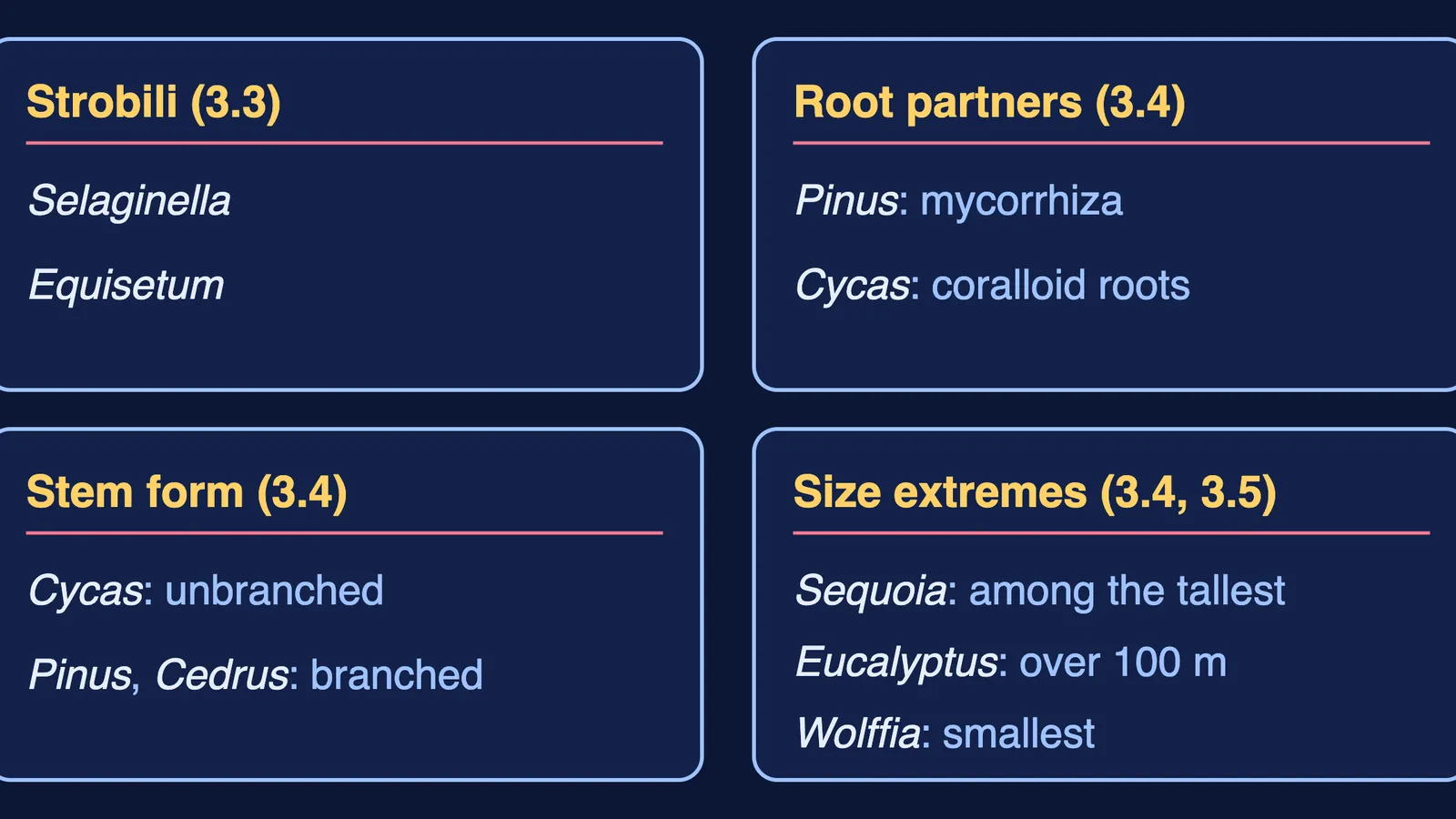
Pteridophyte features (3.3): microphylls in *Selaginella*; strobili in *Selaginella* and *Equisetum*; heterospory in *Selaginella* and *Salvinia*.
Gymnosperms (3.4): *Cycas*, *Pinus*, *Cedrus*, *Ginkgo* and *Sequoia*, the giant redwood; mycorrhiza in *Pinus*, coralloid roots in *Cycas*; an unbranched stem in *Cycas*, branched in *Pinus* and *Cedrus*.
Angiosperm size range (3.5): *Wolffia*, the smallest, up to *Eucalyptus* trees over 100 metres.
That is 35 genera.
How do you remember NCERT examples for NEET?
Try one verb per genus: the single action NCERT ties to it. *Volvox* forms colonies, *Ectocarpus* branches, *Chlorella* feeds space travellers, *Sphagnum* makes peat, *Salvinia* makes two kinds of spores. Genera with no special action get their group as the verb: "*Dictyota* is brown". Say name and verb aloud, then check the section.
Which is an example of each group? Questions 1 to 6
How to attack: name every option's group first. In match items, fix your surest pair and strike codes that disagree.
Q1. Which is an example of a filamentous green alga? (1) *Polysiphonia* (2) *Ulothrix* (3) *Chlorella* (4) *Fucus*
Answer: (2). NCERT names *Ulothrix* as filamentous; *Polysiphonia* is red, *Chlorella* unicellular, *Fucus* brown (3.1).
Q2. Which is NOT one of NCERT's moss examples? (1) *Funaria* (2) *Polytrichum* (3) *Marchantia* (4) *Sphagnum*
Answer: (3). *Marchantia* is the thalloid liverwort; the other three are the mosses (3.2.1, 3.2.2).
Q3. Which is an example of a naked-seeded plant? (1) *Adiantum* (2) *Ginkgo* (3) *Lycopodium* (4) *Dictyota*
Answer: (2). *Ginkgo* is drawn among the gymnosperms (Figure 3.4); *Adiantum* and *Lycopodium* are pteridophytes, *Dictyota* a brown alga.
Q4. Which is an example of Chlorophyceae? (1) *Spirogyra* (2) *Gelidium* (3) *Sargassum* (4) *Psilotum*
Answer: (1). *Spirogyra* is in NCERT's green algae list; *Gelidium* is red, *Sargassum* brown, *Psilotum* a pteridophyte (3.1.1 to 3.1.3, 3.3).
Q5. Match the organism with its feature. List-I: (A) *Polytrichum* (B) *Lycopodium* (C) *Chlamydomonas* (D) *Polysiphonia* List-II: (I) Food stored as floridean starch (II) Haploid leafy gametophyte is the main plant (III) Chlorophyll a and b, with starch as the stored food (IV) Sporophyte with true root, stem, leaves and vascular tissue (1) A-IV, B-II, C-III, D-I (2) A-II, B-IV, C-III, D-I (3) A-II, B-IV, C-I, D-III (4) A-II, B-I, C-IV, D-III
Answer: (2). Moss, pteridophyte, green alga, red alga (3.2, 3.3, Table 3.1).
Q6. Match the organism with what NCERT says about it. List-I: (A) *Ectocarpus* (B) *Funaria* (C) *Laminaria* (D) *Volvox* List-II: (I) A colonial form (II) A marine alga used as food (III) A simple branched filamentous form (IV) A moss drawn with its gametophyte bearing a sporophyte (1) A-III, B-II, C-IV, D-I (2) A-I, B-IV, C-II, D-III (3) A-II, B-IV, C-III, D-I (4) A-III, B-IV, C-II, D-I
Answer: (4). See 3.1, 3.1.2 and Figure 3.2 (c).
Can you judge statements and pairs about NCERT examples? Questions 7 to 12
How to attack: mark each statement T or F first; for pairs, check the group before the feature.
Key for Q7 to Q10: (1) Both statements are correct (2) Both statements are incorrect (3) Statement I is correct but Statement II is incorrect (4) Statement I is incorrect but Statement II is correct
Q7. Statement I: *Dryopteris* is one of NCERT's pteridophyte examples. Statement II: *Polysiphonia* is one of NCERT's brown algae.
Answer: (3). *Polysiphonia* is a red alga (3.3, 3.1.3).
Q8. Statement I: *Porphyra* is a brown alga. Statement II: *Lycopodium* and *Psilotum* are both pteridophytes in NCERT.
Answer: (4). *Porphyra* is red (3.1.3, 3.3).
Q9. Statement I: *Dictyota* is among NCERT's brown algae. Statement II: *Pteris* is one of NCERT's pteridophyte examples.
Answer: (1). See 3.1.2 and 3.3.
Q10. Statement I: *Funaria* is a liverwort. Statement II: *Gracilaria* is a green alga.
Answer: (2). *Funaria* is a moss and *Gracilaria* a red alga (3.2.2, 3.1.3).
Q11. Which pair is correctly matched? (1) *Laminaria*: red alga (2) *Ulothrix*: brown alga (3) *Fucus*: brown alga (4) *Polysiphonia*: green alga
Answer: (3). *Laminaria* is brown, *Ulothrix* green, *Polysiphonia* red (3.1.1 to 3.1.3).
Q12. Which pair is correctly matched? (1) *Chlorella*: colonial alga (2) *Volvox*: filamentous alga (3) *Psilotum*: moss (4) *Sargassum*: marine alga used as food
Answer: (4). *Chlorella* is unicellular, *Volvox* colonial, *Psilotum* a pteridophyte (3.1, 3.3).
What should you do after the set?
Allow about a minute per question. Note each missed genus with its verb and section, then retry only those after two days. Different formats are in the Plant Kingdom statement and match-the-list set and the Plant Kingdom exceptions and odd-one-out questions. If a chatbot gave you examples, run them through our two-step NCERT check for AI examples.
Not sure which plant group to revise first? Fermi's AI tutor works out what you already know and builds a plan for the session.