On this page
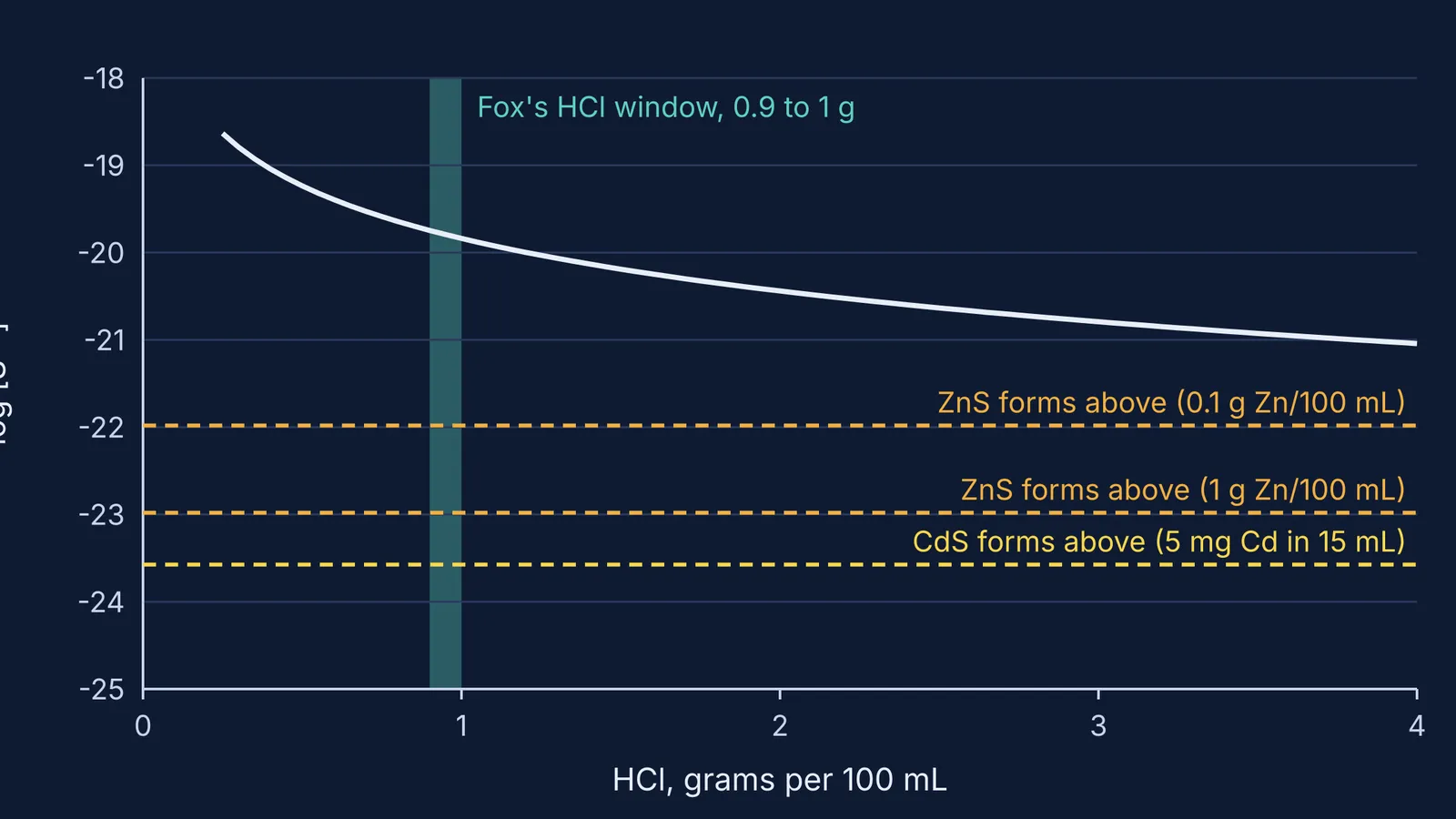
Less than 0.9 g of hydrogen chloride per 100 c.c. and zinc sulphide comes down with the cadmium sulphide. More than about 1 g and "some of the cadmium remains in solution and cannot be precipitated by hydrogen sulphide". That was the window for separating cadmium from zinc with H₂S, as John Jacob Fox of the Government Laboratory, London, described it in 1907. It is only about 10% wide. His paper, "Separation of Cadmium from Zinc as Sulphide in the presence of Trichloroacetic Acid", is in J. Chem. Soc. Trans. 91, 964–967. We read it in the scanned 1907 volume and checked the numbers against the page images. The paper gives only his name and laboratory. H₂S is a toxic gas; this post covers the history and the calculation only.
The idea was old: Friedrich Stromeyer's 1818 cadmium tests already used H₂S in excess acid to pull cadmium away from zinc. Fox put numbers on both edges.
How narrow was the hydrochloric acid window?
Convert his limits to molarity (HCl = 36.46 g/mol):
0.9 g per 100 mL = 0.247 M. Below this, ZnS falls out.
1.0 g per 100 mL = 0.274 M. Above this, some cadmium stays dissolved.
The sulphuric acid limit, 10 g per 100 mL, is 1.02 M. Fox found it "more convenient" but with "considerable risk of keeping small amounts of cadmium in solution".
With much cadmium, three precipitations were needed to free it of zinc.
Why did Fox choose trichloroacetic acid?
He wanted "an organic acid of the same order of strength as mineral acids". Trichloroacetic acid (Cl₃C–COOH, 163.4 g/mol) is ionised about as much as HCl at N/32, in the ratio "1 to 1·08". He assumed that in strong solutions it is less dissociated than HCl.
His tests, with 1 g of zinc per 100 c.c. (0.153 M Zn²⁺):
6.1 g of the acid per 100 c.c. (0.373 M): ZnS precipitated. The same number of moles of HCl, 1.36 g, allowed only traces.
11 g per 100 c.c. (0.673 M): no ZnS.
With 0.1 g of zinc per 100 c.c., "as little as 4·5 grams of trichloroacetic acid, or 1 gram of hydrogen chloride" was enough. Check the moles: 4.5 ÷ 163.4 = 0.0275 mol and 1 ÷ 36.46 = 0.0274 mol. At low zinc the two acids work alike, mole for mole.
On the cadmium side, strong trichloroacetic acid held nothing back. With 0.0051 g of cadmium in 15, 55 and 105 c.c., carrying 6.70, 16.74 and 33.48 g of the acid, he recovered 0.0050 g each time. The last is about 32 g per 100 mL, or 1.95 M. Only at 50% acid and above did CdS fail to appear at once, and "a few drops of a dilute solution of ammonia" started it.
Did the separation work?
His full test used 50 g of ZnSO₄·7H₂O, "corresponding to 11·380 grams of zinc", and 0.4128 g of CdCl₂·2H₂O, "corresponding to 0·2116 gram of cadmium", in 350 c.c. with 1% HCl.
Check his masses. ZnSO₄·7H₂O is 287.5 g/mol, so 50 g contains 50 × 65.38 ÷ 287.5 = 11.37 g Zn. CdCl₂·2H₂O is 219.3 g/mol, so 0.4128 g contains 0.4128 × 112.41 ÷ 219.3 = 0.2116 g Cd. Both agree.
Two precipitations. Zinc was 3.25 g per 100 mL, so some ZnS came down with the CdS in HCl. The sulphides were redissolved, neutralised, and 17.3 g of trichloroacetic acid added in 100 c.c. (1.06 M). Cadmium found: 0.2119 g, 0.14% above the amount taken.
What the first step dragged down. The filtrate gave 0.1546 g of zinc, 1.4% of the zinc in the mixture.
For routine analysis he kept HCl for Group II, since the organic acid "might interfere" with Group III, and used at least 10 g of it per 100 c.c. in a second step.
What does NCERT's Ksp predict? Worked example
NCERT Class 11 Chemistry, Unit 6 (Reprint 2026-27), gives Ka₁ = 9.1 × 10⁻⁸ and Ka₂ = 1.2 × 10⁻¹³ for H₂S (exercise 6.45), and Ksp(ZnS) = 1.6 × 10⁻²⁴ and Ksp(CdS) = 8.0 × 10⁻²⁷ (Table 6.9). Take saturated H₂S as 0.1 M, the figure behind NCERT's [S²⁻] = 1.0 × 10⁻¹⁹ M in 0.1 M HCl (exercise 6.73).
[H⁺] at 1 g HCl per 100 mL: 0.274 M.
[S²⁻] = Ka₁Ka₂[H₂S]/[H⁺]² = (9.1 × 10⁻⁸ × 1.2 × 10⁻¹³ × 0.1) ÷ 0.274² = 1.45 × 10⁻²⁰ M.
Cadmium left in solution: Ksp/[S²⁻] = 8.0 × 10⁻²⁷ ÷ 1.45 × 10⁻²⁰ = 5.5 × 10⁻⁷ M, about 0.06 mg per litre. On paper, CdS is complete.
Zinc at 0.1 g per 100 mL (0.0153 M): Q = 0.0153 × 1.45 × 10⁻²⁰ = 2.2 × 10⁻²². That is 139 times Ksp, so the model says ZnS should precipitate. Fox found none.
Zinc at 1 g per 100 mL with 1.36 g HCl (0.373 M): [S²⁻] = 7.8 × 10⁻²¹ and Q = 1.2 × 10⁻²¹, about 750 times Ksp. Fox saw only traces.
Acid the model needs to hold 0.0153 M Zn²⁺ at Ksp: [H⁺] = √(Ka₁Ka₂[H₂S][Zn²⁺]/Ksp) = 3.2 M, about 12 g HCl per 100 mL.
NCERT's exercise 6.73 shows the same. Mixing 10 mL of the 0.1 M HCl solution with 5 mL of 0.04 M ZnCl₂ gives [Zn²⁺] = 0.0133 M and [S²⁻] = 6.7 × 10⁻²⁰ M, so Q = 8.9 × 10⁻²² and ZnS "precipitates". Real Group II separations leave zinc behind. See why H₂S is passed in acidic medium for Group 2 for the standard explanation.
Why does the simple model miss Fox's window?
The direction is right: doubling the acid cuts [S²⁻] fourfold. Q rises with [Zn²⁺], which is why Fox found that "the concentration of the zinc is also a determining factor". The size is wrong by factors of 100 to 1000. Likely reasons, which Fox did not test and we have not checked against a source:
Sulphide Ksp values scatter widely between tables. Our check of NCERT's NiS value shows how far apart they can be.
Ksp assumes very dilute solutions; at 0.27 M acid and 0.15 M zinc, ions act less concentrated than they are.
A precipitate does not always form the moment Q passes Ksp. Fox's own CdS in 50% acid needed a few drops of ammonia to start.
The cadmium edge needs a different reason, because the model says no ordinary acid strength could keep CdS dissolved. A modern explanation, not in Fox's paper, is that Cd²⁺ forms chloro complexes in strong HCl. His trichloroacetic acid results fit that: no chloride, and no cadmium left behind even at 1.95 M. Fox himself put it down to the acid being less dissociated.
Where does this show up in JEE and NEET?
Class 11 Equilibrium: common ion effect, [S²⁻] from Ka₁Ka₂, ionic product against Ksp.
Class 12 practical salt analysis: why Group II is acidic and Group IV ammoniacal.
For timed practice on ionic-equilibrium numericals like these, Fermi Test Prep offers JEE Main and Advanced preparation with an AI tutor.
Quick checklist
Fox's HCl window: 0.9 to 1 g per 100 mL, 0.247 to 0.274 M.
Trichloroacetic acid: 10 g or more per 100 mL stops ZnS, and CdS still comes down.
NCERT's numbers say ZnS should form at Fox's acidity, by factors of 100 to 1000.
Treat sulphide Ksp predictions as direction and order of magnitude, not exact limits.